Results and discussion
This work investigates gas adsorption properties of SWSiCNTs using GCMC.
The gases are CH 4 , CO 2 and N 2 . Therefore, our results are presented in some following sections.
CO2, CH4 and N2 adsorptivities
At first, we show CO
2
, CH
4
and N
2
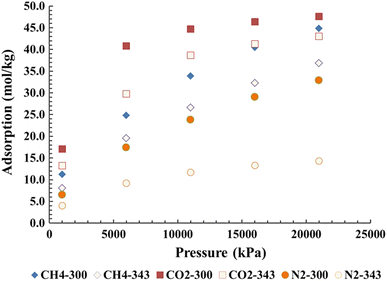
adsorptivities in (10,10), (20,20) and (40,40) SWSiCNTs at 300 and 343 K at varying pressure ranges 1–21 MPa. Figures
1
,
2
and
3
present the obtained data of gases in (10,10), (20,20) and (40,40) SWSiCNTs, respectively.
CH
4
, CO
2
and N
2
adsorption in (10,10) SWSiCNT at 300 and 343 K CH
4
, CO
2
and N
2
adsorption in (20,20) SWSiCNT at 300 and 343 K CH
4
, CO
2
and N
2
adsorption in (40,40) SWSiCNT at 300 and 343 KFig. 1
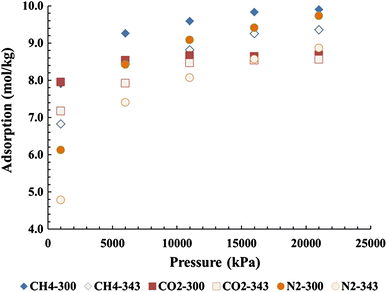
Fig. 2
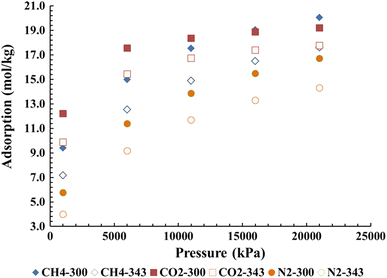
Fig. 3
A result obtained from Fig. 1 shows that the gases have less adsorption, especially at higher temperature. According to Fig. 1 , maximum adsorption in all gases takes place almost at 10 MPa (moderate pressure) and range of adsorptivity of gases together is low, about between 7.5 and 9.5 mol/kg. This means that (10,10) SWSiCNT has low gas adsorptivity and it seems that CH 4 and CO 2 have better adsorption, which relates to amount of adsorption as shown in Fig. 1 .
From Fig. 3 , we observe that the gases have more adsorptivity in (20,20) SWSiCNT than in (10,10) SWSiCNT. However, the adsorption is decreased as a function of increasing the temperature. According to Fig. 3 , maximum of adsorption in all gases occurred almost at 15 MPa pressure, and range of adsorptivity of gases together was about between 13 and 19 mol/kg. This means that the (20,20) SWSiCNT has more gas adsorptivity rather than the (10,10) SWSiCNT, and CH 4 and CO 2 have better adsorptivity. Moreover, CO 2 has better amount of adsorption than CH 4 especially at low and moderate pressure (see Fig. 3 ).
Figure 5 also indicates that the gases have more adsorptivity in (40,40) SWSiCNT than in (10,10) and (20,20) SWSiCNTs. The gas adsorptions are decreased with increasing the temperature. Although, according to Figs. 1 , 3 and 5 , the maximum gas adsorptions occur in the (40,40) SWSiCNT, the range of adsorptivity of gases together in the latter nanotube is about between 10 and 45 mol/kg. This means that the (40,40) SWSiCNT has more gas adsorptivity rather than the (10,10) and (20,20) SWSiCNTs. Furthermore, it is clear that CO 2 has better adsorptivity for this reason: the most adsorptivity we can see in Fig. 5 . Figure 5 shows that the (40,40) SWSiCNT can adsorb CO 2 at ambient temperature at low and moderate pressure (<10 MPa). In addition, CH 4 is adsorbed better than N 2 . Consequently, the large diameter SWSiCNT can adsorb CO 2 much more than CH 4 and N 2 , while small diameter SWSiCNT can adsorb CO 2 the same as CH 4 . The important point is that CO 2 has more ɛ / k B rather than CH 4 and N 2 (Table 1 ), so, its interaction with atoms of SWSiCNT nanotubes is more considerable.
Therefore, more adsorptivity of CO 2 is expected energetically. It means that natural adsorptivity directly depends on the atomic interactions.
Adsorption fitting to Langmuir and Langmuir–Freundlich equations
In the next investigation, we have fitted adsorption data to Langmuir (
) and Langmuir–Freundlich (
) equations, where
θ
is the amount adsorbed,
P
is the equilibrium pressure, and
θ
m
,
k
,
b
,
n
are isotherm parameters. Figures
4
and
5
present CH
4
, CO
2
and N
2
plots at 300 and 343 K related to (10,10) and (40,40) SWSiCNTs, respectively. It is obvious that both figures show that the data of adsorption correspond to the Langmuir–Freundlich equation. These observations emphasize that the Langmuir–Freundlich is the best fitting that illustrates the adsorption of gases imply with varying energetic inhomogeneity in both (10,10) as smaller diameter and (40,40) as larger diameter SWSiCNTs [
14
,
15
]. However, the gases adsorption adaptation to the Langmuir–Freundlich model can distinguish that multi-layer adsorptivity is very feasible [
14
,
15
]. Because the pressure is increased and temperature is lowered, additional layers are formed. This has led to the modern concept of multilayer adsorption. In Fig.
6
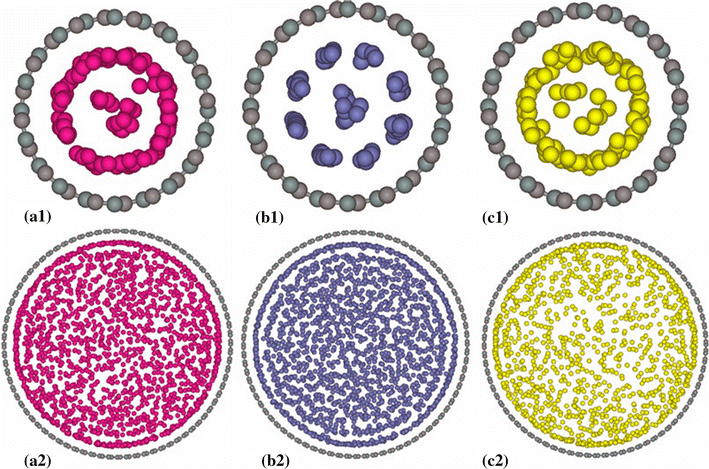
, we can see that even in the (10,10) SWSiCNT, the secondary layer of gas adsorption is taking place. So, Langmuir’s model of uni-molecular adsorption is valid here.
The data of adsorption fitted on Langmuir (
dash lines
) and Langmuir–Freundlich (
color lines
) equations in (10,10) SWSiCNT at 300 and 343 K.
a
CH
4
,
b
CO
2
,
c
N
2 The data of adsorption fitted on Langmuir (
dash lines
) and Langmuir–Freundlich (
color lines
) equations in (40,40) SWSiCNT at 300 and 343 K.
a
CH
4
,
b
CO
2
,
c
N
2 The cross-section of (10,10) and (40,40) SWSiCNTs while CO
2
, CH
4
and N
2
are adsorbed inside them at 300 K and 21 kPa.
a
CH
4
,
b
CO
2
,
c
N
2
. “
1
” and “
2
” are assigned to (10,10) and (40,40) SWSiCNTs, respectivelyFig. 4
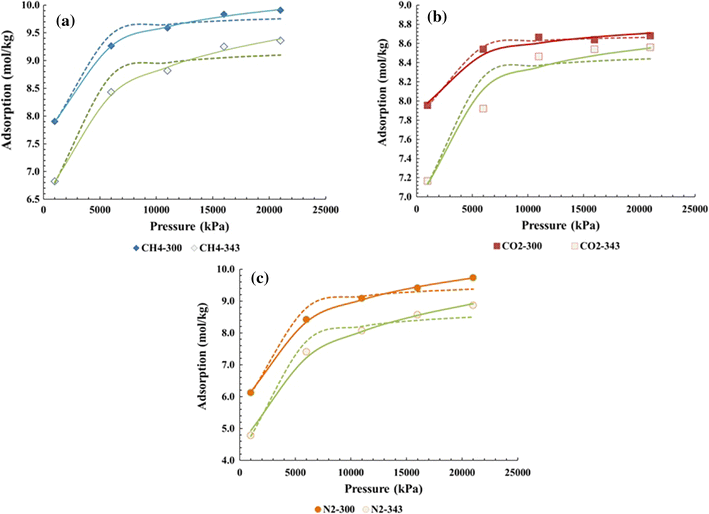
Fig. 5
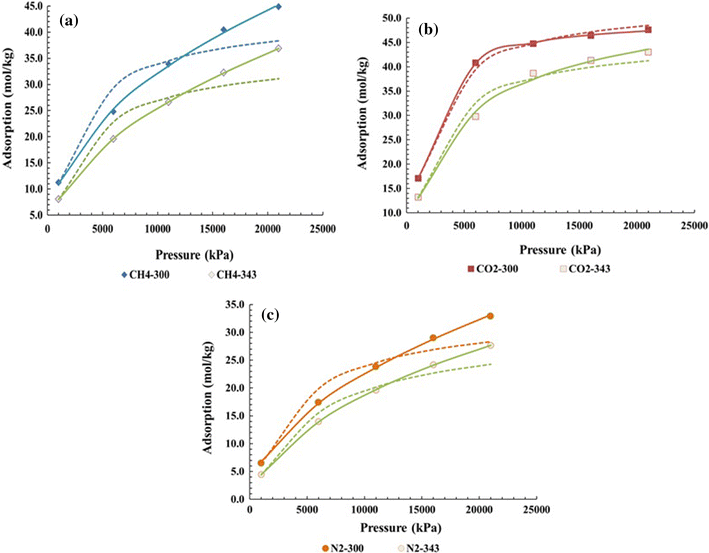
Fig. 6
The comparison of gases adsorption
In this subsection, we compare the CO 2 , CH 4 and N 2 adsorptions in SWSiCNTs and other nanoporous materials. Therefore, we first focus on CO 2 adsorption.
The comparison of CO2 adsorption
Mishra et al. [
9
] have reported CO
2
adsorption property of ZnDABCO at 294 and 350 K, experimentally. Figure
7
a that is related to 294 K, shows that ZnDABCO has more CO
2
adsorptivity than the (10,10) SWSiCNT, but it has less than the (20,20) and (40,40) SWSiCNTs. However, CO
2
adsorption properties of ZnDABCO and (20,20) SWSiCNT are very close. Figure
7
b also is related to 350 K, and shows that ZnDABCO has CO
2
adsorptivity close to the (10,10) SWSiCNT, but it is less than the (20,20) and (40,40) SWSiCNTs. As a result, it seems, in relatively high temperature, SWSiCNT has good CO
2
adsorption than inorganic nanoporous materials. In fact, many inorganic nanoporous materials such as MOFs are destroyed in high temperature, while nanotubes, especially SiCNTs, have the most thermal stability [
21
].
a
CO
2
adsorption property of ZnDABCO reported from Ref. [
9
] and our results at 294 K.
b
CO
2
adsorption property of ZnDABCO reported from Ref. [
9
] and our results at 350 K.
c
CO
2
adsorption equilibrium isotherm from Refs. [
8
,
10
] and our data at 298 K and range 1–100 kPa.
d
Adsorption simulation of CO
2
from Ref. [
11
] that is about CO
2
adsorption in Cu-BTC and our data at 298 K.
e
Adsorption simulation of CO
2
from Ref. [
12
] experimental and simulation results, Ref. [
5
] simulation data and our data at range of 1,000–25,000 kPaFig. 7
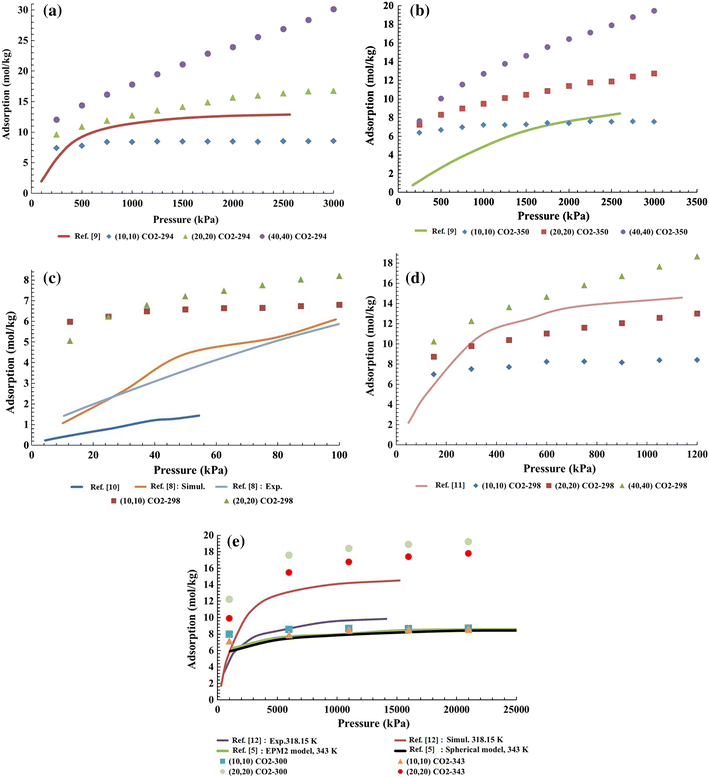
Figure 7 c also presents the CO 2 adsorption equilibrium isotherms reported from Refs. [ 8 , 10 ] and our data at 298 K and range 1–100 kPa. This figure again indicates that the (10,10) and (20,20) SWSiCNTs have more CO 2 adsorptivity than activated carbon and Cu-TDPAT. It should be noted that our obtained simulation data values are above the simulation data values of Cu-TDPAT [ 8 ].
Karra et al. [ 11 ] reported atomistic GCMC simulations to realize the adsorption of CO 2 , CO, and N 2 in IRMOF-1, IRMOF-3, Cu-BTC, Zn 2 [bdc] 2 [dabco] at 298 K and pressure lower than 1,200 kPa. Figure 7 d presents their simulation data (Ref. [ 11 ]) and our simulation results.
Another study is performed by Billemont et al. that they have been used both experimental and simulation approaches to indicate the adsorption of CO 2 on the Filtrasorb F400 activated carbon (experimental absolute adsorption) and on CS1000A and CS1000AF (simulated adsorption) as nanoporous carbons in the presence of water at 318.15 K [ 12 ]. They show that CS1000AF has more adsorption of CO 2 than CS1000A theoretically. Then, we compare our data with simulation data of CO 2 adsorptivity on CS1000A and also Filtrasorb F400. In the section that is related to adsorption of CH 4 comparison, we will remind about Billemont et al. (Ref. [ 12 ]) research again. Figure 7 e presents this comparison.
Huang et al. [ 5 ] using GCMC have investigated the adsorption of CO 2 (applying Harris and Yung’s EPM2 and spherical models for CO 2 as different potential models) and CH 4 at 343 K. Their obtained data of simulation are shown in Fig. 7 -e. Our results that we consider the spherical model for CO 2 at 300 and 343 K with comparing to Billemont et al. of simulation and experimental indication (Ref. [ 12 ]), illustrate that (20,20) SWSiCNT has more CO 2 adsorptivity than nanoporous carbon, but (10,10) SWSiCNT is less CO 2 adsorptivity than nanoporous carbon. In addition, the results of Huang et al. (Ref. [ 5 ]) have shown CO 2 adsorptivity close to the (10,10) SWSiCNT in the desired pressure range and at 343 K. Therefore, the (20,20) SWSiCNT can adsorb CO 2 more than nanoporous carbon and SWCNTs at the same thermodynamic conditions. As a result, Billemont et al. of simulation and experimental research (Ref. [ 12 ]) has been done at 318.15 K, and our investigation is at 300 and 343 K, and we know the adsorption decreases with increasing temperature, so, we can realize that (20,20) SWSiCNT even at 343 K has more CO 2 adsorptivity than nanoporous carbon at 318.15 K.
Consequently, as final investigation of the adsorption of CO 2 , we can find that SWSiCNT with diameter large enough (diameter larger than (10,10) tube) is proper to adsorb CO 2 as compared to some MOFs, nanoporous carbon and CNTs.
The comparison of CH4 adsorption
In our work, also, we compare CH
4
adsorptivity in SWSiCNTs with other nanoporous materials such as Cu-TDPAT and ZnDABCO as MOF, activated carbon and CNTs. At first, we report our obtained simulation data at 294 K and pressure under 3,000 kPa, with Mishra et al. (Ref. [
9
]) as experimental study that it has been considered the adsorption of CH
4
on a zinc based metal organic framework: ZnDABCO. Figure
8
a illustrates the adsorption isotherms of CH
4
in this case. In Fig.
8
a, we can find that CH
4
adsorptivity even in the (10,10) SWSiCNT is more than in ZnDABCO; however, our data are from simulation, and Mishra et al.’s (Ref. [
9
]) work is an experimental study. Furthermore, Fig.
8
a, shows that CH
4
adsorptivity behavior is the same, in both ZnDABCO and SWSiCNT.
a
CH
4
adsorption property of ZnDABCO reported from Ref. [
9
] and our results at 294 K.
b
CH
4
adsorption equilibrium isotherm from Refs. [
8
,
10
] and our data at 298 K and range of 1–100 kPa.
c
Adsorption simulation of CH
4
from Ref. [
12
] experimental and simulation results, Ref. [
5
] simulation data and our data at range of 1,000–25,000 kPaFig. 8
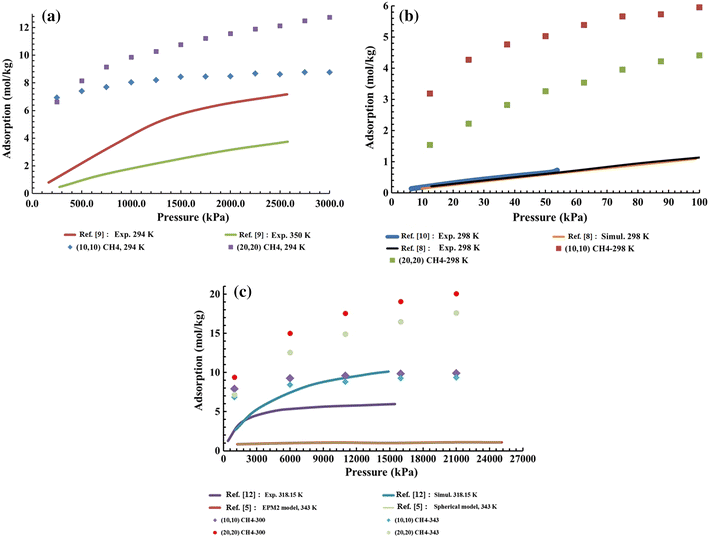
Figure 8 b also compares Yi et al.’s (Ref. [ 10 ]) experimental study and Zhang et al.’s (Ref. [ 8 ]) experimental and simulation works with our simulation data at 298 K and pressure range of 0–100 kPa, while Yi et al. (Ref. [ 10 ]) represented their data on activated carbon, and Zhang et al. (Ref. [ 8 ]) reported their data on Cu-TDPAT. Figure 8 b shows that considering GCMC simulation on adsorptivity of CH 4 in Cu-TDPAT and SWSiCNT, we can realize that SWSiCNT, even with (10,10) chirality is more CH 4 adsorbable than Cu-TDPAT at same thermodynamic conditions. Also, this figure emphasizes that experimental data from Ref. [ 10 ] on activated carbon are very close to experimental and simulation data from Ref. [ 8 ] on Cu-TDPAT. This is a very gratifying challenge in gas adsorption investigations, because reports contain both simulation and experimental studies on two different nanoporous materials. Simulation data and experimental data from Ref. [ 8 ] provide similar estimates of the adsorption of gases on MOFs. Also, our obtained data exhibit that SWSiCNT is a more CH 4 adsorbable nanoporous material. Therefore, we understand that this type of analysis (simulation calculations) can be accurate, while the achievement of this method can be significant, and results obtained from the simulation calculations are credible in this field.
In addition, we compare CH 4 adsorption at 300 and 343 K and pressure range 0–25,000 kPa with Ref. [ 12 ] as experimental (on Filtrasorb F400 activated carbon at 318.15 K) and simulation (on CS1000A and CS1000AF activated carbons) investigations and with Ref. [ 5 ] as simulation study (on CNTs). Figure 8 c exhibits that GCMC simulation data of CH 4 on (10,10) SWSiCNT is more than GCMC simulation data of CH 4 on CNTs (Ref. [ 5 ]). In fact, CNTs have about 1 mol/kg CH 4 adsorbed value at 343 K (considering both EPM2 and spherical models of CH 4 ) while (10,10) SWSiCNT has about 7–9 mol/kg CH 4 adsorbed value at 343 K (considering spherical model of CH 4 in our work). However, simulation investigation on CS1000A and CS1000AF activated carbons at 318.15 K from Ref. [ 12 ] is very close to our data of (10,10) SWSiCNT at 300 and 343 K, but (20,20) SWSiCNT, even at 343 K (that is more than 318.15 K) shows more CH 4 adsorptivity.
Finally, with considering to Fig. 8 a, b and c, we can result that SWSiCNT with large enough diameter is more CH 4 adsorbable at room temperature, and also, GCMC simulation can predict suitable the CH 4 adsorption behavior, this approach can also be reliable in terms of accuracy.
The comparison of N2 adsorption
In last comparison, we represent our N 2 adsorption from GCMC simulations with experiments reports and with few existing theoretical works.
Figure
9
a exhibits our data and Mishra et al. (Ref. [
9
]) experimental report at 294 K under pressure of 3,000 kPa. Mishra et al. [
9
] present their temperature investigations and they have been resulted that ZnDABCO has a little more N
2
adsorptivity at 294 K than 350 K. Also, our GCMC simulation data of N
2
is more than Mishra et al. (Ref. [
9
]) reports. In Fig.
9
a, we can realize that N
2
cannot more adsorbable in one type of materiel at different thermodynamics conditions. It means that with varying the thermodynamic conditions, for instance in ZnDABCO, according to Ref. [
9
] as experimental work, we can see that the increase of pressure cannot significantly affect nitrogen uptake, and even though with decreasing the temperature, not significant changing occur in N
2
uptake. Also, we can observe from our simulation calculations that the increase of pressure cannot have considerable effect on nitrogen uptake in (10,10) and (20,20) SWSiCNTs. Here, like CO
2
and CH
4
adsorptions compared in previous subsections, we find that N
2
adsorption behavior from simulation data is similar to experimental study.
a
N
2
adsorption property of ZnDABCO reported from Ref. [
9
] and our results at 294 K.
b
N
2
adsorption equilibrium isotherm from Ref. [
8
,
10
] and our data at 298 K and range of 1–100 kPa.
c
Adsorption simulation of N
2
from Ref. [
12
] experimental and simulation results, Ref. [
5
] simulation data and our data at range of 1,000–25,000 kPaFig. 9
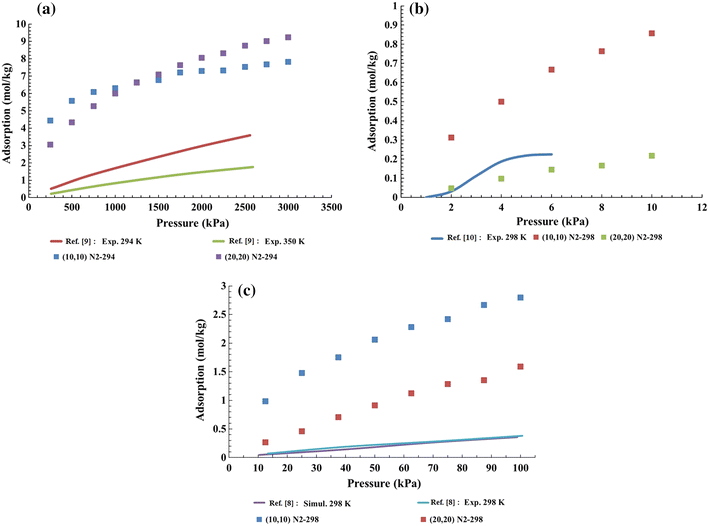
In this paper, Fig. 9 b shows interesting results. In Sect. 3.1 related to reports of gas adsorption in our work, we can see that N 2 adsorptions, at 300 K and range 1,000–21,000 kPa, are 5–30 mol/kg in (10,10), (20,20) and (40,40) SWSiCNTs (please see Figs. 1 , 2 , 3 ). But Fig. 9 b exhibits our simulation of N 2 adsorption at 298 K at pressure range 0–12 kPa (very low pressure). Figures 1 , 2 and 3 show that at pressure range 1,000–21,000 kPa, N 2 adsorption in SWSiCNTs is in the order of: (10,10) < (20,20) < (40,40), but at 0–12 kPa (according Fig. 9 b), we can observe that N 2 adsorption in SWSiCNTs is in the order of: (10,10) > (20,20). Also, Yi et al. [ 10 ] have been studied as experimental work on activated carbon shows N 2 adsorption similar to (20,20) SWSiCNT at 298 K. This observation of N 2 adsorption can see in Fig. 9 c which this latter figure also, exhibits that: (1) N 2 adsorption in SWSiCNTs are order as: (10,10) > (20,20) under 100 kPa similar to results of Fig. 8 b, (2) our GCMC simulation data of N 2 adsorption in (20,20) SWSiCNT is more than Cu-TDPAT (Ref. [ 8 ]) and (3) experimental and simulation data of N 2 adsorption in Ref. [ 8 ] investigation is very close to together.
Then, from Fig. 9 a, b and c we can understand that N 2 adsorption at least under 100 kPa (about 1 atm) is differ than over than 1,000 kPa (10 atm) in SWSiCNTs so that, at low pressure (about 1 atm and ambient pressure) SWSiCNT with small diameter is more N 2 adsorbable than other SWSiCNT, contrariwise, SWSiCNT with large diameter is more N 2 adsorbable at pressure over 1,000 kPa (10 atm). Also, N 2 can adsorb lower than other gases because of their weakness interaction potentials with atoms of adsorbent (here SWSiCNT) and this lower adsorptivity is proved even with experimental observations.