Department of Electrical Engineering, Guilan Science and Research Branch, Islamic Azad University, Guilan, IR
Department of Electrical Engineering, Roudbar Branch, Islamic Azad University, Roudbar, IR
Abstract
In this work we investigate the n-type single halo implantation in channel of lightly doped drain and source CNTFET (SH-LDDS-CNTFET) and propose the n-type double linear halo implantation in the channel of LDDS-CNTFET. These transistors are simulated with a non-equilibrium Green’s function method. We demonstrate that in the proposed structure the
fT
at the
VGS
ranges of 0–0.25 V and more than 0.42 V is much higher compared to the LDDS-CNTFET and SH-LDDS-CNTFET and the SH-LDDS-CNTFET, respectively. Finally, simulations demonstrate that the
fT
of the proposed transistor is more than the LDDS-CNTFET at a wide range of
VGS
, whereas the
fT
of SH-LDDS-CNTFET is more than the LDDS-CNTFET for narrow ranges of
VGS
.
Introduction
After discovering the carbon nanotube (CNT) by Aijima [
1
], scientific researches about this structure are expanded due to its excellent electronic properties. One of the important properties of this structure is quasi-ballistic transport with very high carrier mobility [
2
,
3
]. Using carbon nanotube, two types of field effect transistors have been discussed. The first type is Schottky barrier carbon nanotube field effect transistor (SB-CNTFET) and second type is MOSFET-like CNTFETs (MOSCNTs). The MOSCNT was more favorable because of the high on–off current ratio, but leakage current (
IL
) of this transistor is very high because of electron band-to-band tunneling (BTBT) [
4
]. In order to deal with this problem, some solutions such as drain and source with a linearly or lightly doped, source and drain extensions and asymmetric oxide thickness, have been proposed [
5
–
9
]. Also, the dual material gate structure and the source and drain parameters effect on the characteristics of CNTFET are investigated [
10
,
11
]. Moreover the p-type halo implanted deteriorates the cutoff frequency and the switching delay of CNTFET [
12
].
This paper is mainly focused on the
fT
of MOSCNT, linearly doped CNTFET (LD-CNTFET) and lightly doped drain and source CNTFET (LDDS-CNTFET), which are discussed in [
7
], to select a structure with the highest
fT
. Moreover, we have investigated the implantation of n-type single halo in channel of LDDS-CNTFET (SH-LDDS-CNTFET) and its effects on some characteristics such as the
fT
. Based on this investigation we have proposed implanting n-type double linear halo in the channel of LDDS-CNTFET which is named “DLH-LDDS-CNTFET”. These structure characteristics such as the leakage current, the on-current and the
fT
have been investigated. We have used a non-equilibrium Green’s function (NEGF) method to simulate these transistors [
8
,
13
–
17
].
Proposed transistor and method of simulation
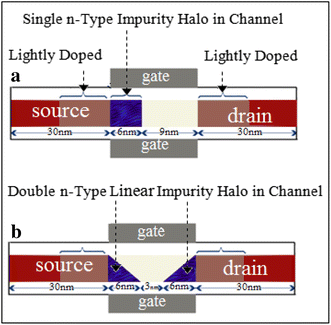
A cross-section schematic representation of implanting the n-type single halo in the source side of channel of LDDS-CNTFET and their geometric details is shown in Fig.
1
a. The channel is a (16, 0) CNT and radius 0.63 nm that is embedded in cylindrical gate insulator of HfO
2
with thickness 2 nm and dielectric constant 16. The channel length is 15 nm, which consists of 9 nm undoped CNT and 6 nm n-type doped CNT. The concentration of this single halo is 1.4 nm
−1
. Our proposed structure is shown in Fig.
1
b. This figure illustrates a cross-section schematic representation of the n-type double linear halo implantation in the channel of LDDS-CNTFET (DLH-LDDS-CNTFET) and their detailed geometries. The drain and source length are 30 nm, which consists of 15 nm highly doped regions and 15 nm lightly doped regions are taken to be 2 and 0.2 nm
−1
, respectively. Figure
1
b also shows that the concentration of n-type double linear halo vary from 1.4 nm
−1
to 0 in length of 6 nm.
Fig. 1
The device cross-section representation. The device cross-section with implanting the n-type halo in the channel,
a
single halo and
b
double linear halo
Self consistent solution of the Poisson and Schrodinger equations has been done within the NEGF formalism for simulating the device characteristics. The band structure of CNT is calculated by the tight-binding method with one orbital. The electrostatic potential of CNT required for calculating the Hamiltonian of Schrodinger is provided by solving the Poisson equation. By solving the Schrodinger equation, the density of states and the charge of the CNT are calculated. The Poisson equation is solved based on the charge and consequently the new potential is calculated. The iteration between the Poisson and the Schrodinger equations stops after reaching minimum of error [
6
–
8
,
16
,
17
].
Results and discussion
At first, we calculate the
fT
versus
VGS
for the three structures MOSCNT, LD-CNTFET and LDDS-CNTFET as discussed in [
7
], to select a structure with the highest cutoff frequency. Note that these three devices have intrinsic channel. The gate capacitance (
Cg
) and the transconductance (
gm
) are defined by [
18
,
19
].
where
Qch
is the total charge of the CNT channel which can be obtained by integrating over the electron density [
n
(
x
)] in the channel. The
IDS
is the drain-source current. We compute the cutoff frequency using [
20
]:
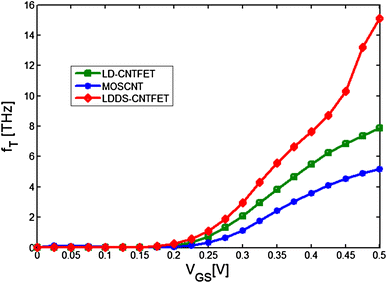
Figure
2
illustrates the
fT
of MOSCNT, LD-CNTFET and LDDS-CNTFET versus
VGS
at drain-source voltage
VDS
= 0.4 V. In comparison with the MOSCNT and the LD-CNTFET, the LDDS-CNTFET has illustrated a larger
fT
. From an analytical standpoint, the doping profile of drain and source of this device leads to increase of the
gm
and decrease of the channel charge variation versus gate-source voltage (
Cg
) and as a result, increasing the
fT
-characteristic. Therefore, we choose the LDDS-CNTFET for implanting the n-type impurity halo in the channel.
Fig. 2
The gate-source bias dependence of
fT
. The gate-source bias dependence of
fT
at
VDS
= 0.4 V for MOSCNT, LD-CNTFET and LDDS-NTFET
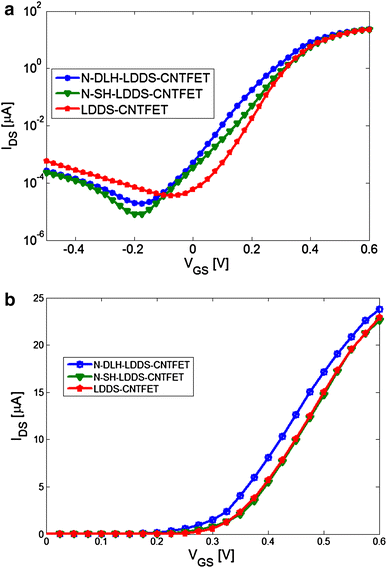
We have calculated
IDS
versus
VGS
characteristics of the LDDS-CNTFET, the SH-LDDS-CNTFET of Fig.
1
a and the proposed structure (DLH-LDDS-CNTFET) of Fig.
1
b at
VDS
= 0.4 V that are shown in Fig.
3
. This figure illustrates the on-current of DLH-LDDS-CNTFET is higher than others, because the channel barrier potential of this structure is reduced by implantation of the n-type double linear halo. This figure also demonstrates that the
IL
of proposed device has slightly increased when compared with the SH-LDDS-CNTFET, but it is also much less than the
IL
of LDDS-CNTFET. Now we must investigate the band to band tunneling to analyze leakage current variations of these three devices.
Fig. 3
The
IDS
–
VGS
characteristics of LDDS-CNTFET, SH-LDDS-CNTFET and DLH-LDDS-CNTFET. Comparison of the
IDS
–
VGS
characteristics between LDDS-CNTFET, SH-LDDS-CNTFET and DLH-LDDS-CNTFET
a
logarithmic scale and
b
linear scale at
VDS
= 0.4 V
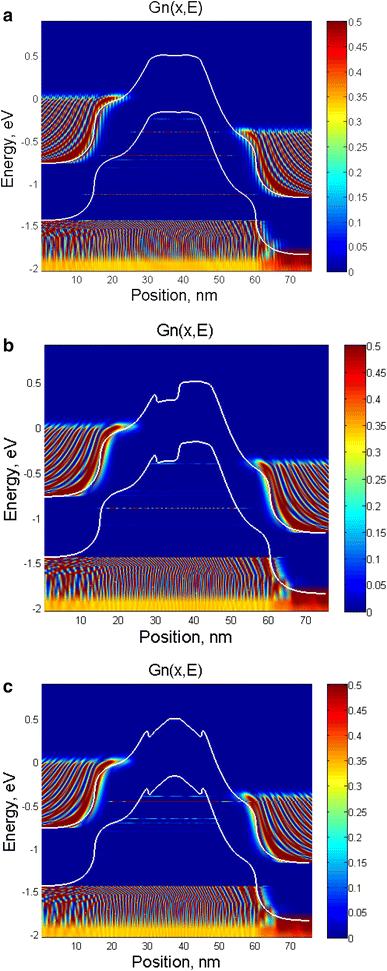
Figure
4
shows the energy band structures (solid line) and color-scaled plot for the number of electrons per unit energy for three discussed transistors at
VDS
= 0.4 V and
VGS
= −0.4 V. Figure
4
a illustrates a large number of tunneling electrons that causes increase the leakage current, for the LDDS-CNTFET represented in Ref. [
7
]. Figure
4
b shows the n-type impurity halo implanted in channel significantly decrease the probability of electrons tunneling, because the halo causes change answers of Schrodinger equation using create the nonuniform potential. Also Fig.
4
c indicates that the number of tunneling electrons in double linear halo implanted channel is a little more than the single halo structure (Fig.
4
b), but much less than the intrinsic channel structure (Fig.
4
a).
Fig. 4
The energy band structures and color-scaled plot for the number of electrons. The energy band structures (
solid line
) and color-scaled plot for the number of electrons per unit energy along the CNT axis for
a
LDDS-CNTFET,
b
SH-LDDS-CNTFET, and
c
DLH-LDDS-CNTFET for
VGS
= −0.4 V and
VDS
= 0.4 V
Then, we have calculated the
fT
for the LDDS-CNTFET, the SH-LDDS-CNTFET of Fig.
1
a and our proposed structure of Fig.
1
b biased under
VDS
= 0.4 V. These results are indicated in Fig.
5
. Dash-dotted, dashed and solid lines represent the
fT
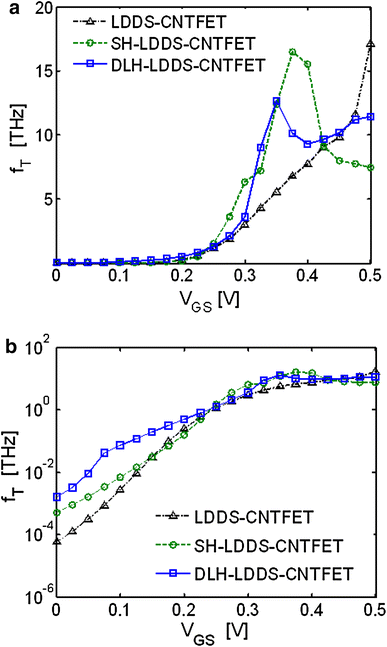
for the LDDS-CNTFET, SH-LDDS-CNTFET, and DLH-LDDS-CNTFET, respectively. It can be seen in this figure that n-type single halo implant in the channel of LDDS-CNTFET increases the
fT
at
VGS
ranges of 0–0.15 V and 0.22–0.42 V. The reason of increasing the
fT
increases the transconductance. This figure also demonstrates that the cutoff frequency of DLH-LDDS-CNTFET significantly increases at low
VGS
range (
VGS
= 0–0.25 V). From an analytical standpoint, using double linear halo the sensitivity of channel charge versus the
VGS
variations (
Cg
) is decreased, therefore according to (3) this device cutoff frequency is increased. As well, the cutoff frequency of the proposed device in the
VGS
higher than 0.42 V is more than the single halo structure. On the other hand, the cutoff frequency of DLH-LDDS-CNTFET (solid line) is more than the LDDS-CNTFET (dash-dot line) in the wide range of the
VGS
from 0 to 0.47 V, In that event the cutoff frequency of single halo structure (dash line) is more than the LDDS-CNTFET in the
VGS
regions of 0–0.15 V and 0.22–0.42 V. Finally, we have simulated the cutoff frequency of LDDS-CNTFET with implanting p-type single halo in the channel. Our results show that this parameter decreases strongly.
Fig. 5
The cutoff frequency versus
VGS
for LDDS-CNTFET, SH-LDDS-CNTFET and DLH-LDDS-CNTFET. The cutoff frequency versus
VGS
at
VDS
= 0.4 V for LDDS-CNTFET, SH-LDDS-CNTFET and DLH-LDDS-CNTFET
a
linear scale and
b
logarithmic scale
Conclusion
In this paper, we have demonstrated that the cutoff frequency of LDDS-CNTFET is higher in comparison with those of both the LD-CNTFET and the MOSCNT. We have simulated these devices by non-equilibrium Green’s function method. It can be seen that in the n-type single halo structure the leakage current is significantly decreased and the
fT
in the gate voltage ranges of 0–0.15 V and 0.22–0.42 V is increased. We have realized that the
fT
of the proposed transistor (Fig.
1
b) for
VGS
of 0–0.25 V is much higher than either the LDDS-CNTFET or the SH-LDDS-CNTFET. And also the
fT
of the DLH-LDDS-CNTFET is higher than the SH-LDDS-CNTFET for
VGS
higher than 0.42 V. Moreover, we have illustrated that the
fT
of the proposed device is higher than the LDDS-CNTFET for a broad range of
VGS
which means 0–0.47 V, whereas the
fT
of SH-LDDS-CNTFET compared to the LDDS-CNTFET is superior only in the narrow ranges of gate-source voltage.
References
Iijima (1991) Helical microtubules of graphitic carbon (pp. 56-58) 10.1038/354056a0
Javey et al. (2002) High dielectrics for advanced carbon nanotube transistors and logic (pp. 241-246) 10.1038/nmat769
Lin et al. (2005) High performance carbon nanotube field-effect transistor with tunable polarities (pp. 481-489) 10.1109/TNANO.2005.851427
Heinze et al. (2003) Electrostatic engineering of nanotube transistors for improved performance (pp. 5038-5040) 10.1063/1.1632531
Hassaninia et al. (2008) Simulation of carbon nanotube FETs with linear doping profile near the source and drain contacts (pp. 980-985) 10.1016/j.sse.2008.01.021
Yousefi et al. (2010) Numerical study of lightly doped drain and source carbon nanotube field effect transistors (pp. 765-771) 10.1109/TED.2010.2041282
Arefinia and Orouji (2008) Impact of single halo implantation on the carbon nanotube field-effect transistor. A quantum simulation study (pp. 196-201) 10.1016/j.physe.2008.07.003
Li and Zhang (2005) Simulation of ambipolar-to-unipolar conversion of carbon nanotube based field effect transistors (pp. 1415-1418) 10.1088/0957-4484/16/8/074
Orouji and Arefinia (2009) Detailed simulation study of a dual material gate carbon nanotube field-effect transistor (pp. 552-557) 10.1016/j.physe.2008.10.005
Orouji and Ahmadmiri (2010) Novel attributes and design considerations of source and drain regions in carbon nanotube transistors (pp. 1456-1462) 10.1016/j.physe.2009.11.118
Kordrostami et al. (2012) Influence of channel and underlap engineering on the high-frequency and switching performance of CNTFETs (pp. 526-533) 10.1109/TNANO.2011.2181998
Guo et al. (2004) Atomistic simulation of carbon nanotube field-effect transistors using non-equilibrium Green’s function formalism (pp. 373-377) 10.1007/s10825-004-7080-7
Yoon and Guo (2007) Analysis of strain effects in ballistic carbon nanotube FETs (pp. 1280-1287) 10.1109/TED.2007.896356
Venugopal et al. (2002) Simulating quantum transport in nanoscale transistors: real versus mode-space approaches (pp. 3730-3739) 10.1063/1.1503165
Alam and Lake (2006) Dielectric scaling of a zero-Schottky-barrier 5 nm gate carbon nanotube transistor with source/drain underlaps (pp. 24317-24324) 10.1063/1.2218764
Monga et al. (2010) A compact subthreshold current and capacitance modeling of short-channel double-gate MOSFETs (pp. 901-907) 10.1016/j.mcm.2009.08.043
Yoon et al. (2006) Effect of phonon scattering on intrinsic delay and cutoff frequency of carbon nanotube FETs (pp. 2467-2470) 10.1109/TED.2006.882034