Mathematical method to find best suited PV technology for different climatic zones of India

Abstract

This paper presents a reliable mathematical method to predict the energy generation from grid connected photovoltaic plant of different commercially used technologies in different zones of India. Global horizontal insolation (GHI) and daytime temperature are the two major parameters affecting the output of photovoltaic (PV) plant. Depending on those two major parameters, India is classified into 15 climatic zones. Typical Meteorological Year data were collected from National Renewable Energy Laboratory to classify India in different climatic zones. Energy generation of different commercially used PV technologies in different climatic zones of India is predicted using proposed mathematical method. These results show a decisive study to choose the best PV technology for different climatic zones of India. Results predict that in almost all climatic zones, amorphous silicon (a-Si) is the best suitable PV technology. In very low-temperature zones, irrespective of GHI, the second best suitable PV technology is mono and cadmium telluride (CdTe) as generation from these two technologies is same. Whereas in other climatic zones, after a-Si the best suitable is CdTe PV technology. Predicted energy generation is validated with the 1-year generation of 2014 from 15 working PV plants of different technologies. Predicted generation is in good co-relation with the actual real-time generation from the PV plants.


Introduction

Interest in forecasting the energy production of PV power plants has increased in recent years from the concern about climate change [ 1 ]. Rough estimation of the average energy produced by the PV power plants can be provided through estimation of global irradiance. Goh and Tan [ 2 ] developed statistical forecasting of solar data using time series model. Since then number of research work is available on forecasting solar irradiance [ 3 , 4 , 5 , 6 , 7 , 8 , 910 ]. Theoretically, prediction of global irradiance can be applied to forecast the energy production of PV power plant. The environmental factors influencing the performance of PV module are analyzed in the literature [ 11 , 12 , 1314 ]. The effect of temperature on the performance of PV modules is analyzed in [ 15 , 1617 ]. But, considerably lesser number of literature is present in predicting the actual output of PV power plant.

Some literature is available for estimating field performance of standalone PV array system [ 18 , 19 , 20 , 21 , 22 , 2324 ]. Also some power efficiency models [ 25 , 26 , 27 , 2829 ] can predict the average performance of a PV system under variable climatic conditions.

Ayompe et al. [ 29 ] used different models for PV-cell temperature and models for PV-cell efficiency to predict the accuracy of output power from PV module. The four- and five-parameter models were also investigated [ 30 , 31 , 32 , 3334 ] and compared [ 35 ] based on the equivalent circuit of a one-diode model. Considering solar radiation and module temperature, Jones and Underwood [ 28 ] proposed a power output model of PV module. Neural networks model is more complicated which uses various inputs such as the solar radiation, ambient temperature, and module temperature [ 30 , 31 ]. The design of neural network model is based on trial and error processes and requires past experience for successful implementation.

Good match between the utility load and the solar resource profile leads to a cost-effective system [ 29 ]. Most of the above-mentioned models require either detailed data [ 26 , 30 , 31 , 32 , 33 , 34 , 35 , 3637 ] and are complicated to use [ 35 , 36 ] or restricted in economic performance evaluation [ 17 , 18 , 19 , 2021 , 41 ]. These limitations of the mentioned literature are barrier in easy manipulation of the system performance.

Another problem is that different types of PV technologies respond dissimilarly in the same climatic condition [ 38 ]. Santana-Rodŕiguez et al. [ 39 ] concluded that the performance of modules made of amorphous silicon technology is better than other technologies in Mexico City. Ronak et al. [ 40 ] observed that performance of amorphous silicon is well under Malaysia’s tropical hot and humid climate. Adiyabat et al. [ 41 ] showed that a PV module with a high-temperature coefficient, such as crystalline silicon, is advantageous for use in the Gobi Desert area.

Numbers of energy prediction models are available to predict the energy generation of different types of PV modules [ 42 ]. Dolara et al. [ 43 ] investigated the PV power output prediction using three mathematical models and considered both poly-crystalline and mono-crystalline PV module. Dolara et al. [ 44 ] and Leva et al. [ 45 ] investigated the P V power output prediction using neural network and hybrid model. Some of the renowned models used for prediction, design and economic analysis of PV power plant. Hybrid Optimization Model for Electric Renewables (HOMER), RetScreen, System Advisor Model (SAM), PVSyst, PVSol, PVWATT are the most popular PV production model. The first three models mentioned can be used for any type of renewable energy resources. Comparing with actual PV plant generation the mentioned models are showing less correlation. Reason behind the poor performance of HOMER and RetScreen models are use of average of 22-year satellite-measured meteorological data up to the year 2002 from National Aeronautics and Space Administration (NASA) renewable energy resource website (Surface Meteorology and Solar Energy). Taking average of 22-year data is not representative of the current weather condition. Typical Meteorological Year (TMY) is the most representative of weather condition for an entire year of a particular location. So TMY data should be used instead of average data. Another drawback is ambient temperature used in all the above-mentioned models is the whole day average temperature whereas only daytime temperature is needed for PV plant energy prediction. SAM model is using TMY file for meteorological parameter; however, its power output prediction is not very close for Indian condition. PVSyst and PVSol both have the ambient temperature issue and PVSol is limited for PV plant using up to 5000 numbers of PV panels only. PVSol is good for rooftop PV plant design where as PVSyst is better in Grid interactive plant. But the economic analysis of PVSyst is not good as per the literature. PVWATT is the latest one and easy model used for energy prediction but that is also not showing the expected accuracy in prediction of energy generation for Indian PV power plants. Therefore, a simple model with adequate precision is desirable for prediction of output from PV power plant based on different PV technology in different climatic zones of India.

The objective of this paper is to present a simple but accurate method for prediction of the energy production from PV plants based on different type of PV technology. This method is applicable to any type of climatic location of India to choose the best suitable technology for that specific location. Establishment of energy demand security needed a bridge between energy schemes and location adjuvant PV technology. Application of the finding of the paper through energy supply planning is helpful to make the energy generation economic and environment friendly. ‘Potential map of the location for PV power plants based on different technology and solar resource availability’ is effective for selection of PV technology for a particular location. Considering these aspects, the technology explained in this paper suggests the development of a location adjuvant map for solar PV plants which is adjuvant in energy supply planning. The scope of this study is to relate the location and solar energy to study the potential of the location for different types of solar PV plants. Prospective practical users of this method are people from energy industry, energy planners, engineers, city planners, and climate concern citizens.

The research is presented here in four stages. In the next section material and methods used for the research are described, such as collection of data for 300 grid points of India from NREL, manufactures data for different types of PV technologies, etc., followed by which the classification map of India based on global horizontal insolation (GHI) and daytime temperature is presented (till now all available resource maps of India are only based on insolation though temperature is another determining parameter for solar PV technology). In the subsequent section mathematical method for different PV technologies is described to predict the best suitable PV technology for a particular location. Finally, the validation of the method with the real-time energy output of 15 operating PV power plants of different PV technologies under the scheme of National Thermal Power Corporation (NTPC) Vidyut Vyapar Nigam Ltd. (NVVN) for the one whole year of 2014 is presented.

Methodology developed

Methodology used in this work consists of five different steps. They are concisely discussed as follows:

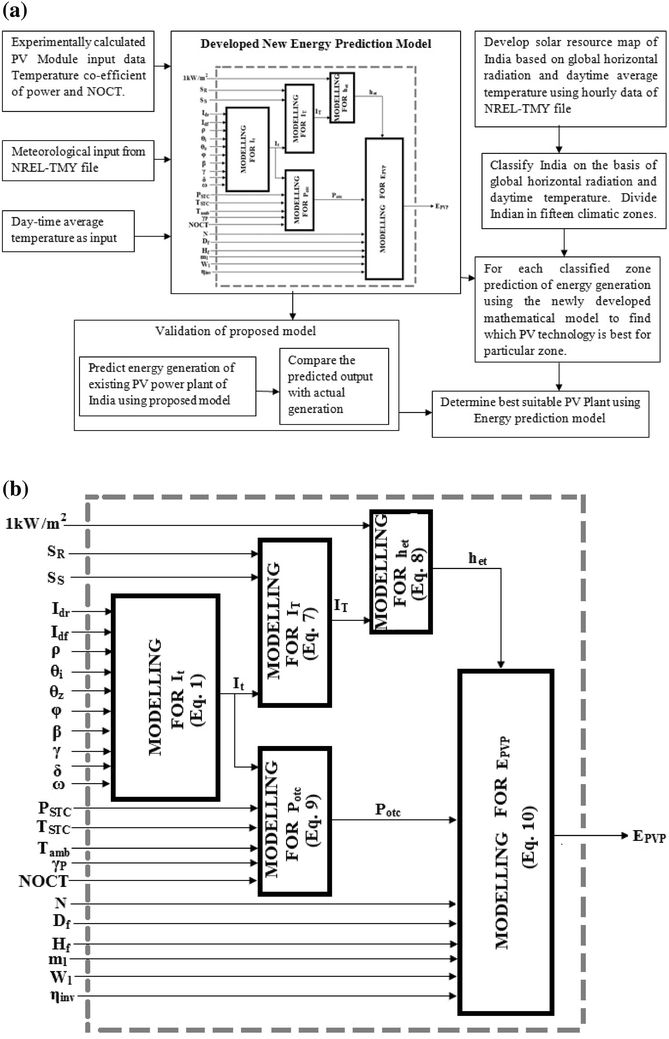
Figure  1 a, b depicts the general sketch of the developed methodology and developed energy prediction model, respectively.

Fig. 1

a General sketch of the developed methodology. b Developed energy prediction model

Division of Indian map in grids

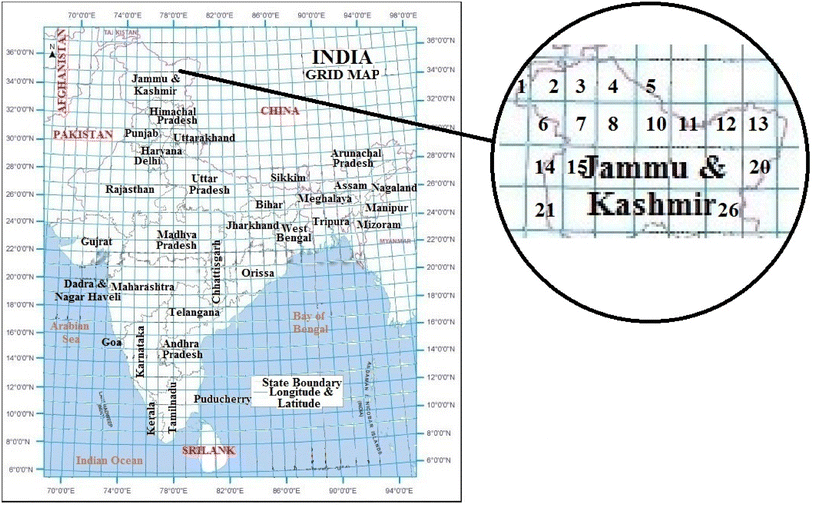
Mainland area of 3, 287, 263 km 2 makes India one of the largest countries in the world. India is equally divided into two halves through the Tropic of Cancer. Pakistan and Burma are situated in the west, China and Nepal in the north to northeastern part and Bhutan in the northeastern part of India. The total length of the land boundary and the shoreline of the country are 15,200 km and 7517 km, respectively. The boundary of India is wide between 8°4′ and 37°6′(N) North Latitude and 68°7′ and 97°25′(E) East Longitudes with a measure of 3214 and 2933 km, respectively. Map of India is divided into 1° × 1° grids. This grid division of India is required for secondary data collection of GHI and temperature from TMY file of NREL. Andaman and Nicobar Islands in the Bay of Bengal and Lakshadweep Islands in Arabian Sea are also part of the Republic of India. But these two islands are not considered in the study as 1° × 1° grids are large enough for their area. So a separate study for these two locations is needed. Required data for 300 grid points are collected for classification of India on the basis of GHI and day-time temperature. Grid map of India used for data collection is shown in Fig.  2 .

Fig. 2

Grid map of India

Map of India is divided into 1° grids and magnified grids are also shown in Fig.  2 .

Secondary data collection for climatic zone division of India

GHI and dry bulb temperature for 300 grid points of India are collected from TMY files of NREL website. It is a 10 × 10 km resolution data. In TMY, the month that is most representative of the location is selected for consideration. The month for which average radiation is most closely equal to the monthly average over the whole measurement period is representative of the TMY data for that month. This process is then repeated for each month in the year. The months are added together to give a full year of hourly samples. From hourly data of each day average GHI and average daytime temperature of each day is calculated for each grid points. Average of 365 days data is considered to calculate the yearly average GHI and average daytime temperature for each grid points. Hourly data of TMY file is analyzed to get the annual average GHI and only day-time annual average temperature of those grid points. Day-time average temperature is considered to reduce the error in temperature correction. Consideration of overall day temperature instead of only day-time temperature causes overestimation of generation from PV module.

A TMY data set provides designers and other users with a reasonably sized annual dataset that holds hourly meteorological values that typify conditions at a specific location over a longer period of time, such as 30 years. TMY data have natural diurnal and seasonal variations and represent a year of typical climatic conditions for a location. The TMY data set is composed of 12 typical meteorological months (January through December) that are concatenated essentially without modification to form a single year with a serially complete data record for primary measurements. This method is an empirical approach that selects individual months from different years occurring in the period of record. For example, in the case of the National Solar Radiation Data Base (NSRDB) that contains 30 years of data, all 30 Januarys are examined, and the one judged most typical by the TMY algorithm is selected to be included in the TMY. The other months of the year are treated in a like manner, and then the 12 selected typical months are concatenated to form a complete year. Adjacent months in the TMY may be selected from different years,

Final selection of a month includes consideration of the monthly mean and median and the persistence of weather patterns. The process may be considered a series of steps. Step 1

For each month of the calendar year, five candidate months with cumulative distribution functions (CDFs) for the daily indices that are closest to the long-term (30 years for the NSRDB) CDFs are selected. The CDF gives the proportion of values that are less than or equal to a specified value of an index.

Step 2

The five candidate months are ranked with respect to closeness of the month to the long-term mean and median.

Step 3

The persistence of mean dry bulb temperature and daily global horizontal radiation are evaluated by determining the frequency and length of runs of consecutive days with values above and below fixed long-term percentiles.

The persistence criteria excludes the month with the longest run, the month with the most runs, and the month with zero runs. The persistence data are used to select from the five candidate months the month to be used in the TMY. The highest ranked candidate month from Step 2 that meets the persistence criteria is used in the TMY.

Step 4

The 12 selected months were concatenated to make a complete year and discontinuities at the month interfaces were smoothed for 6 h each side using curve fitting techniques.

Only for 10 grid points the analyzed annual average GHI and day-time temperature are shown in Table  1 .

Table 1

Annual average GHI and day-time temperature of some grid points of India

Grid no.

Longitude and latitude

Annual avg. GHI kWh/m2/day

Annual avg. day-time temperature (°C)

1

36.5N74.5E

3.72

–3.06

2

36.5N75.5E

4.27

–6.56

3

35.5N74.5E

4.55

6.12

4

35.5N75.5E

4.28

2.74

5

35.5N76.5E

4.22

–7.88

6

35.5N78.5E

5.10

–4.23

7

35.5N79.5E

5.38

–3.16

8

34.5N74.5E

4.41

11.08

9

34.5N75.5E

4.24

1.75

10

34.5N76.5E

4.93

2.85

Selection of PV technology

Selection of appropriate PV technology is the key for success of any PV power project. In laboratory scale, many new PV technologies are available such as organic solar cell, dye sensitized solar cells, etc., but they are not used commercially for PV power plant. Hence, mono crystalline silicon (Mono C-Si), polycrystalline silicon (Poly C-Si), amorphous silicon (a-Si), CIGS, CdTe PV technologies from reputed manufacturers are considered which are widely used for commercial PV power plant projects. Specifications of the selected PV technologies are collected from their datasheets. Required specifications of the selected PV technologies are enlisted in Table  2 .

Table 2

Technical specifications of selected PV modules

PV technology

Manufacturer name

Model no

PSTC (W)

Temp coefficient of power (%/°C)

NOCT (°C)

Mono-crystalline

Helios Solar

Helios Solar 9T6-420

420

0.41

45

Poly-crystalline

Conergy

PE-300

300

0.43

47

a-Si

Sungen International Limited

SG-HN105-GG

100

0.268

40.28

CIGS

Stion

STO-150

150

0.26

45.6

CdTe

First solar

FS-385

85

0.25

45

Mathematical model to predict the energy generation

Output of PV module is dependent on the meteorological parameters mainly on insolation and ambient temperature. Energy outputs for fixed lilted modules are evaluated zone wise for different technology PV modules. Mathematical modeling is represented below.

Solar radiation on tilted PV array

Total solar radiation received by PV array which is tilted at a certain angle is known as solar radiation on tilted PV array. In NREL website, the long-term published data of solar radiation and other meteorological parameters are available as hourly average values on horizontal surface for different grid points of India. The solar radiation on a tilted PV array is the main input parameter for the design of the PV system. According to the Liu and Jordan formula using the hourly beam and diffuse radiation on a horizontal surface, the total radiation on a tilted PV array (at angle β) for a given latitude φ can be evaluated:

It=Ibrb+Idrd+ρrr(Ib+Id)
Ib is the hourly beam radiation on a horizontal surface; Id hourly diffuse radiation on a horizontal surface; rb , rd and rr are known as conversion factors for beam, diffuse and reflected components, respectively; ρ is the reflection coefficient of the ground (0.2 and 0.6 for non-snow-covered and snow-covered ground, respectively).
rb=CosθiCosθz
rd=1+Cosβ2
rr=1-Cosβ2
Cosθi=(CosϕCosβ+SinϕSinβCosγ)CosδCosω+CosδSinωSinβSinγ+(SinϕCosβ-CosϕSinβCosγ)Sinδ
Cosθz=CosϕCosδCosω+SinϕSinδ
θi is angle of incidence, θz zenith angle; ϕ the latitude angle; β the tilt angle; γ the azimuth angle; δ the solar declination angle; ω is the hour angle.
Insolationontiltedsurface,IT=SRSSIt
SR is the sunrise time; SS is the sunset time.

Daily PV array output is the summation of the hourly energy output.

Equivalent full sun-shine hours on tilted surface

No. of hours for which the intensity of solar radiation incident at a place is kept constant at its peak value of 1 kW/m 2 is known as equivalent hours of full sunshine ( het ). When insolation on tilted unit area surface is expressed by IT  kWh/m 2 /day, then it can be expressed as constant peak value of solar radiation of 1 kW/m 2 incident on a receiving surface for IT  h, then het will be equal to IT  h/day. The expression is given by Eq. ( 7 )

het=IT1kWm2
het is the equivalent full sun-shine hours on tilted surface; IT is Insolation on tilted surface in kWh/m 2 /day.

PV panel output after temperature correction

Power output of PV panel after consideration of reduction in power output from PV panel due to deviation of its temperature from 25 °C is known as PV panel output after temperature correction. The output of PV module is dependent on solar radiation and the operating temperature of PV module. Rise in the PV operating temperature with respect to STC condition, reduces the energy output from PV module. Operating temperature of PV module can be calculated by means of ambient temperature, incident solar irradiance on PV module at given location and Nominal Operating Cell Temperature (NOCT) of the particular technology [ 46 , 47 , 4849 ].

Potc=Pm1-Ta+(NOCT-20)800×It-TSTC×γP
Potc is the panel output after temperature correction; Pm the power output at STC; Ta the ambient temperature in  °C; NOCT the nominal operating cell temperature; It the irradiance in W/m 2 ; TSTC the temperature of the PV module at STC in °C; γP is the temperature coefficient of power for PV panel in %/°C.

Generated energy from PV plant feed to the grid

Total generated energy from PV array that is fed to the electricity grid is known as generated energy from PV plant feed to the grid.

EPVP=Potc×het×(1-Df)(1-Hf)(1-Wl)(1-ml)×ηinv
EPVP is the energy output from PV plant; Df the dust factor in %; Hf the humidity factor in %; Wl the wiring losses in %; ml the mismatch losses in %, ηinv is the inverter efficiency in %.

Performance ratio

Performance ratio is defined as the ratio of the array yield to the reference yield. Array yield is defined as the total energy generated by the PV array for a defined period divided by the rated output power of the installed PV array. Reference yield is defined as the ratio of total in plane solar insolation to the reference irradiance. Array yield and the reference yield both are time-dependent parameters. The performance ratio (PR) is a system performance index that indicates the overall effect of losses on the array’s rated output due to array temperature, incomplete utilization of the irradiation, and system component inefficiencies or failures (IEC 61724).

PR=EPVPAa×IT×ηPanel×100
PR is the performance ratio in %; Aa the active area of panel; ηPanel is the solar panel efficiency in %.

Energy yield factor

Energy yield factor (YF) of the PV system defined as the portion of the daily net energy output of the entire PV plant which is supplied by the array per kW of installed PV array.

YF=EPVPPm
YF is the yield factor.

Capacity utilization factor

Practical output of a power plant over a period of time divided by its potential output of power plant if had operated at full nameplate capacity for the entire time is known as net capacity utilization factor (CUF) of that power plant. To calculate the CUF, the sum of energy production in a particular period considered and divides by the amount of energy the plant actually capable of produce at its full capacity.

Collected data of solar PV projects in India

Under the scheme of Jawaharlal Nehru National Solar Mission (JNNSM) numbers of Solar PV plants are already installed in India and many other are going to be installed to fulfill the target of JNNSM. For successful execution of JNNSM, NTPC Vidyut Vyapar Nigam Ltd (NVVN) [ 50 ] has given the responsibility to prepare the guidelines for selection of developers for commissioning grid connected solar power projects in India. Location and monthly field measured generation data of fifteen existing PV plants of different technologies for one whole year of 2014 in India are collected from the project installer [ 50 ]. Some of the PV plants details are tabulated in Table  3 .

Table 3

Details of some PV plants in India

Bidder name

Capacity in MW

Location

Latitude and longitude

Technology

Comet Power Pvt. Ltd.

5

Village–Bham Bhuo Ki Dhani, Tehsil—Osiyan, Dist.—Jodhpur, Rajasthan.

26°44′37.32″N, 72°58′56.28″E

Poly C-Si

Videocon Industries Ltd, Mumbai

5

Taluka: Warora, Dist.—Chandrapur, Maharashtra.

20º18′8.64″N, 79º 01′9.60″ E

Poly C-Si

Mahindra Suryaprakash Private Limited

20

Village-Rawra, Tehsil Phalodi, Distt.—Jodhpur, Rajasthan.

27°23′44.38″N, 72° 09′ 14.78″E

Thin film

Mahindra Suryaprakash Private Limited

10

Village-Rawra, Tehsil Phalodi, Distt.—Jodhpur, Rajasthan.

27°23′44.38″N, 72° 09′14.78″E

Thin film

NVR Infrastructure And Services Private Limited

10

Village-Kisnayat Buddan, Tehsil Kolayat, Distt.Bikaner, Rajasthan.

27.83° N, 72.95°E

Poly C-Si and thin film

Sai Mathili Power Company Private Limited

10

Village-Gurha, Tehsil Kolayat, Distt.—Bikaner, Rajasthan.

27°51′50″N, 72°50′20″E

CIGS

Results and discussion

Results and discussion part is sub-divided into three parts. (1) Classification of India in different climatic zones considering on GHI and day-time temperature. (2) Prediction of energy output and CUF from different PV technologies in different climatic zones of India using mathematical method. (3) Validation of the mathematical method with practical field output data of 15 PV plants of different technologies.

Classification of India in different climatic zones

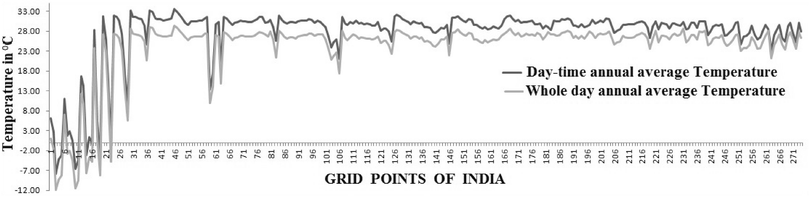
To know the energy output from different photovoltaic technologies in different zones of India, first step is to classify India in different climatic zones on the basis of annual average GHI and day-time temperature, the major two factors affecting the output of PV technology. Indian map is divided into grids by its longitude and latitude. For each degree apart one point is selected as grid point. Thus, 300 grid points have been selected. Secondary data of TMY file from NREL website [ 30 ] are collected for those 300 grid points to classify India in 15 climatic zones depending on annual average GHI and day-time average temperature. For 300 grid points daytime and whole day annual average temperature is also calculated to know the difference between these two temperatures. This temperature difference causes error in most of the prediction techniques as whole day average temperature is considered in most of the PV output predicting softwares, such as RetScreen and Homer. Figure  3 shows the daytime and whole day average temperature for the selected grid points.

Fig. 3

Day-time and whole day annual average temperature for 300 grid points of India. Maximum 5.16 °C temperature difference is observed between these two temperatures

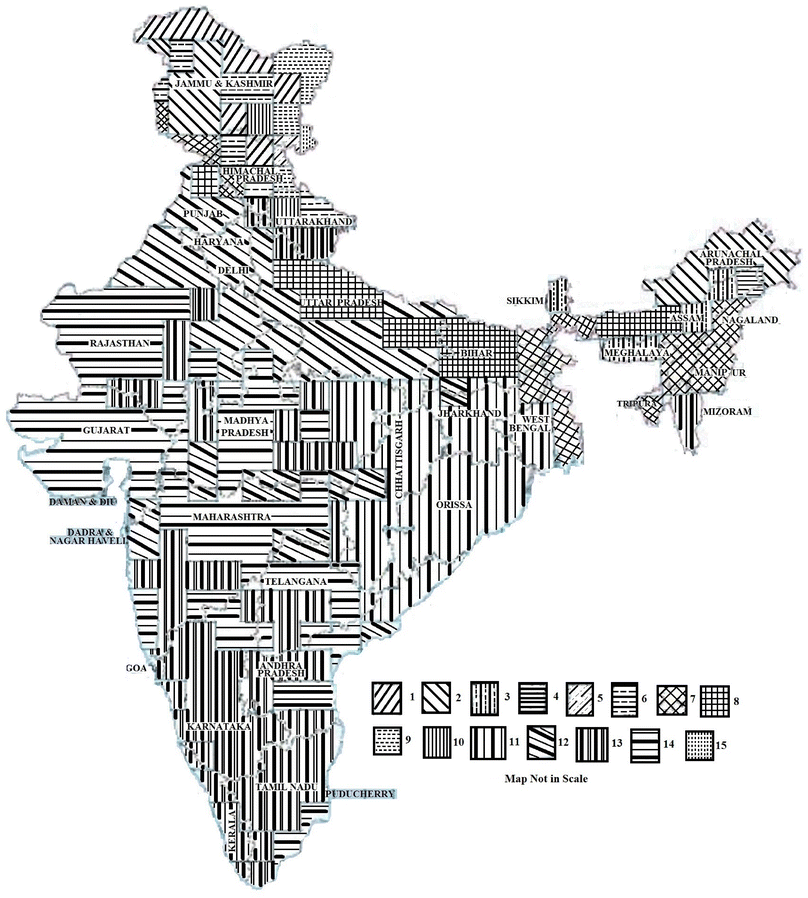
Classification of India in different climatic zones depending on GHI and day-time average temperature is presented in Fig.  4 .

Fig. 4

Classification of India on the basis of annual average GHI and day-time temperature

Energy output (kWh) of different PV technologies in different climatic zones of India

Annual average energy output and CUF of 1 MW p power plant of different technologies in different climatic zones is calculated using 2.4.4 and 2.4.7. All the related data like temperature coefficient of power and NOCT value for different PV technologies are used from the data sheets of manufacturers to calculate the energy output.

It is seen that in all climatic zones energy generation and CUF is maximum for 1 MW a-Si PV power plant (Tables  5 , 6 ).

Table 4

Name of the climatic zones

Climatic zones

GHI

Day-time Temperature

1. Low GHI very low temperature (LIVLT)

<4.5 kWh/m2/day

<0 °C

2. Low GHI low temperature (LILT)

0–20 °C

3. Low GHI medium temperature (LIMT)

20–30 °C

4. Low GHI high temperature (LIHT)

≥30 °C

5.Medium GHI very low temperature (MIVLT)

4.5–5 kWh/m2/day

<0 °C

6. Medium GHI low temperature (MILT)

0–20 °C

7. Medium GHI medium temperature (MIMT)

20–30 °C

8. Medium GHI high temperature (MIHT)

≥30 °C

9. High GHI very low temperature (HIVLT)

5–5.5 kWh/m2/day

<0 °C

10. High GHI low temperature (HILT)

0–20 °C

11. High GHI medium temperature (HIMT)

20–30 °C

12. High GHI high temperature (HIHT)

≥30 °C

13. Very high GHI medium temperature (VHIMT)

≥5.5 kWh/m2/day

20–30 °C

14. Very high GHI high temperature (VHIHT)

≥30 °C

15. Very high GHI low temperature (VHILT)

0–20 °C

Table 5

Annual average energy output range and CUF at different climatic zones of India for different PV technologies

Type of cell

Zone 1

Zone 2

Yearly generation (kWh)

Average CUF

Yearly generation (kWh)

Average CUF

Zone-1 and 2

 Mono C-Si

1,469,873.24–1,865,416.1

19.04

1,363,573.18–1,698,380.38

17.48

 Poly C-Si

1,457,232.33–1,849,373.52

18.87

1,351,846.45–1,675,069.28

17.28

 a-Si

1,488,466.55–1,889,012.86

19.28

1,380,821.84–1,774,325.73

18.01

 CIGS

1,467,580.24–1,862,506.05

19.01

1,361,446.01–1,750,996.87

17.77

 CdTe

1,469,873.24–1,865,416.1

19.04

1,363,573.182–1,757,583.18

17.81

Type of cell

Zone 3

Zone 4

Yearly generation (kWh)

Average CUF

Yearly generation (kWh)

Average CUF

Zone-3 and 4

 Mono C-Si

1,437,138.15–1,482,542.94

16.66

1,482,543

16.92

 Poly C-Si

1,417,412.73–1,457,862.07

16.41

1,457,862

16.64

 a-Si

1,501,401.71–1,575,940.78

17.56

1,575,941

17.99

 CIGS

1,481,661.26–1,555,976.99

17.34

1,555,977

17.76

 CdTe

1,487,234.47–1,563,685.54

17.41

1,563,686

17.85

Type of cell

Zone 5

Zone 6

Yearly generation (kWh)

Average CUF

Yearly generation (kWh)

Average CUF

Zone-5 and 6

 Mono C-Si

1,778,776.55–1,976,714.59

21.44

1,740,455.21–1,878,863.89

20.66

 Poly C-Si

1,763,479.07–1,959,714.85

21.25

1,725,487.3–1,853,075.56

20.43

 a-Si

1,801,277.36–2,001,719.24

21.71

1,762,471.27–1,962,879.80

21.26

 CIGS

1,776,001.66–1,973,630.92

21.4

1,737,740.1–1,937,071.83

20.97

 CdTe

1,778,776.55–1,976,714.59

21.44

1,740,455.21–1,944,358.05

21.03

Type of cell

Zone 7

Zone 8

Yearly generation (kWh)

Average CUF

Yearly generation (kWh)

Average CUF

Zone-7 and 8

 Mono C-Si

1,479,352.94–1,732,409.73

18.33

1,457,001–1,713,706.25

18.10

 Poly C-Si

1,459,048.1–1,703,569.16

18.05

1,432,745.34–1,685,177.05

17.80

 a-Si

1,545,504.19–1,841,548.78

19.33

1,548,789.74–1,821,667.01

19.24

 CIGS

1,525,183.87–1,818,220.31

19.08

1,529,169.9–1,798,590.40

18.99

 CdTe

1,530,920.8–1,827,228.05

19.17

1,536,745.64–1,807,500.89

19.09

Type of cell

Zone 9

Zone 10

Yearly generation (kWh)

Average CUF

Yearly generation (kWh)

Average CUF

Zone-9 and 10

 Mono C-Si

1,954,055.02–2,251,295.31

24.00

1,932,728.36–2,017,438.51

22.55

 Poly C-Si

1,937,250.14–2,231,934.17

23.80

1,916,106.9–1,989,748.18

22.29

 a-Si

1,978,773.03–2,279,773.29

24.31

1,957,176.60–2,107,650.98

23.20

 CIGS

1,951,006.69–2,247,783.29

23.97

1,929,713.3–2,079,939.55

22.89

 CdTe

1,954,055.02–2,251,295.31

24.00

1,932,728.36–2,087,763.16

22.95

Type of cell

Zone 11

Zone 12

Yearly generation (kWh)

Average CUF

Yearly generation (kWh)

Average CUF

Zone-11 and 12

 Mono C-Si

1,547,875.49–1,864,503.05

19.48

1,523,953.61–1,864,503.05

19.34

 Poly C-Si

1,526,630.14–1,833,463.43

19.18

1,498,583.35–1,833,463.43

19.02

 a-Si

1,617,090.82–1,981,963.76

20.54

1,619,960.26–1,981,963.76

20.56

 CIGS

1,595,829.28–1,956,856.54

20.28

1,599,438.84–1,956,856.54

20.30

 CdTe

1,601,831.94–1,966,551.11

20.37

1,607,362.70–1,966,551.11

20.40

Type of cell

Zone 13

Zone 14

Yearly generation (kWh)

Average CUF

Yearly generation (kWh)

Average CUF

Zone-13 and 14

 Mono C-Si

2,181,317.21–21,847,68.13

24.92

1,701,133.52–1,993,089.47

21.08

 Poly C-Si

2,154,781.12–2,162,557.89

24.64

1,677,784.63–1,959,909.18

20.76

 a-Si

2,208,910.00–2,282,462.97

25.64

1,777,201.98–2,118,650.92

22.24

 CIGS

2,177,914.36–2,252,453.11

25.29

1,753,835.30–2,091,812.16

21.95

 CdTe

2,181,317.21–2,260,925.63

25.36

1,760,432.29–2,102,175.32

22.05

Type of cell

Yearly generation (kWh)

Average CUF

Zone-15

 Mono C-Si

1,976,723.92–1,629,540.59

20.58

 Poly C-Si

1,602,412.55–1,943,816.09

20.24

 a-Si

1,732,199.05–2,101,254.37

21.88

 CIGS

1,710,255.81–2,074,635.99

21.60

 CdTe

1,718,728.68–2,084,914.06

21.71

Validation of the mathematical method

Depending on the availability of actual field data 15 PV power plants are selected. It is found that all the 15 selected PV power plants of different technologies are situated in the same climatic zone, i.e., Zone 14 (very high GHI high temperature). Among the selected 15 PV power plants, plant 1–9 is based on Multi C-Si, 10 is of a-Si, 11–13 is based on CdTe technology and 14–15 is based on CIS technology. For validation of the mathematical method actual field output of PV plants are compared with the predicted value. 15 different PV power plants are of different capacity, so exported energy of the PV power plants are normalized to 1 MW power plant. Validation table is presented in Table  6 .

Table 6

Validation table of mathematical model

Plant no.

Technology

Actual generated energy (kWh/MW)

Absolute %error in energy prediction

Predicted energy generation (kWh/MW)

Actual CUF (%)

Predicted CUF (%)

Absolute %error in CUF prediction

Plant 1

Multi C-Si

1,690,376.2

4.67

1,602,413–1,943,816

19.41

18.29–22.19

4.10

Plant 2

1,774,504

0.08

20.32

0.40

Plant 3

1,939,950.4

9.41

22.18

9.58

Plant 4

1,909,264.2

7.68

21.92

8.30

Plant 5

1,693,517.8

4.49

19.44

3.95

Plant 6

1,940,648

9.45

22.19

9.63

Plant 7

1,955,562

10.29

22.17

9.54

Plant 8

1,794,901.8

1.23

20.80

2.77

Plant 9

1,882,971.8

6.20

21.72

7.31

Plant 10

a-Si

1,853,285.2

3.31

1,732,199–2,101,254

21.54

19.77–23.99

1.55

Plant 11

CdTe

1,817,119.8

4.45

1,718,729–2,084,914

21.43

19.62–23.80

1.29

Plant 12

1,807,359

4.97

20.82

4.10

Plant 13

2,024,909.2

6.47

23.80

9.63

Plant 14

CIS

1,795,320

5.13

1,710,256–2,074,636

21.44

19.52–23.68

0.74

Plant 15

1,864,970

1.45

21.75

0.69

Table  6 shows that actual generation and CUF of all the selected PV plants are in the range of predicted value got through mathematical model. Percentage errors in prediction of energy generation and CUF for all the fifteen PV plants are also calculated. Results indicate that maximum percentage error in prediction of annual energy generation is 10.29% where as minimum is with a value of 0.08% for plant 2. So, mathematical model is in good correlation with the actual field output and CUF of PV power plants.

Conclusion

The mathematical model used for technical feasibility study of PV power plant is validated collecting the actual field output data of 15 PV power plants of different technologies. Findings of the proposed work are tabulated below:

So, technical feasibility model is in good correlation with the actual field output of PV power plants. This validation would be more trustable if more numbers of a-Si, CdTe and CIGS-based PV power plants data can be compared with predicted data. Due to unavailability of more practical data and as PV plants are not installed in all climatic zones of India till now, further validation in all climatic zones is not possible now. The ministry has future plans for installation of PV power plants all over India; therefore, much better validation of the work will be possible.


References

  1. Chakraborty et al. (2014) New location selection criterions for solar PV power plant 4(4) (pp. 1020-1030)
  2. Goh and Tan (1977) Stochastic modeling and forecasting of solar radiation data (pp. 755-757) 10.1016/0038-092X(77)90041-X
  3. Chakraborty et al. (2015) Technical mapping of solar PV for ISM-an approach toward green campus 3(3) (pp. 196-206) 10.1002/ese3.65
  4. Sfetsos and Coonick (2000) Univariate and multivariate forecasting of hourly solar radiation with artificial intelligence techniques 68(2) (pp. 169-178) 10.1016/S0038-092X(99)00064-X
  5. Das et al. (2015) Life cycle economic analysis of stand-alone solar PV system in India—a relative study 12(1) (pp. 37-44) 10.1260/1708-5284.12.1.37
  6. Hontoria et al. (2002) Generation of hourly irradiation synthetic series using the neural network multilayer perception (pp. 441-446) 10.1016/S0038-092X(02)00010-5
  7. Shuanghua and Jiacong (2005) Forecast of solar irradiance using recurrent neural networks combined with wavelet analysis (pp. 161-172) 10.1016/j.applthermaleng.2004.06.017
  8. Mellit et al. (2006) An adaptive wavelet network model for forecasting daily total solar radiation (pp. 705-722) 10.1016/j.apenergy.2005.06.003
  9. Hocaoglu et al. (2008) Hourly solar radiation forecasting using optimal coefficient 2-D linear filters and feed-forward neural networks 82(8) (pp. 714-726) 10.1016/j.solener.2008.02.003
  10. Mellit et al. (2008) Methodology for predicting sequences of mean monthly clearness index and daily solar radiation data in remote areas: application for sizing a stand-alone PV system (pp. 1570-1590) 10.1016/j.renene.2007.08.006
  11. Cao and Lin (2008) Study of hourly and daily solar irradiation forecast using diagonal recurrent wavelet neural networks 49(6) (pp. 1396-1406) 10.1016/j.enconman.2007.12.030
  12. Reikard (2009) Prediction solar radiation at high resolutions: a comparison of time series forecasts (pp. 342-349) 10.1016/j.solener.2008.08.007
  13. Kerr and Cuevas (2003) Generalized analysis of the illumination intensity vs. open-circuit voltage of PV modules (pp. 263-267) 10.1016/j.solener.2003.07.027
  14. Radziemska and Klugmann (2002) Thermally-affected parameters of the current–voltage characteristics of silicon photocell (pp. 1889-1900) 10.1016/S0196-8904(01)00132-7
  15. Van Dyk (2000) Temperature-dependent of performance of crystalline silicon photovoltaic modules (pp. 198-200)
  16. Nishioka (2003) Field-test analysis of PV-system-output characteristics focusing on module temperature (pp. 665-671) 10.1016/S0927-0248(02)00148-4
  17. Pau (2009) Output energy of a photovoltaic module mounted on a single axis tracking system (pp. 2071-2078) 10.1016/j.apenergy.2009.02.006
  18. Unknown ()
  19. Charles and Edward (1996) Performance and cost evaluation of a standalone photovoltaic system in Malta (pp. 437-440) 10.1016/0960-1481(96)88894-X
  20. García-Valverde et al. (2009) Life cycle assessment study of a 4.2 kWp stand-alone photovoltaic system (pp. 1434-1445) 10.1016/j.solener.2009.03.012
  21. Lesourd (2001) Solar photovoltaic systems: the economics of a renewable energy resource (pp. 147-156) 10.1016/S1364-8152(00)00078-5
  22. Kannan et al. (2006) Life cycle assessment study of solar PV systems: an example of a 2.7 kWp distributed solar PV system in Singapore (pp. 555-563) 10.1016/j.solener.2005.04.008
  23. Bhuiyan et al. (2000) Economic evaluation of standalone residential photovoltaic power system in Bangladesh (pp. 403-410) 10.1016/S0960-1481(00)00041-0
  24. Evans (1981) Simplified method for predicting photovoltaic array output (pp. 555-560) 10.1016/0038-092X(81)90051-7
  25. Mondol et al. (2005) Long-term validated simulation of a building integrated photovoltaic system (pp. 163-176) 10.1016/j.solener.2004.04.021
  26. Hove (2000) A method for predicting long-term average performance of photovoltaic systems (pp. 207-229) 10.1016/S0960-1481(99)00131-7
  27. Stamenic et al. (2004) Low light conditions modelling for building integrated photovoltaic (BIPV) systems (pp. 37-45) 10.1016/j.solener.2004.03.016
  28. Jones and Underwood (2002) A modelling method for building-integrated photovoltaic power supply (pp. 167-177) 10.1191/0143624402bt040oa
  29. Ayompe et al. (2010) Validated real-time energy models for small-scale grid connected PV-systems 35(10) (pp. 4086-4091) 10.1016/j.energy.2010.06.021
  30. Joyce et al. (2001) Modelling a PV system 22(1) (pp. 275-280) 10.1016/S0960-1481(00)00031-8
  31. De Soto et al. (2006) Improvement and validation of a model for photovoltaic array performance (pp. 78-88) 10.1016/j.solener.2005.06.010
  32. Celik and Acikgoz (2007) Modelling and experimental verification of the operating current of mono-crystalline photovoltaic modules using four- and five parameter models 84(1) (pp. 1-15) 10.1016/j.apenergy.2006.04.007
  33. Zhou et al. (2007) A novel model for photovoltaic array performance prediction 84(12) (pp. 1187-1198) 10.1016/j.apenergy.2007.04.006
  34. Unknown ()
  35. Ashraf and Chandra (2004) Artificial neural network based models for forecasting electricity generation of grid connected solar PV power plant (pp. 119-130) 10.1504/IJGEI.2004.004704
  36. Sulaiman et al. (2010) Performance analysis of evolutionary ANN for output prediction of a grid-connected photovoltaic system 5(4) (pp. 244-249)
  37. Unknown ()
  38. Joyce et al. (2001) Modelling a PV system 22(1) (pp. 275-280) 10.1016/S0960-1481(00)00031-8
  39. Santana-Rodŕiguez (2013) Evaluation of a grid-connected photovoltaic system and in situ characterization of photovoltaic modules under the environmental conditions of Mexico city 59(2) (pp. 88-94)
  40. Ronak (2011) Predicting the performance of amorphous and crystalline silicon based photovoltaic solar thermal collectors (pp. 1741-1747) 10.1016/j.enconman.2010.10.039
  41. Adiyabat (2006) Evaluation of solar energy potential and PV module performance in the Gobi Desert of Mongolia 14(6) (pp. 553-566) 10.1002/pip.692
  42. Unknown ()
  43. Dolara et al. (2015) Comparison of different physical models for PV power output prediction (pp. 83-99) 10.1016/j.solener.2015.06.017
  44. Dolara et al. (2015) A physical hybrid artificial neural network for short term forecasting of PV plant power output 8(2) (pp. 1138-1153) 10.3390/en8021138
  45. Leva et al. (2017) Analysis and validation of 24 hours ahead neural network forecasting of photovoltaic output power (pp. 88-100) 10.1016/j.matcom.2015.05.010
  46. Unknown ()
  47. Skoplaki and Palyvos (2009) On the temperature dependence of photovoltaic module electrical performance: a review of efficiency/power correlations 83(5) (pp. 614-624) 10.1016/j.solener.2008.10.008
  48. Garcia and Balenzategui (2004) Estimation of photovoltaic module yearly temperature and performance based on nominal operation cell temperature calculations 29(12) (pp. 1997-2010) 10.1016/j.renene.2004.03.010
  49. Malik and Damit (2003) Outdoor testing of single crystal silicon solar cells 28(9) (pp. 1433-1445) 10.1016/S0960-1481(02)00255-0
  50. Unknown ()