Escuela Politécnica, Universidad Europea de Madrid, Madrid, ES
Termodinámica, Escuela Técnica Superior de Ingenieros de Montes, Universidad Politécnica de Madrid, Madrid, ES
Abstract
Sustainable and renewable are certainly very appreciated terms nowadays. These words may summarize a whole new attitude towards our world and the people who live in it. This paper’s goal is to define an original multi-criteria energy model, named SRIME, specially designed for developing countries. First, an extensive research will be carried out on: energy demand; potential renewable energy, its current know-how and potential future development; potential avoided emissions (CO
2
, NO
X
, SO
2
); and the possible international support versus the in-country possibilities. The precedence constraints will be applied to establish in which degree renewable energy may be substituting for the fossil fuel: the purely economic approach will give way to a sustainable, renewable, development focused energy planning. It must be noted that an innovative function has been specifically included in the SRIME, which evaluates, applying the precedence constraints, the influence renewable energy may have on developing countries rural health and education. Six functions have been established: replaceable amount of fossil energy; CO
2
, NO
X
and SO
2
avoidable emissions; rural health and education development maximization; and the cost function. These functions will be optimized through the Chebyshev distance (
L∞
) compromise programming minimization, so that the Pareto optimal solution may be obtained.
Introduction
The MCDM has been used over the years [
1
,
2
], and is indeed a currently widely used tool for energy applications [
3
–
6
]. The aim of this paper is to focus on a set of sustainable and renewable factors that will be assessed through a precedence constraints evaluation. The optimal solution will be then chosen among the possible solutions for every one of the six equations, applying the Linear Programming Computation (LPC). The best compromised solution is then found among the Pareto optimal solutions [
7
], which will allow rejection of the solutions corresponding to any of the six optimizing equations that are found to be situated furthest from the rest of the optimal values obtained for the remaining equations. This way the dominating solutions will be softened, letting energy planners base their decisions on a solution that can not be improved without making at least one of the variables worse off.
This method’s greatest challenge is how investigators and then planners will decide to calculate the weights to be applied to every one of the six equations. This decision will require a broad consensus among a wide range of experts so that decisions are not postponed, generating conflict, wasting time and, therefore, damaging future programming.
The subjective part of the compromise programming is also a demanding issue, which has to be carefully and professionally performed. The value given to the different subjects must be thoroughly assessed, avoiding a personal opinionated view from the experts.
SRIME model
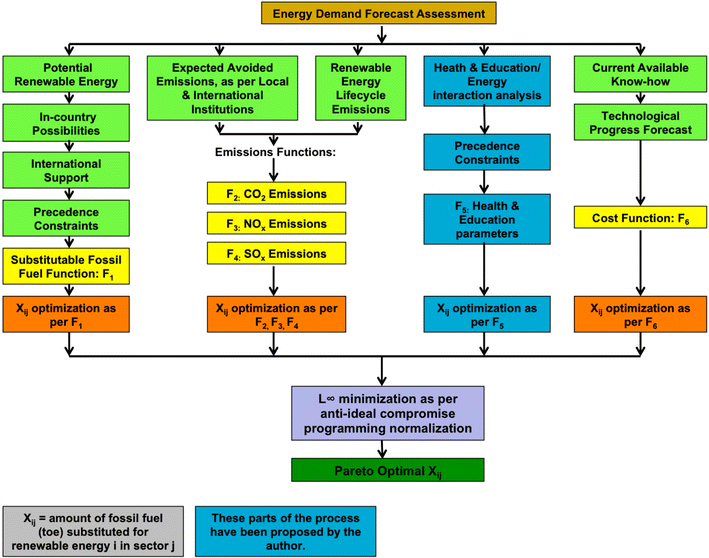
Figure
1
shows the steps that are proposed in this model, which has been specifically designed for low materially developed countries. The first stage is to carry out a thorough evaluation of the current energy demand, and subsequent future needs. Secondly, the possible renewable solutions will be assessed, taking into account the in-country possibilities, along with the international support, aiming to enunciate the first function, using the precedence constraints.
1
The third step will be to study the potentially avoidable emissions so that the corresponding three functions may be stated (
F2
,
F3
,
F4
). Then the fifth function will come from a deep study of the possible interactions between health and education and renewable energy, according to the parameters described by the UN and other international organizations. The last phase is to enunciate the cost function (
F6
).
Fig. 1
SRIME energy model. Own construction
The
Lk
distances will then be minimized, according to the chosen weights, so that a compromised solution may be selected among the several obtained by the preferred optimization tool.
2
Functions
Maximization of RE potential capacity: F1
The so-called green economy focuses on the various advantages our world shall enjoy if we were to go green [
8
–
11
]. Not only climate change is involved here but also the potential enhancement of the overall development factors, especially the health co-benefits. You may find the corresponding equation and Table
1
below, which includes a summary of the potential precedence constraints the authors have chosen to be applied [
12
–
14
].
3
Current technological level to apply the alternative energy
Supply availability
F1x11,x12,…,xij,…,xnm=A11x11+A12x12+⋯+Anmxnm
Environmental impact minimization: F2, F3,F4
Environmental impact has ben a major concern in the world for the past ten years. Local researchers are indeed looking into potential present and future sustainable possibilities [
15
,
16
].
These are the three corresponding functions:
F2x11,x12,…,xij,…,xnm=B11x11+B12x12+⋯+BnmxnmF3x11,x12,…,xij,…,xnm=C11x11+C12x12+⋯+CnmxnmF4x11,x12,…,xij,…,xnm=D11x11+D12x12+⋯+Dnmxnm
Bij
/
Cij
/
Dij
: life cycle CO
2
/NO
x
/SO
2
avoided emissions (ton/energy unit)
For all
Bij
≥ 0;
Cij
≥ 0;
Dij
≥ 0 ⇒ max
F2
;
F3
;
F4
⇒ optimal avoided emissions maximization
Coefficients
Bij
,
Cij
,
Dij
are obtained from official statistics and specialized publications.
Maximization of the most rural development friendly types of RE, aiming to improve health and education
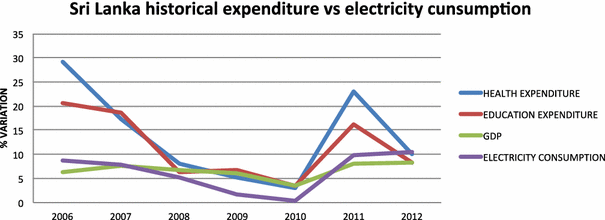
One of the most usual indicators to estimate energy demand is the GDP growth rate. LEC and LRY commonly enjoy a high degree of causality. However, while HMDP show a bidirectional causality, LMDP only dictate a uni-directional causality from LRY to LEC [
17
]. As you can see below in Fig.
2
, this is confirmed by the SL official data.
Fig. 2
SL expenditure vs energy consumption. Prepared by the authors based on official data [
18
–
23
]
This is the corresponding equation:
F5x11,x12,…,xij,…,xnm=E11x11+E12x12+…+Enmxnm
Coefficients
Eij
are non-dimensional and obtained through precedence constraints, where no energy or cost quantification is involved. These precedence constraints are based on:
Identified health and education ad-hoc applications.
Low overnight capital cost/unnecessary donor support for health and education enhancing applications.
Low maintenance cost.
Unnecessary maintenance contract.
Long lasting systems for health and education purposes.
Short distance from health and education centres to energy source.
Safe from being stolen in rural environment.
Low rural environmental impact.
Predictability.
Batteries not required for health and education purposes.
Alternating current.
Possible modularity/size accommodation for schools and hospitals.
Added benefits for rural development.
In-country development: manufacturing, training, etc.
Low LEC.
Hospitals and schools space efficiency for rural development.
Low or inexistent waste generation.
Cost minimization of substitution of renewable for existing conventional energy: F6
F6x11,x12,…,xij,…,xnm=G11x11+G12x12+⋯+GnmxnmGij=initial investment or production cost/energy unitGij≥0or0≤Gij.
This function can also consider the renewable energy subsidies, therefore affecting the
C
coefficients. Another possibility can be to modify the coefficients, aiming to reach the best possible subsidy for every RE.
As per coefficients
Bij
,
Cij
and
Dij
, coefficients
Gij
are also obtained from official sources.
Restrictions
The restrictions to be applied are described below in Table
2
, having in mind the following [
1
,
3
,
12
and own construction]:
Table 2
Restrictions
Non-electric energy use
Electric energy use
RE potential production
Current RE systemsa
∑j=1nXij≤Sj (7)
∑i=1lXie≤Se (8)
Xie+∑j=1mXij≤Pi (9)
Xie+∑j=1mXij≤Ri (10)
Sj
:
Energy demand of application
j
, calculated as:
Sj
=
pj
−
ij
; where
pj
is the energy demand corresponding to sector
j
and
ij
is the amount of fossil fuel renewable sources can not replace.
Se
:
Energy demand of application
i
, calculated as:
Se
=
pe
−
ie
; where
pe
is the energy demand corresponding to sector
e
and
ie.
is the amount of fossil fuel renewable sources can not replace.
Pi
:
Potential application of renewable source
i
in the corresponding sector.
Ri
:
Minimum amount of conventional energy renewable sources can replace, as RE has already replaced this amount.
Compromise programming
As indicated by Linares et al. [
24
–
26
], to obtain the set of compromised solutions, both the normalized Manhattan distance,
L1
or the Chebyshev distance,
L∞
, may be minimized [
27
,
28
]. Nonetheless,
Lk
will also help us obtain the optimal solution. Equation (11) below shows the general definition for
Ld
. Equations (12), (13) and (14) show the normalization to be carried out and Table
3
the distances that must be minimized.
Taking into account that
Wi
is the weight or preference assigned by the decision makers, the distances to be minimized may be found below in Table
4
.
Table 4
Restrictions summary
Distance
d = 1: Manhattan distance, L1
d = 2: Euclidean distance, L2
d = ∞: Chebyshev distance, L∞
Restrictions
∑j=1nXij≤Sj (15)
∑j=1nXij≤Sj (15)
∑j=1nXij≤Sj (15)
∑i=1lXie≤Se (16)
∑i=1lXie≤Se (16)
∑i=1lXie≤Se (16)
Xie+∑j=1mXij≤Pi (17)
Xie+∑j=1mXij≤Pi (17)
Xie+∑j=1mXij≤Pi (17)
Xie+∑j=1mXij≤Ri (18)
Xie+∑j=1mXij≤Ri (18)
Xie+∑j=1mXij≤Ri (18)
W1F1∗+-F1(x)F1∗+-F∗1≤D (19)
W1F1∗+-F1(x)F1∗+-F∗1≤D (19)
W2F2∗+-F2(x)F2∗+-F∗2≤D (20)
W2F2∗+-F2(x)F2∗+-F∗2≤D (20)
W3F3∗+-F3(x)F3∗+-F∗3≤D (21)
W3F3∗+-F3(x)F3∗+-F∗3≤D (21)
Case study: Sri Lanka
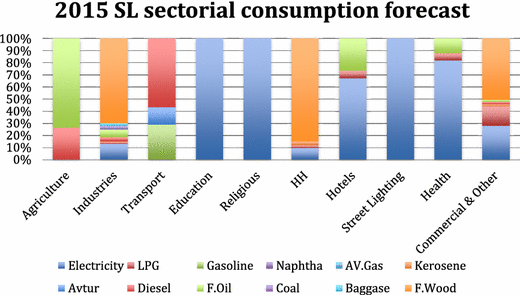
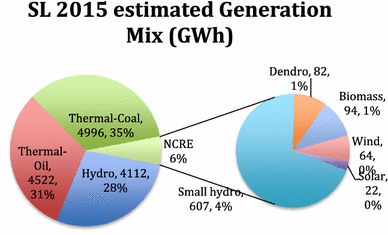
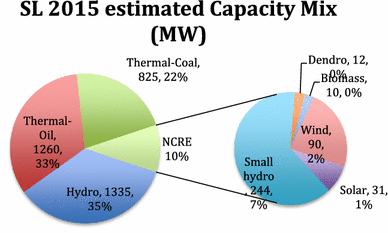
The authors have prepared a sectorial energy consumption forecast for 2015 (see Table
5
; Fig.
3
) and the estimated generation and capacity mix (see Figs.
4
,
5
). The global electricity data has been obtained from the Long Term Generation Expansion Plan 2013–2032, prepared by the Ceylon Electricity Board, and the rest of he energy consumption and the electricity sectorial data has been estimated by the authors based, on official and private documentation [
29
–
50
].
SL is very much dependent on petroleum, which currently accounts for approximately 24 % of SL import bill and 45 % of exports. The demand has been doubled, in value terms, during the last 3 years [
52
]. The geo-climatic settings are particularly conducive, though, to harnessing hydro resources. The climate is largely determined by the meteorological conditions caused in the Indian sub continent due to the tropical circulation [
53
]. The current hydro power stations are operated to meet both peak and base electricity generation requirements. A 400 MW potential has been identified for small hydropower projects [
54
], typically characterised with less than 10 MW capacities [
53
]. 128 projects, totalling 271 MW, have been already commissioned as of 31/12/2014 [
55
]. Once these projects are available for power generation, will be carefully followed-up by PUCSL [
56
]. In terms of wind power, GOSL would like to go from the current 5 % to reach 10 % by 2017 and 14.1 % by 2022 [
56
]. There are close to 500 km
2
of windy areas with good-to-excellent wind resource potential. However, only a portion of this is deemed feasible to be harnessed because of technical and system limitations [
57
]. As of 31/12/2013, there are 10 commissioned projects, which will add 78.45 MW capacity to the grid [
55
] and also some possible future WPPs [
58
–
61
]. The wind potential has been estimated as 20,000 MW. In terms of biomass, Gliricidia sepium has been recently appointed as the fourth plantation crop after tea, rubber and coconut. Biomass application in electricity generation is not yet widespread, but it is gaining momentum [
54
]. As of 31/12/2014, 2 Agricultural and Industrial Waste Power projects have been commissioned (11 MW); and another 2 Dendro Power (5.5 MW) [
55
]. A 1000 MW of Dendro thermal potential has been estimated [
59
]. Biofuels are also planned to be developed to claim a 20 per cent share by 2020 [
58
,
62
]. Although the village biogas power is at an early stage, as it has not been an easy task to introduce it [
63
,
64
], there are indeed a number of projects going on. This NCRE seems to be following the increasing tendency currently shown in South Asia [
59
]. A 300 MW MSW biogas generation potential has been identified [
65
].
As showed on Table
6
above, the use of SHSs has been spreading fast in the rural areas of Sri Lanka, mainly because of the financial incentives provided by the donor agencies, and also due to the aggressive marketing strategies of the SHS dealers in rural areas [
66
,
67
]. As of 31/12/2013, 4 solar projects have been commissioned, totalling 1,4 MW. As of 31/12/2012, the installed PV capacity was 10.10 MWp [
68
]. Concerning geothermal energy resources, SL is still at a preliminary stage, although a 700–1300 MWe potential has been recently estimated. As a first step in the development, a USD 10 M investment would cover a site selection study, surface exploration at the most promising site followed by deep drilling, and commissioning of a 2 MW binary power plant if the wells are successful [
69
]. Regarding off-grid schemes, a pilot project was recently conducted to connect two village micro hydro power plants (10 and 20 kW) to the national grid. This pilot project has become instrumental in removing the technical, social, and legal barriers for grid interconnection. It is necessary, though, to review these fees structure and try to reduce them, taking into account the capacity of the project [
70
] and the potential funding [
71
–
73
]. The overall target for NCRE is to reach 10 % by 2016 and 20 % by 2020 [
63
]. Some authors are praising SLs NCRE implementation [
64
], while others believe that lack of financing instruments, along with high initial cost and lack of assurance of resource supply or availability are the main barriers for renewable technologies expansion in SL [
65
,
66
]. Reaching the above mentioned targets is not just an environmental matter, but are related in one way or another to at least five other MDG [
67
,
74
]:
Table 6
2012 status of Sri Lanka off-grid energy technologies
Technology
Number of units installed
Capacity of a unit (KW)
Estimated total capacity (MW)
Number of households electrified
Number of units still in use (estimated)
Solar home systems (PV)
120,000
0.03–0.06
3.6
120,000
100,000
Village micro hydro power
300
3–50
4.5
10,500
80
Village dendro power
11
10–30
0.1
100
–
Wind home systems
30
0.25–3.0
0.007
30
–
Village biogas power
10
0.3–2.0
0.006
30
2
Pico hydro power
40
0.3–1.5
0.012
40
40
Total
8.2
130,700
Eradicate extreme poverty and hunger.
Achieve universal primary education.
Gender equality and empowering women.
Reduce child mortality.
Improve maternal health.
Taking into account all of the above, the authors have estimated that the following energy is considered to be substitutable in 2015 (see below Table
7
).
Table 7
Substitutable energy in 2015 (ktoe)
Electricity
LPG
Gasoline
Naphta
Avgas
Kerosene
Avtur
Diesel
Foil
Coal
Bagasse
Fwood
Agriculture
0.5
1.3
Industries
74.5
12.8
27.1
Transport
147.3
288.6
0.4
Education
0.8
Religious
1.3
HH
85.7
Hotels
4.2
1.2
Street light
2.9
Health
3.1
0.4
Commercial
47.2
2.2
2.1
The authors have defined the following variables:
BT
I
: biomass thermal, industrial.
BT
H
: biomass thermal, household.
BT
HE
: biomass thermal, health.
BT
C
: biomass thermal, commercial.
LBF
A
: liquid biofuel, agriculture.
LBF
T
: liquid biofuel, transport.
SH: small hydro.
WPP: wind power plant.
BEG: biomass for electricity generation.
PV: photovoltaic electricity generation.
MSW: municipal solid waste.
The restrictions for this case study have been established by the authors as per below:
A: Based on energy demand and RE real potential (in ktoe):
Current technological level to apply the alternative energy
2
3
2
2
4
Operating time
3
5
2
3
3
4
2
Implementation issues
3
5
2
3
3
5
3
Integration possibility
5
5
5
5
5
5
5
Potential demand
2
2
2
4
4
5
4
Supply availability
3
3
2
4
4
4
4
Political interest
2
2
2
3
3
5
4
Current price compared with conventional energies
1
2
2
1
2
5
3
Social demand
1
2
1
2
2
5
2
Legislative forecast
3
3
3
3
3
3
3
Environmental impact
5
3
5
5
5
5
5
The following values are then calculated (see Table
9
below):
Table 9
Calculation of
N
and
M
factors
Alternative
M
N
Coefficient
SH
216
3.4 × 10⁹
2.5
WPP
82,944
108
2.5
PV
186,624
9 × 10⁷
2
BT
248,832
2.4 × 10⁷
2
MSW
466,560
2.3 × 10⁷
2
BEG
3.1 × 10⁶
1.9 × 10⁶
1.5
LBF
8,847,360
864,000
1
Mij=Πi=1naijNij=Πi=1n6-aij
Once the coefficients are applied, this is the final equation for
F1
:
F1
= 2.5 SH + 2.5 WPP + 2 PV + 2 BT
I
+ 2 BT
H
+ 2 BT
HE
+ 2 BT
C
+ 2 MSW + 1.5 BEG + LBF
A
+ LBF
T
Environmental impact minimization
CEB expected generation system for 2015 [
20
] has been taken into account (see below Table
10
) to establish the potentially avoided emissions. According to the different types of fuel and their corresponding GWh in 2015, a 9.9 tCO
2
/toe weighted average will be considered as the amount of avoided emission as well as 0.028 tNO
x
/toe and 0.041 tSO
2
/toe [
20
,
104
–
114
].
Table 10
Generation forecast data from the Long Term Generation Expansion Plan 2013–2032, prepared by the CEB [
20
]
Capacity balance (MW)
Energy balance (GWh)
2013
2014
2015
2013
2014
2015
Plant name
Hydro
Existing major hydro
1335
1335
1335
4112
4112
4112
New major hydro
0
0
0
0
0
0
Mini hydro
219
232
244
–
–
–
Sub total
1554
1567
1579
4112
4112
4112
NCRE-wind
90
90
90
–
–
–
NCRE-solar
1.3
21
31
–
–
–
Total NCRE
613
658
692
Thermal existing and committed
Small gas turbines
85
85
85
16
6
4
Diesel Sapugaskanda
72
72
72
459
431
456
Diesel ext. Sapugaskanda
72
72
72
491
485
487
Gas turbine no 7
115
115
115
290
250
286
Lakdhanavi
0
0
0
0
0
0
Asia power
49
49
49
334
309
332
KPS combined cycle
165
165
165
550
454
549
AES combined cycle
163
163
163
491
362
474
Colombo power
60
60
0
419
417
0
ACE power Horona
0
0
0
0
0
0
Ace power Matara
0
0
0
0
0
0
Heladhanavi
100
100
0
696
696
0
ACE power Embilipitiya
100
100
0
692
672
0
Biomass (Dendro)
10
10
10
94
94
94
Kerawalapitiya
270
270
270
1325
935
1138
Puttalam coal
275
550
825
1665
3241
4996
Northern power
0
20
20
0
131
137
Chunnakkam power extension
0
24
24
0
183
183
Sub total
1535
1854
1870
7523
8668
9135
New thermal plants
Coal
0
0
0
0
0
0
Gas turbine 75 MW
0
0
225
0
0
477
Gas turbine 105 MW
0
0
0
0
0
0
Coal trinco
0
0
0
0
0
0
Biomass (Dendro)
4
8
12
27
54
82
Sub total
4
8
237
27
54
559
Total installed capacity
3184
3540
3807
–
–
–
Installed capacity without NCREa
2874
3197
3442
–
–
–
Peak demand
2451
2692
2894
–
–
–
Difference without NCREa
423
505
548
–
–
–
Difference (%)
17.3
18.8
18.9
–
–
–
Total generation
–
–
–
12,275
13,493
14,499
System demand
–
–
–
12,296
13,508
14,513
Unserved energy
21
15
14
You can find below Table
11
, which includes a summary of the life cycle emissions corresponding to the different types of renewable energy, based on the below mentioned references.
Table 11
RE life cycle CO
2
emissions; tCO
2
/toe, tNO
x
/toe, tSO
2
/toe [
109
,
112
–
121
]
Life cycle emission
SH
WPP
PV
BT
MSW
BEG
CO2
0.12
0.12
0.46
0.63
1
0.52
NOX
0.00006
0.0004
0.0017
0.0083
0.00009
0.0083
SO2
0.00003
0.0005
0.003
0.00042
0.000015
0.00042
In terms of LBF, 90 % of the CO
2
emissions are considered to be potentially avoided [
122
–
124
] that is, approximately 2.7 tCO
2
/toe. When biofuel replaces gasoline and diesel in the transport sector, SO
2
emissions are reduced, but changes in NOx emissions depend on the substitution pattern and technology. The effects of replacing gasoline with ethanol and biodiesel also depend on engine features. Biodiesel can have higher NOx emissions than petroleum diesel in traditional direct-injected diesel engines that are not equipped with NOx control catalysts [
125
]. This is why no NOx avoided emissions have been taken into account. A 50 % average SO
2
emissions reduction is however considered, as the avoided emissions will depend very much on the blend.
Please find below de corresponding functions:
F2
= 9.78 SH + 9.78 WPP + 9.44 PV + 9.27 BT
I
+ 9.27 BT
H
+ 9.27 BT
HE
+ 9.27 BT
C
+ 8.9 MSW + 9.38 BEG + 2.7 LBF
A
+ 2.7 LBF
T
F3
= 0.028 SH + 0.028 WPP + 0.026 PV + 0.02 BT
I
+ 0.02 BT
H
+ 0.02 BT
HE
+ 0.02 BT
C
+ 0.028 MSW + 0.02 BEG
F4
= 0.04126 SH + 0.0407 WPP + 0.038 PV + 0.041 BT
I
+ 0.041 BT
H
+ 0.041 BT
HE
+ 0.041 BT
C
+ 0.04128 MSW + 0.041 BEG + 0.0058 LBF
A
+ 0.0058 LBF
T
F5: Cost minimization of substitution of RE for existing conventional energy
Based on the typical capital cost ranges for RE power generation technologies, USD/kW [
49
,
137
–
139
], the overnight capital cost is calculated (USD/toe) so that the appropriate coefficients can be applied:
F5
= 0.08 SH + 0.32 WPP + 0.3 PV + 0.18 BT
I
+ 0.14 BT
H
+ 0.18 BT
HE
+ 0.14 BT
C
+ 0.48 MSW + 0.55 BEG + 0.94 LBF
A
+ 0.94 LBF
T
It must be noted that a CHP use has been assumed for MSW biogas plants and LBF production.
F6: Maximization of the most rural development friendly types of RE, aiming to improve health and education
See below Table
12
, where the precedence constraints have been evaluated by the authors as per the below mentioned subjects, based on the indicated references.
Low overnight capital cost/unnecessary donor support
2
3
5
1
1
1
Low maintenance cost
4
5
4
5
1
1
Unnecessary maintenance contract
4
1
5
4
1
1
Long lasting systems
5
4
4
4
4
5
Short distance from energy source
4
5
5
5
2
1
Safe from being stolen in rural environment
4
4
3
1
5
5
Low rural environmental impact
3
5
2
5
2
2
Predictability
4
2
4
2
4
5
Batteries not required
2.5
1
2.5
1
2.5
2.5
AC
2.5
2.5
2.5
1
2.5
2.5
Possible rural modularity
1
2.5
1
2.5
1
1
Added benefits for rural development
1
1
1
1
1
2.5
In-country development
5
3
3
1
5
5
Low LEC
4
4
3
1
1
1
Space efficiency for rural Environment
1
4
1
3
1
1
Low waste generation
2.5 s
2.5
1
2.5
2.5
1
M and N are then calculated as per Eqs. (
23
) and (
24
) (see Table
13
below):
Table 13
Calculation of
N
and
M
factors
Alternative
M
N
Coefficient
P and SH
4.1 × 10⁶
4.8 × 10⁷
2.5
SW
6.2 × 10⁶
3.6 × 10⁷
2.5
B
6.6 × 10⁶
1.35 × 10⁷
2
PV
4.6 × 10⁷
4 × 10⁵
2
LBF
2 × 10⁸
105
1.5
MSW
3.3 × 10⁸
19,531
1
Once the coefficients are applied, this is the final equation for F
6
:
F6
= 2.5 SH + 2.5 WPP + 2 PV + 2 BT
I
+ 2 BT
H
+ 2 BT
HE
+ 2 BT
C
+ MSW + 2 BEG + 1.5 LBF
A
+ 1.5 LBF
T
Results and discussion
Please find below Table
14
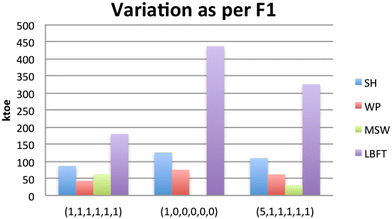
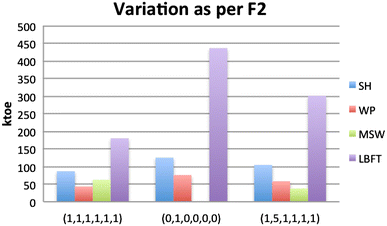
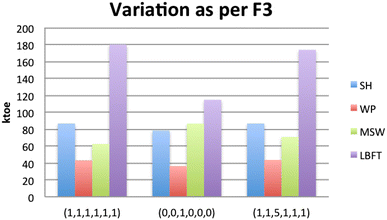
and Figs.
6
,
7
,
8
,
9
,
10
and
11
, which include the results obtained (in ktoe), using the Chebyshev distance, L∞, following the Anti-Ideal Compromise Programming as previously defined in chapter 2.3; taking into account the below mentioned weights.
Table 14
Optimization results using Matlab
®
programming tools
Weights
SH
WP
PV
BTI
BTH
BTHE
BTC
MSW
BEG
LBFA
LBFT
1,1,1,1,1,1a
86.7
43.2
3.6
2146.4
1.1
0.4
431.8
62.3
15.1
1
180.1
1,0,0,0,0,0
125.9
75.2
3.6
2148.9
1.2
0.4
432.1
0
15.1
1.8
436.3
5,1,1,1,1,1
109.1
61.7
3.6
2148.9
1.2
0.4
432.1
30.2
15.1
1.5
325.1
0,1,0,0,0,0
125.2
75.9
3.6
2148.9
1.2
0.4
432.1
0
15.1
1.8
436.3
1,5,1,1,1,1
104.4
58.1
3.6
2148.7
1.2
0.4
432.1
37.8
15.1
1.4
300.8
0,0,1,0,0,0
78.3
36.3
3.6
2148.9
1.2
0.4
432.1
86.5
15.1
0.9
114.7
1,1,5,1,1,1
86.7
43.5
3.6
2148.8
1.2
0.4
432.1
70.7
15.1
1.1
173.7
0,0,0,1,0,0
47.3
86
3.6
2148.9
1.2
0.4
432.1
14.5
15.1
1.8
436.3
1,1,1,5,1,1
95.5
50.7
3.6
2148.8
1.2
0.4
432.1
54.4
15.1
1.3
247.1
0,0,0,0,1,0
47.3
8.6
3.6
2109
0
0
427.8
0
15.1
0
0
1,1,1,1,5,1
61.2
20.8
3.6
2121.1
0.4
0.1
429.1
18
15.1
0.4
66.7
0,0,0,0,0,1
125
76.1
3.6
2148.9
1.2
0.4
432.1
0
15.1
1.8
436.3
1,1,1,1,1,5
112.6
64.6
3.6
2148.8
1.2
0.4
432.1
23.5
15.1
1.6
348.3
1,5,5,5,1,1
104.3
58.2
3.6
2148.9
1.2
0.4
432.1
38.4
15.1
1.4
299.1
5,1,1,1,1,5
112.6
64.4
3.6
2148.8
1.2
0.4
432.1
23.6
15.1
1.6
349.7
Fig. 6
SH, WP, MSW and LBF
T
variation as per the weights assigned to function 1. Source: own construction
Fig. 7
SH, WP, MSW and LBF
T
variation as per the weights assigned to function 2. Source: own construction
Fig. 8
SH, WP, MSW and LBF
T
variation as per the weights assigned to function 3. Source: own construction
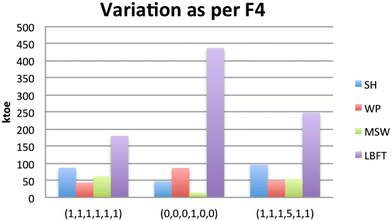
Fig. 9
SH, WP, MSW and LBF
T
variation as per the weights assigned to function 4. Source: own construction
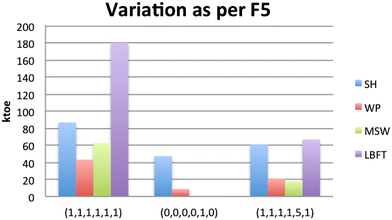
Fig. 10
SH, WP, MSW and LBF
T
variation as per the weights assigned to function 5. Source: own construction
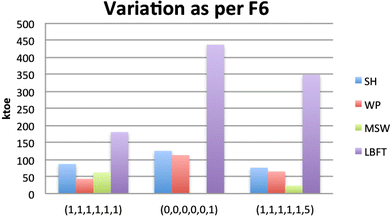
Fig. 11
SH, WP, MSW and LBF
T
Variation as per the weights assigned to function 6. Source: own construction
The authors have aimed to compare the solution obtained given no special weight to any of the functions: (1,1,1,1,1,1); with the obtained values when only one of the functions is taken into account: for example (1,0,0,0,0,0); and finally with the outcome solution when a special weight has been given to a particular function: for example (5,1,1,1,1,1). This way, the different solutions will clearly show the tendency the variables follow, when a particular function is given more importance than the others. The authors have added two more cases to this list, one giving special importance to the three emissions functions (
F2
,
F3
,
F4
), and another one targeting the maximum renewable energy substitution and rural health and education development (
F1
and
F6
).
The nominal weights (1,1,1,1,1,1) are considered as the baseline. Once this baseline is obtained, then the other cases will be taken into account to give some special relative importance to any of the six functions or even to address some different weights to be applied if necessary [
15
,
16
,
23
,
24
]. The results show that PV and BEG stay at their minimum potential value independently of the chosen weights, while the four biomass variables (BT
I
, BT
H
, BT
HE
and BT
C
) reach approximately their maximum potential value, except for the two cases where the economic factor is given a certain weight versus the other functions. This exception is totally expected, as function
F5
will always look for the cheapest solution, i.e., the one implementing less renewable energy substitution. The rest of the variables, SH, WP, MSW LBF
A
and LBFT do vary, depending on the chosen weights. The first three variables are linked together as per Eq. (
22
). This means that any variation in one of them, will therefore affect the other. As can be seen in Figs.
6
,
7
,
8
,
9
,
10
and
11
above, when only one function is optimized, a maximum polarized value is obtained for the different variables. Once all six functions are taking into account, even if a weight 5 is applied to a particular one, the difference from the nominal results [the ones obtained as per (1,1,1,1,1,1)] is less acute, flattening this way the value given to the different variables.
If the individual optimizations [for example: (1,0,0,0,0,0)] are not considered, and the last two cases or also not taken into account, the maximization of the above mentioned variables may be summarized as per Table
15
below.
The authors have summarized below in Table
16
the advantages of applying this energy planning model to Sri Lanka, and also the potential improvements in Table
17
.
Table 16
Advantages of SRIME application in Sri Lanka
SRIME singularity
Advantage for Sri Lanka
Multi-objective (6 equations)
Avoiding this way, single-objective financial perspective, which gradually would make SL poorer and more dependent on oil import
Takes into account CO2 and also NOx and SO2
Automobiles are very contaminant in SL, NOx is therefore of great importance
Maximizing RE
SL has proofed to be a fast RE growing country, improving industry in general
Health and Education equation
Very innovative precedence constraints application, aiming to set a sustainable growth through energy universal access
Possibility of applying weights
This way planners may choose which either if all objectives may have the same weight or there is a particular equation that must be given a certain priority
Pareto optimal solution
Assuring the chosen solution is not ‘dominated’ by any of the equations
Table 17
Potential Improvements for SRIME application in Sri Lanka
Potential Improvement
Advantage
Introduction of hybrid systems
Very efficient for remote rural materially underdeveloped areas, with highly flexible configurations, and currently undergoing a high level of implementation
Equations weights to be decided by an international team of specialists (energy planners, maintenance specialists, policy makers and politicians) including, of course, people from Sri Lanka
One of the most important processes of the SRIME is the weights assignation. Although these groups may have different points of view, and sometimes even opposite objectives: consensus is a must
Conclusions
This paper shows the possibility of using MCDM methods, focusing on a sustainable and renewable energy approach. The resulting energy models give a great level of importance to the human environmental development factors, avoiding, therefore, the purely economic reasoning. These type of models are becoming a common way of choosing global energy plans [
139
] or some independent power plants, such as wind farms [
140
]. This work has aimed at establishing a potential energy model implementation methodology that may be applicable for developing countries. The Case Study shows that if SRIME was implemented in Sri Lanka, SH, WP, MSW and LBF
T
would be specially benefited from the Pareto optimization, while PV and BEG would stay at their official future expected value [
20
], having no growth at all. The SRIME model could be relatively easily interpolated to other Asian tropical countries, due to the similar circumstances in terms of health an education low overall parameters, high biomass consumption, monsoon special weather characteristics, low GDP and extremely high petroleum imports dependency.
Acknowledgments
The authors would like to gratefully acknowledge the support received from Carlos Molina-Dafauce. The authors would also like to thank professors Carlos Romero, Pedro Linares, Cristina Pascual, José L. Hernanz, Inés Izquierdo, and investigator Eder Falcón.
Conflicts of interest
The authors declare no conflict of interest
References
Marcos (1985) (pp. 97-104) Julio Agosto
Unknown ()
Unknown ()
Williamsona et al. (2014) Low head pico hydro turbine selection using a multi-criteria analysis (pp. 43-50) 10.1016/j.renene.2012.06.020
Gong et al. (2011) Multiple objective compromised method for power management in virtual power plants 4(4) (pp. 700-716) 10.3390/en4040700
Maheri (2014) Multi-objective design optimisation of standalone hybrid wind-PV-diesel systems under uncertainties (pp. 650-661) 10.1016/j.renene.2014.01.009
Tomoiaga et al. (2013) Pareto optimal reconfiguration of power distribution systems using a genetic algorithm based on NSGA-II 6(3) (pp. 1439-1455) 10.3390/en6031439
Unknown ()
Unknown ()
Unknown ()
Unknown ()
Unknown ()
Unknown ()
Unknown ()
Wijayatunga et al. (2003) Greenhouse gas emission mitigation in the Sri Lanka power sector supply side and demand side options (pp. 3247-3265) 10.1016/S0196-8904(03)00100-6
Wijayatunga and Prasad (2009) Clean energy technology and regulatory interventions for Greenhouse Gas emission mitigation: Sri Lankan power sector (pp. 1595-1603) 10.1016/j.enconman.2009.02.005
Lee and Chang (2007) Energy consumption and GDP revisited: a panel analysis of developed and developing countries (pp. 1206-1223) 10.1016/j.eneco.2007.01.001
Unknown ()
Unknown ()
Unknown ()
Unknown ()
Unknown ()
Mumtaz et al. (2014) Modeling the causal relationship between energy and growth factors: journey towards sustainable development 63(2014) (pp. 353-365) 10.1016/j.renene.2013.09.033
Unknown ()
Unknown ()
Unknown ()
Unknown ()
Romero (1993) Alianza Universidad Textos
Unknown ()
Unknown ()
Unknown ()
Unknown ()
Unknown ()
Unknown ()
Unknown ()
Unknown ()
Unknown ()
Unknown ()
Unknown ()
Unknown ()
Unknown ()
Unknown ()
Unknown ()
Unknown ()
Unknown ()
Lee and Chang (2007) Energy consumption and GDP revisited: a panel analysis of developed and developing countries (pp. 1206-1223) 10.1016/j.eneco.2007.01.001
Unknown ()
Unknown ()
Unknown ()
Apergis and Payne (2012) Renewable and non-renewable energy consumption-growth nexus: evidence from a panel error correction model (pp. 733-738) 10.1016/j.eneco.2011.04.007
Unknown ()
Unknown ()
Unknown ()
Unknown ()
Unknown ()
Unknown ()
Unknown ()
Unknown ()
Unknown ()
Perera et al. (2003) Sustainable biomass production for energy in Sri Lanka (pp. 541-556) 10.1016/S0961-9534(03)00090-4
Unknown ()
Unknown ()
Unknown ()
Bhattacharyya (2012) Energy access programmes and sustainable development: a critical review and analysis (pp. 260-271) 10.1016/j.esd.2012.05.002
Unknown ()
Unknown ()
McEachern and Hanson (2008) Socio-geographic perception in the diffusion of innovation: solar energy technology in Sri Lanka (pp. 2578-2590) 10.1016/j.enpol.2008.03.020
Unknown ()
Unknown ()
Unknown ()
Miller and Hope (2006) Learning to lend for off-grid solar power: policy lessons from World Bank loans to India, Indonesia, and Sri Lanka (pp. 1179-1191) 10.1016/j.enconman.2005.07.003
Palit and Chaurey (2011) Off-grid rural electrification experiences from South Asia: Status and best practices (pp. 266-276) 10.1016/j.esd.2011.07.004
Subhes and Bhattacharyya (2013) Financing energy access and off-grid electrification: A review of status, options and challenges (pp. 462-472) 10.1016/j.rser.2012.12.008
Unknown ()
Unknown ()
Unknown ()
Morimoto and Hope (2004) The impact of electricity supply on economic growth in Sri Lanka (pp. 77-85) 10.1016/S0140-9883(03)00034-3
Priyantha (2004) Wijayatunga, Jayalath MS. Assessment of economic impact of electricity supply interruptions in the Sri Lanka industrial sector (pp. 235-247) 10.1016/S0196-8904(03)00132-8
Unknown ()
Unknown ()
Moretti et al. (2013) Development of innovative heating and cooling systems using renewable energy sources for non-residential buildings 6(10) (pp. 5114-5129) 10.3390/en6105114
Gallo et al. (2013) Optimization of experimental model parameter identification for energy storage systems 6(9) (pp. 4572-4590) 10.3390/en6094572
Gómez-Gil et al. (2012) Analysis and prediction of energy production in concentrating photovoltaic (CPV) installations 5(3) (pp. 770-789) 10.3390/en5030770
Wu et al. (2014) Energy and exergy analysis of high temperature agent gasification of biomass 7(4) (pp. 2107-2122) 10.3390/en7042107
Unknown ()
Unknown ()
Unknown ()
Unknown ()
Unknown ()
Unknown ()
Unknown ()
Unknown ()
Unknown ()
Unknown ()
Unknown ()
Unknown ()
Unknown ()
Unknown ()
Unknown ()
Unknown ()
Unknown ()
Unknown ()
Unknown ()
Unknown ()
Unknown ()
Unknown ()
Millo et al. (2014) Real world operation of a complex plug-in hybrid electric vehicle: analysis of its CO2 emissions and operating costs 7(7) (pp. 4554-4570) 10.3390/en7074554
Nuesch et al. (2014) Equivalent consumption minimization strategy for the control of real driving NOx emissions of a diesel hybrid electric vehicle 7(5) (pp. 3148-3178) 10.3390/en7053148
Priyantha et al. (2007) Economy wide emission impacts of carbon and energy tax in electricity supply industry: a case study on Sri Lanka (pp. 1975-1982) 10.1016/j.enconman.2007.01.030
Priyantha et al. (2006) Strategies to overcome barriers for cleaner generation technologies in small developing power systems: Sri Lanka case study (pp. 1179-1191) 10.1016/j.enconman.2005.07.003
Priyantha et al. (2004) Impact of distributed and independent power generation on greenhouse gas emissions: Sri Lanka (pp. 3193-3206) 10.1016/j.enconman.2004.01.009
Unknown ()
Unknown ()
Unknown ()
Unknown ()
Unknown ()
Unknown ()
Unknown ()
Houshfar et al. (2012) Experimental investigation on NOx reduction by primary measures in biomass combustion: straw, peat, sewage sludge. Forest residues wood pellets (pp. 270-290) 10.3390/en5020270
Moradian et al. (2013) Co-combustion of animal waste in a commercial waste-to-energy BFB boiler (pp. 6170-6187) 10.3390/en6126170
Tchapda and Pisupati (2014) A review of thermal co-conversion of coal and biomass/waste (pp. 1098-1148) 10.3390/en7031098
Unknown ()
Unknown ()
Unknown ()
Unknown ()
Unknown ()
Unknown ()
Unknown ()
Unknown ()
Unknown ()
Unknown ()
Bhattacharyya (2012) Energy access programmes and sustainable development: A critical review and analysis (pp. 260-271) 10.1016/j.esd.2012.05.002
Unknown ()
Unknown ()
Subhes and Bhattacharyya (2013) Financing energy access and off-grid electrification: a review of status, options and challenges (pp. 462-472) 10.1016/j.rser.2012.12.008
Unknown ()
Unknown ()
Unknown ()
Unknown ()
Kang et al. (2011) An integrated multi-criteria decision making model for evaluating wind farm performance 4(11) (pp. 2002-2026) 10.3390/en4112002