Department of Electrical Engineering, Jamia Millia Islamia, New Delhi, 110025, IN
School of Engineering and Technology, IGNOU, New Delhi, 110068, IN
Department of Electronics Engineering, Government Polytechnic Jansath, Muzaffarnagar, Uttar Pradesh, 251314, IN
Abstract
Over the most recent couple of decades, tremendous consideration is drawn towards photovoltaic–thermal systems because of their advantages over the solar thermal and PV applications. This paper intends to show different electrical and thermal aspects of photovoltaic–thermal systems and the researches in absorber design modification, development, and applications. From the previous review articles, it has been concluded that the heat energy exhausted from the PV module can be further utilized in different ways and helps in achieving better efficiency. Furthermore, the types of photovoltaic–thermal systems such as air collector, water collector, and combi system, coupling with heat pump and their application to buildings are also stated. This paper also discussed certain design aspects like modifications in the flow channel by adding fins, thin metallic sheets, roll-bond absorber, and porous media and the effect of these modifications on the hybrid system’s efficiency. Furthermore, the use of the latest technologies such as nanofluids, thermoelectric generators, and phase-change materials improves the overall system performance. The role of soft-computing techniques is forecasting the impact of various parameters on the photovoltaic–thermal system is also discussed.
Introduction
The industrial reformation in the eighteenth century has tremendously hiked energy demand globally. The developed countries around the globe shift their focus towards sustainable power sources, especially solar and wind, to meet the increasing energy demand [
1
]. Amongst all the available sustainable energy sources, the solar PV has the highest capital cost, but due to its lower operational cost and maintenance [
2
], this technology is acknowledged around the world. Other advantages of solar PV are increased efficiency and pollution-free energy [
3
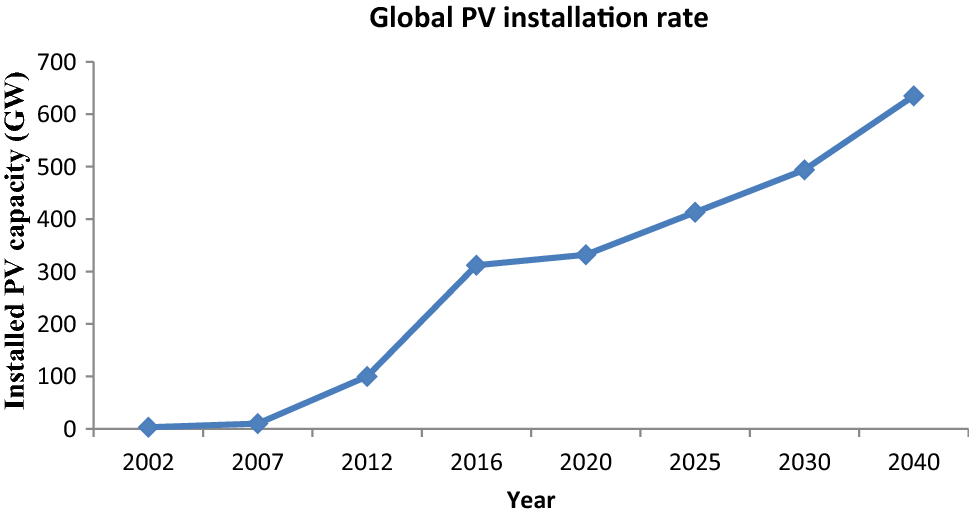
]. The installed capacity of solar PV is increasing day by day worldwide due to its above-mentioned point of interest as shown in Fig.
1
.
Banker and Pearce [
4
] discussed the development of PV technology over the last 2 decades. The PV technology gained popularity due to the decline in the price of a photovoltaic module. This reduction in cost is mainly due to competition among the manufacturers. Different governments in various parts of the world also show interest in emerging PV technology. Incentives had also been provided to consumers in many parts of the world. Liou [
5
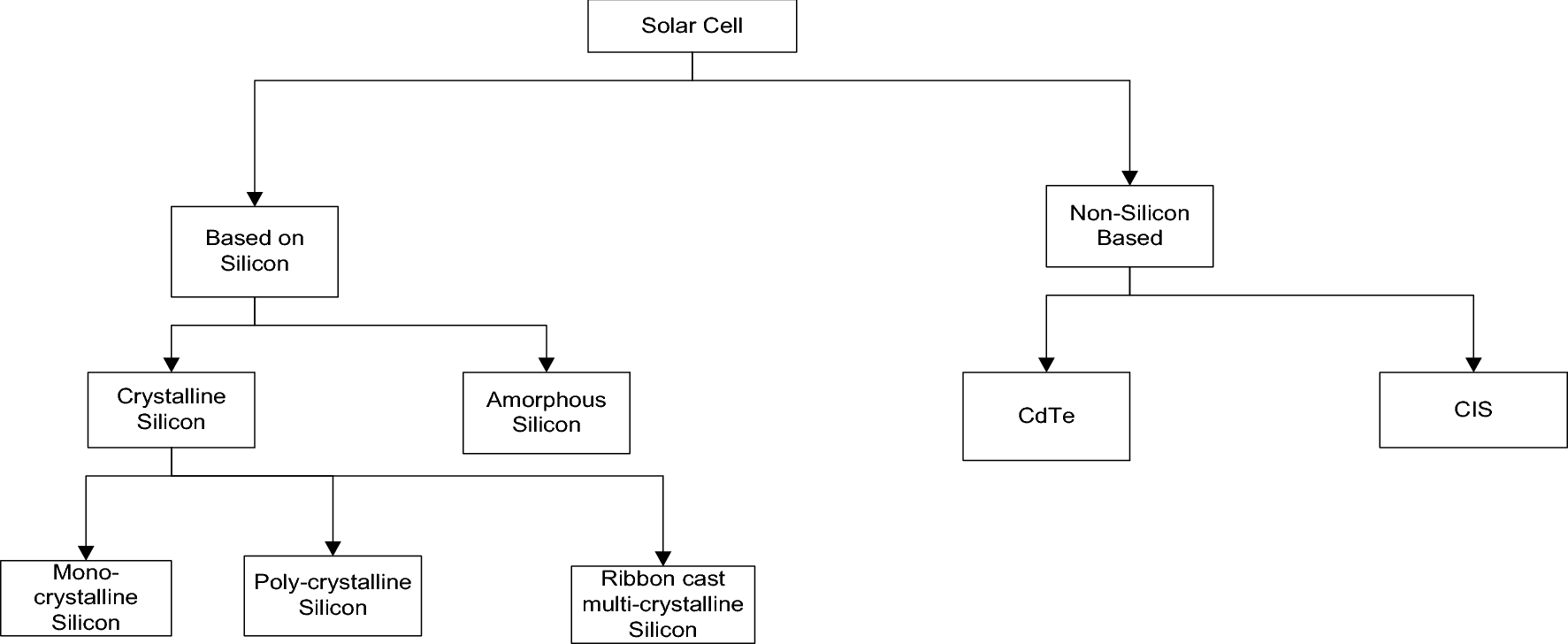
] discussed different silicon- and non-silicon-based technologies utilized for photovoltaic applications, as depicted in Fig.
2
. The crystalline silicon technology is widely accepted as compared to other solar cell technologies because of lower cost and higher performance. In the most recent research, the efficiency of multi-crystalline silicon technology up to 23% is mentioned in the literature [
6
]. Tiwari et al. [
7
] reviewed the latest PV generation technologies and their applications.
Debberma [
8
] reviewed the latest research in the area of PV generation and its applications in buildings. Apart from these traditional PV technologies, a few latest cell technologies are also discussed in the literature.
Gallium arsenide (GaAs): GaAs is a composite semiconductor formed by the combination of gallium and arsenide elements. The efficiency of GaAs can be increased by alloying it with other elements like aluminum, phosphorous, and antimony. This technology is not so popular because of its high fabrication cost [
8
].
Dye-sensitized solar cell (DSSc): This technology is discovered by Michael Gretel and Brian Oregano in the year 1991. DSSc is developed from the semiconductor formed by the combination of a photosensitized anode and an electrolyte. This latest technology gained attention due to its lower cost of fabrication, higher efficiency, and its ability to respond at low radiation levels. To enhance the power conversion efficiency (PCE) and stability for commercial applications, some dye-sensitized materials are also identified, such as porphyrin-based dyes and dyes containing polythiophene [
9
].
Perovskite solar cells (PSCs): PSCs are developed to achieve higher efficiency and low-cost solar cell. The fabrication of PSCs can be achieved using two different methods: (1) Mesoporous architecture and (2) thin-film architecture. Although the PSCs are prepared using simple chemical approach, it offers very high power conversion efficiency. The highest power conversion efficiency reported from the PSCs was 22.1% [
10
].
Organic solar cell: This latest technology is in trend because of its low cost and conversion efficiency of about 9%, but further enhancement in the efficiency is required if it is to be used for commercial applications. Its fabrication involves electron donor and acceptor materials instead of a semiconductor p–n junction [
8
].
The solar cell market mainly depends upon the crystalline silicon technology, but nowadays, amorphous or thin-film technology is widely accepted commercially for solar PV applications, because its efficiency does not vary much with the change in temperature, which happens with mono-crystalline and poly-crystalline silicon-based PV cells. However, it offers certain disadvantages such as shorter life and less efficiency as compared to crystalline silicon. However, the cost of generation of electricity by PV technology is much higher than the generation of heat energy. Therefore, generating thermal energy from the photovoltaic application creates much interest among the researchers. The current photovoltaic technology has the drawback of net absorbing radiation from the entire spectrum. Therefore, electrical efficiency (
ηele
) is low, since a major portion of incident sunlight is wasted as heat. The temperature of the cell increases because of this heat, which results in reduction of
ηele
of the solar PV system. Therefore, the removal of heat energy associated with the PV cell is important.
Photovoltaic–thermal (PV/T) is the combination of PV technology and solar thermal technology, which converts the incident radiation into electricity and heat simultaneously, gains popularity. By cooling the PV surface with the help of air/water as a flowing fluid,
ηele
of the system is significantly improved [
11
]:
ηele=η01-β0Tc-T0.
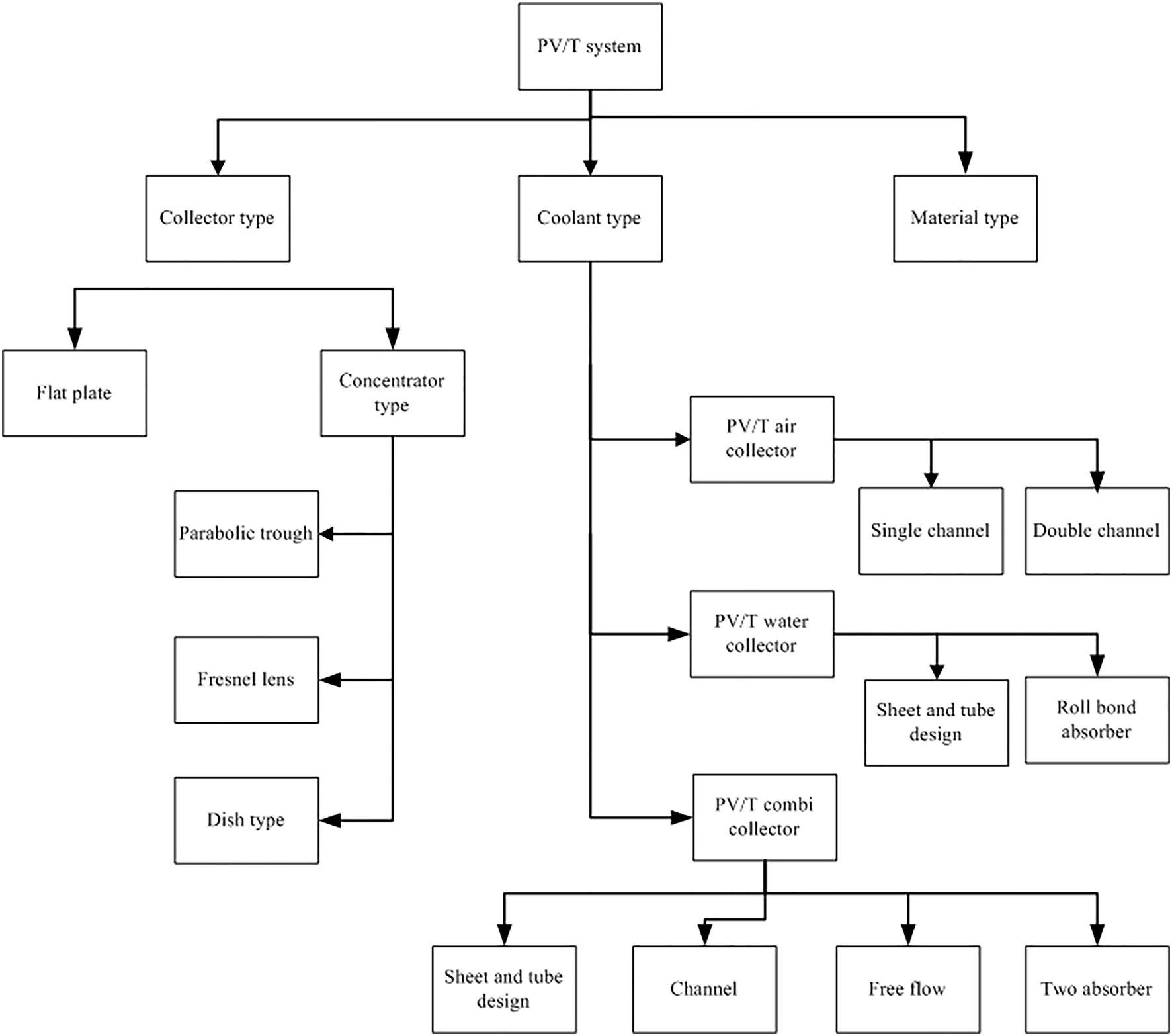
A PV/T system requires a PV module, a channel, coolant (air/water), DC fan, and collector [
12
]. The classification of PV/T technology is depicted in Fig.
3
. The coolant in the PV/T system is further used for drying of crops, room heating, and water heating [
13
]. Ibrahim et al. [
14
] classified the PV/T system based on fluid circulation below the PV such as natural or forced flow. The simplest and economical method used for cooling is the circulation of air by natural means, but at the same time, this method is less efficient in geographical regions where ambient temperature is greater than 20 °C [
15
]. The performance of hybrid PV/T system is measured in terms of thermal, electrical, and exergy efficiencies of the system. The
ηele
of the system mainly depends upon the cell temperature, since the material used for the manufacturing of PV cells is sensitive to change in temperature.
The
η
th of PV/T system changes with the change in air mass flow rate, type of solar collector, modifications in the absorber such as adding fins and TMS in the coolant channel, sheet and tube absorber, roll-bond absorber, and temperature at the inlet and on the basis of fluid flow (single channel/double channel).
In previous studies, most of the researchers discussed the flat-plate collector because of its simple design and control operations [
16
]. A concentrating collector requires a large number of reflectors and lenses and complex mechanism for sunlight tracking makes the overall system complex and costly [
17
], but this type of PV collector helps in extracting higher energy as compared to flat-plate PV collector [
18
]. Therefore, it is preferred in industrial applications.
Another important aspect that makes PV/T a potential application is integrated with buildings to utilize thermal energy and electricity. These systems are known as building-integrated photovoltaic (BIPV) solar systems and building-integrated photovoltaic–thermal (BIPV/T) systems [
19
]. When the PV/T system is incorporated into the building, it generates heat, light, and electrical energy simultaneously for building use [
20
]. With the evolution of soft-computing techniques, optimization of parameters becomes quite easier which helps the researchers to understand the dynamics of the system.
Since the current technology is in developing phase with the recent research going on, it offers several limitations: (1) higher installation cost as compared to PV and solar thermal system, (2) engineers working in this domain face various technical problems in design, (3) the market potential of PV/T is still very low compared to solar PV systems, and (4) researchers often get confused with the contradictory statements given in earlier reviews. To understand these factors, a review of the current research status of PV/T is needed. Although several reviews on the PV/T technology already exist in the literature, in the present article, the authors have carried out a comprehensive review on PV/T air collector, PV/T water collector, recent advancement in PV/T air and water collector and building-integrated PV/T. However, due to recently emerged soft-computing techniques, the performance prediction of PV/T becomes quite easy. Hence, it has become necessary to discuss the role of soft-computing techniques in PV/T. Furthermore, the present article also includes the role of thermoelectric generator in enhancing the performance of PV/T, solar dryer for rural areas, effect of nanofluids and PCM on the performance of PV/T, recent advancement in thermal absorber design, i.e., roll-bond absorber and PV laminations on roll-bond absorber, PV/T with SAHP and application of PV, and PV/T in buildings.
Photovoltaic–thermal (PV/T) air collector
The theory of PV/T was stated by Kern and Russel [
21
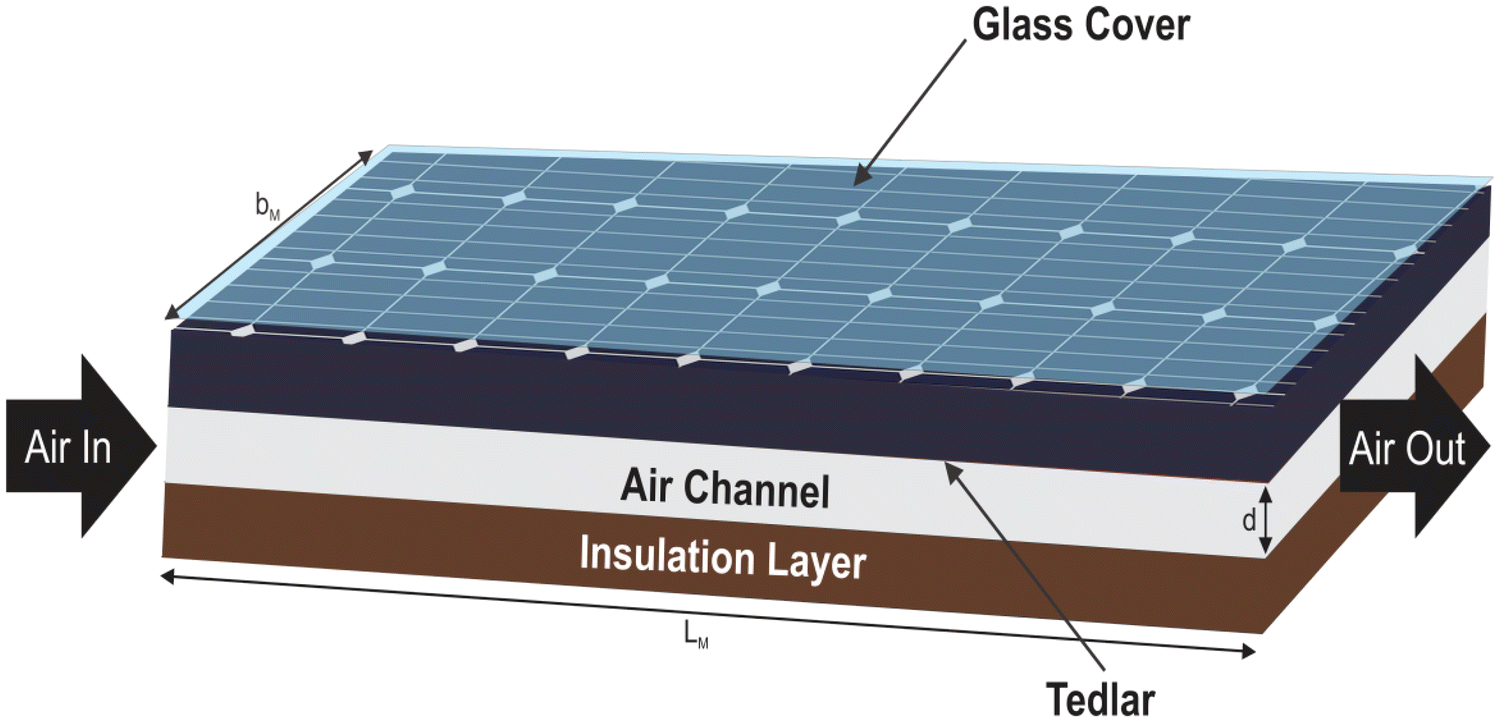
]. The concept of PV/T evolves from the fact that more than half of the sunlight incident on the solar cell is converted into heat. This heat may cause structural damage to the cell if it remains on the PV cell surface for a longer period. The heat recovered from the module can be for numerous applications such as crop drying, floor heating, hairdryer, etc. The layered diagram of PV/T module is shown in Fig.
4
.
The PV/T air-collector design varies from each other based on the channel position. The overall efficiency (
ηT
) of the PV/T system is the sum of its thermal and electrical efficiencies [
22
,
23
–
24
]:
ηT=ηth+ηele.
The
η
th of PV/T collector is calculated as:
ηth=QuGtAc,
where
Qu
is the usable heat collected which is further calculated as:
Qu=mCpTout-Tin.
The
ηele
of PV/T collector is calculated as:
ηele=VmImAcGt.
Exergy efficiency (
ηEx
) is also considered as an important parameter to estimate the PV/T system performance. The expression for the exergy efficiency of a single-channel glazed photovoltaic–thermal (SCPV/T) system was given by Singh et al. [
25
]:
ηEx=ExOUTExIN×100.
The general expression for exergy balance in a single-channel photovoltaic–thermal (SCPV/T) module is given by Agrawal and Tiwari [
26
]:
∑ExOUT=∑ExTh+∑Exele,
where
∑ExTh=Qu-mCpT0·lnToutTin∑Exele=ηAcGt1000.
The generalized expression of input exergy from a source is given by Kalogirou et al. [
27
]:
∑ExIN=AcNc×Gt1-43T0TSun+13fT04TSun4,
where
f
is the geometric factor that represents the portion of the hemisphere covered by radiation reservoir. The above equation is valid only if geometric factor
f
≥
T03TSun3
. Petela [
28
] gives the expression to calculate the input exergy for fully concentrated radiation (
f
= 1):
∑ExIN=AcNc×Gt1-43T0TSun+13T04TSun4.
The performance of the glazed PV/T tile is investigated by Agrawal et al. [
29
]. The PV/T tile consists of a single solar cell below which a channel is formed in which air flowing using DC fan at the inlet of channel. The experimental setup consists of two PV/T tiles connected in series with each other. The
ηele
and
η
th of the proposed experimental setup were found to be 12.4% and 35.7%, respectively. Agrawal and Tiwari [
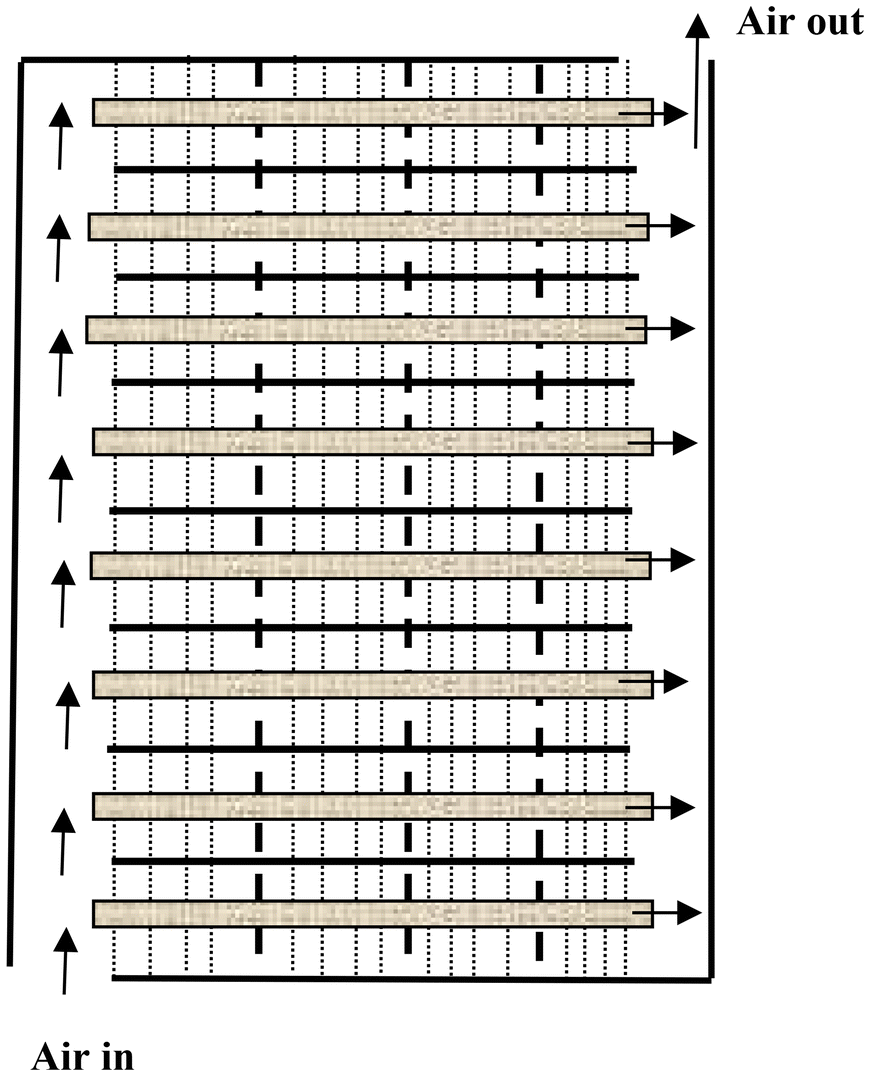
30
] investigated the performance of the hybrid micro-channel solar cell thermal (MCSCT) module, as depicted in Fig.
5
. The experimentation shows that the performance of MCSCT is better as compared to the conventional PV modules of similar ratings.
Amori et al. [
31
] worked upon flat-plate PV/T collector. At a constant air velocity of 0.0991 kg/s, an average reduction of 15.52 °C in cell temperature was observed with a single-pass air channel compared to the PV system without cooling. The
η
th,
ηele
, and
ηT
of the system were observed as 46%, 9.4%, and 55%, respectively.
The experimental analysis was conducted by Slimani et al. [
32
] to investigate the effect of glazing and absorber plate on the performance of four different PVT collectors. It has been reported that the
ηT
of double-pass PV/T air collector with additional glass cover is better as compared to the other three configurations. The advantage of the double-pass design is that it provides uniform cooling of the PV module and hence lowers down its temperature and thereby increasing its
ηele
. A comparative study is presented by Sopian et al. [
33
] between the single-channel and double-channel PV/T air collector, and from the experimental study, it has been reported that the double-pass design is efficient than the single-pass design in terms of
ηT
. The authors also confirmed that the
ηele
enhances with a rise in the air mass flow rate.
Impact of parameters and design modifications on PV/T air collector
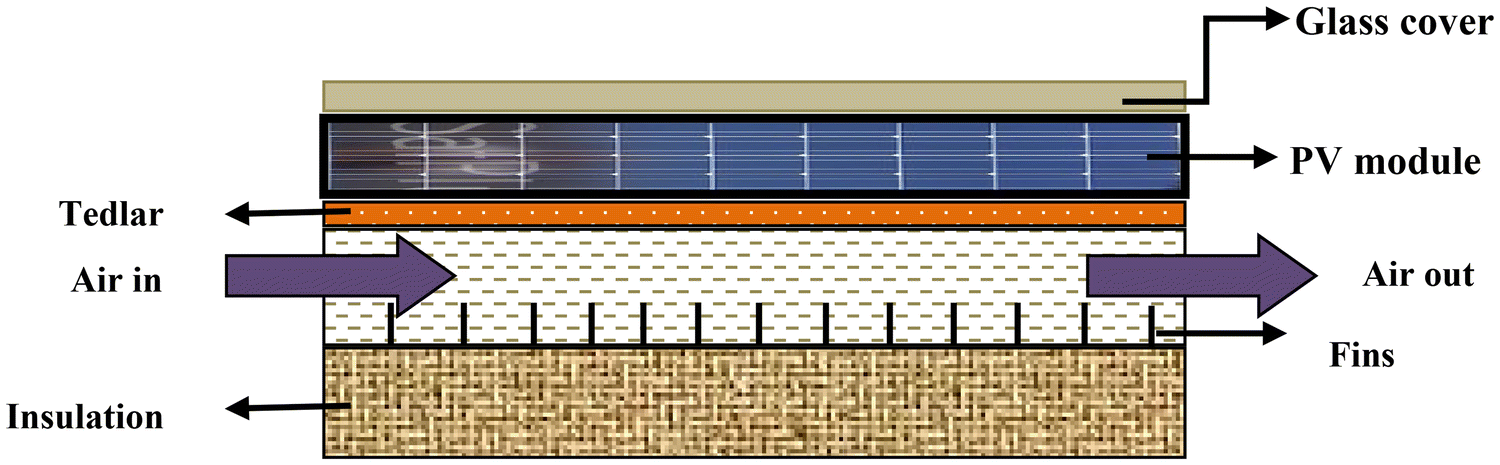
Packing factor, air mass flow rate, glazing (additional glass cover), wind velocity and temperature of the coolant, etc. are the parameters that have an impact on the PV/T air-collector performance. Modifications in the channel like the use of fins, TMS, hexagonal honeycomb heat exchanger, and v-grooved absorber were also adopted by various analysts to improve its overall performance. In this segment, a review of the research work conducted in this direction is presented. Tonui and Tripanagnostopoulos [
34
] suggested low-cost methods to improve the heat transfer from the PV surface to the flowing fluid through the channel. In the modified system, aluminum fins were added in the air channel, as shown in Fig.
6
.
The performance of the modified system is significantly better than the conventional PV/T system. Rectangular fins were used in the lower channel to enhance the heat transfer rate from the PV module to air duct. From the experimental investigation, the maximum
η
th and
ηele
for the modified system were reported as 56.19% and 13.75%, respectively [
35
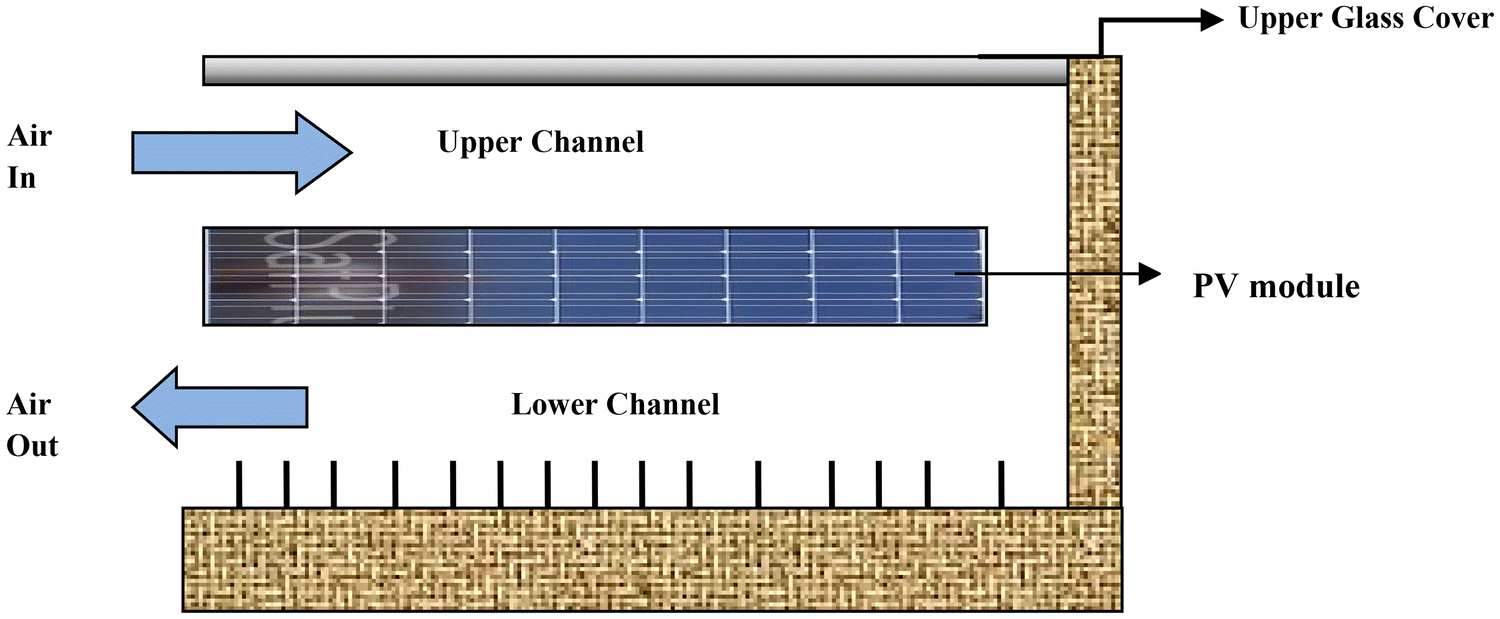
]. Kumar and Rosen [
36
] presented the comparative study of conventional PV/T air collector with a double-pass PV/T air collector with fins in the lower channel, as shown in Fig.
7
.
It has been observed that by fixing the fins in the lower channel, the
η
th and
ηele
of the double-pass PV/T were improved by 15.5% and 10.5%, respectively, as compared to conventional PV/T collector. Shahsavar and Ameri [
37
] performed an analysis with TMS suspended in the middle of the air duct. Tripanagnostopoulos et al. [
38
] suggested that the surface roughness and TMS used in the channel are the cost-effective and simple methods used for removal of heat from the PV panel.
Jin et al. [
39
] modified the channel with a rectangular tunnel heat exchanger and compared its performance with conventional PV/T air collector. The investigation shows that the
η
th and
ηele
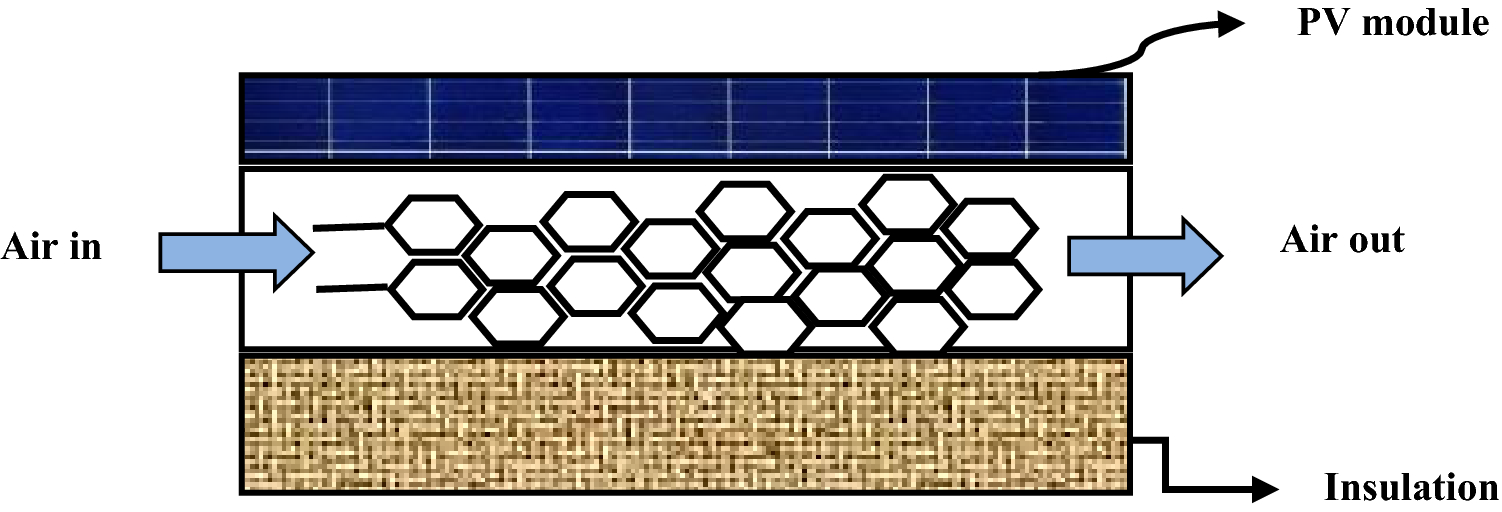
for the modified system were 54.70% and 10.02%, respectively. It has been observed that the performance of the system with heat exchanger was significantly better as compared to conventional PV/T. Hussain et al. [
40
] implemented the honeycomb heat exchanger in the air channel, as shown in Fig.
8
. From the experimental investigation, a significant improvement in
η
th of the proposed system was observed. At a solar irradiance level of 828 W/m
2
and a mass flow rate of 0.11 kg/s, the
η
th of the system was found to be 87%.
Fig. 8
PV/T air collector with honeycomb heat exchanger [
40
]
Othman et al. [
41
] talked about the idea of a v-grooved aluminum absorber plate as shown in Fig.
9
. From the trial examination, it has been observed that
η
th and
ηele
of the system enhanced significantly.
Fig. 9
PV/T air collector with v-grooved absorber plate [
41
]
The
ηele
of the PV module has greatly affected by the change in the packing factor. As the packing factor increase from 0.38 to 0.98, then the
ηele
of the system increases by about 17% as reported by Kumar and Rosen [
36
]. A contradictory statement is given by Vats et al. [
42
] about the relation between the packing factor and the system’s efficiency. The study conducted by Wu et al. [
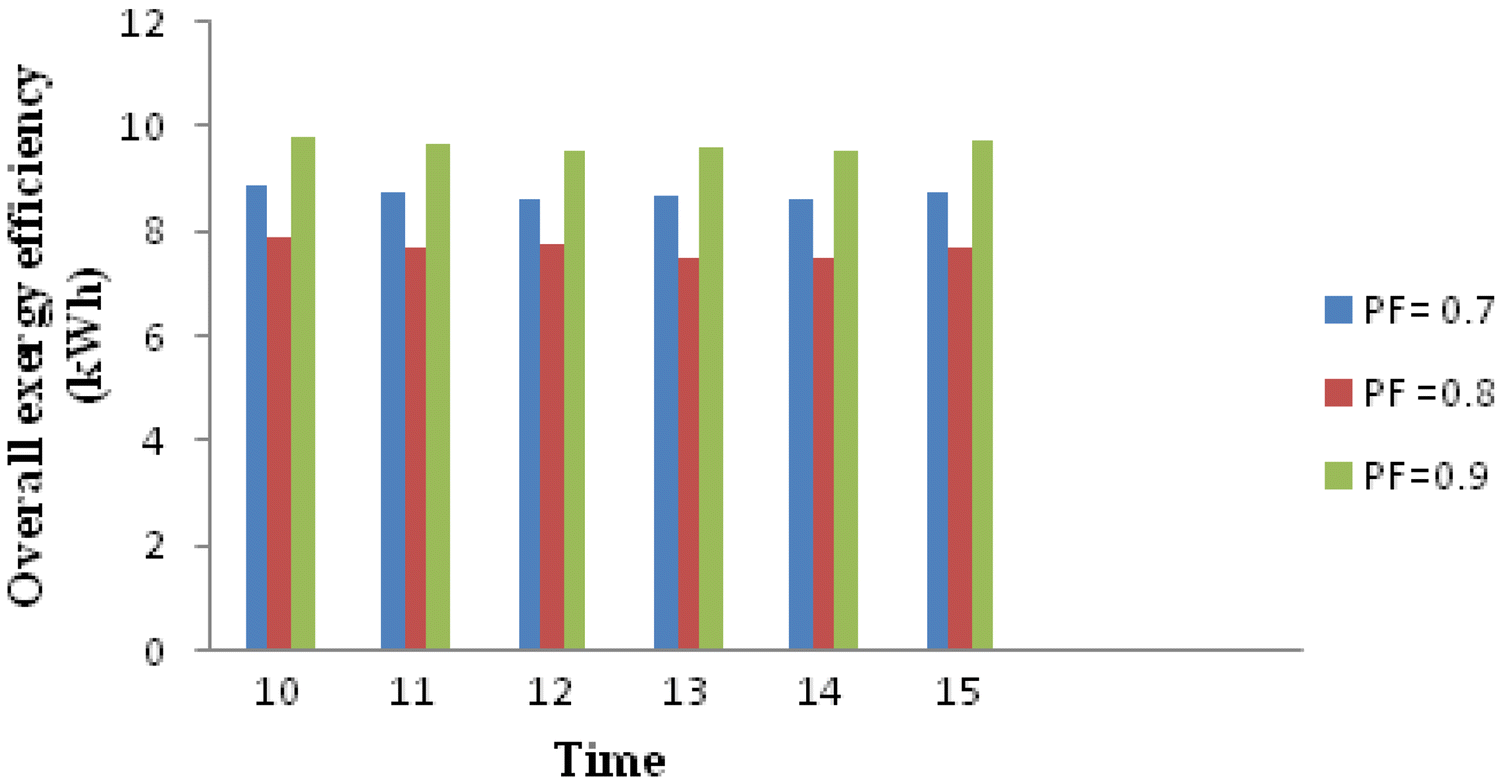
43
] discussed an irregular behavior of exergy efficiency (
ηEx
) with the packing factor. The hourly variation of
ηEx
with different values of the packing factor is depicted in Fig.
10
. The lower
ηEx
is observed at 0.8 packing factor, while higher
ηEx
is observed at 0.9 packing factor. An experimental investigation was performed at different packing factor by Sopian et al. [
44
]. A significant increment in
η
th,
ηele
and
ηT
of the system is observed when the packing factor increases from 0.5 to 0.7.
Fig. 10
Variation in
ηEx
at different values of packing factor [
43
]
PV/T system with glazing helps in achieving a better
η
th as compared to an unglazed system. Glazing is used above the PV surface to trap more heat energy which increases the thermal energy output almost double that of unglazed PV/T, but at the same time, slight decrement in
ηele
is observed [
45
]. Other effects of glazing are edge shedding and increased temperature which may lead to a reduction in electrical output [
46
] and increase the sensitivity of the PV module towards reflection losses and lead to the formation of hot spots. The
ηele
of the PV/T collector is inversely proportional to the amount of glazing [
47
]. Rajeb et al. [
48
] discussed the applications of anti-reflective coating which is used to reduce the reflection losses from the upper glazing. Hence, it helps in achieving better
ηele
.
The performance of a hybrid PV/T air collector is also influenced by the mass flow rate. At a higher mass flow rate, a higher amount of heat can be recovered from the PV panel and helps in reducing the module temperature. Kumar and Rosen [
36
] reported that for an increase in the air mass flow rate from 0.03 to 0.15 kg/s, about 20% increment in
ηele
is observed for the PV/T system.
Khalid and Mohammad [
49
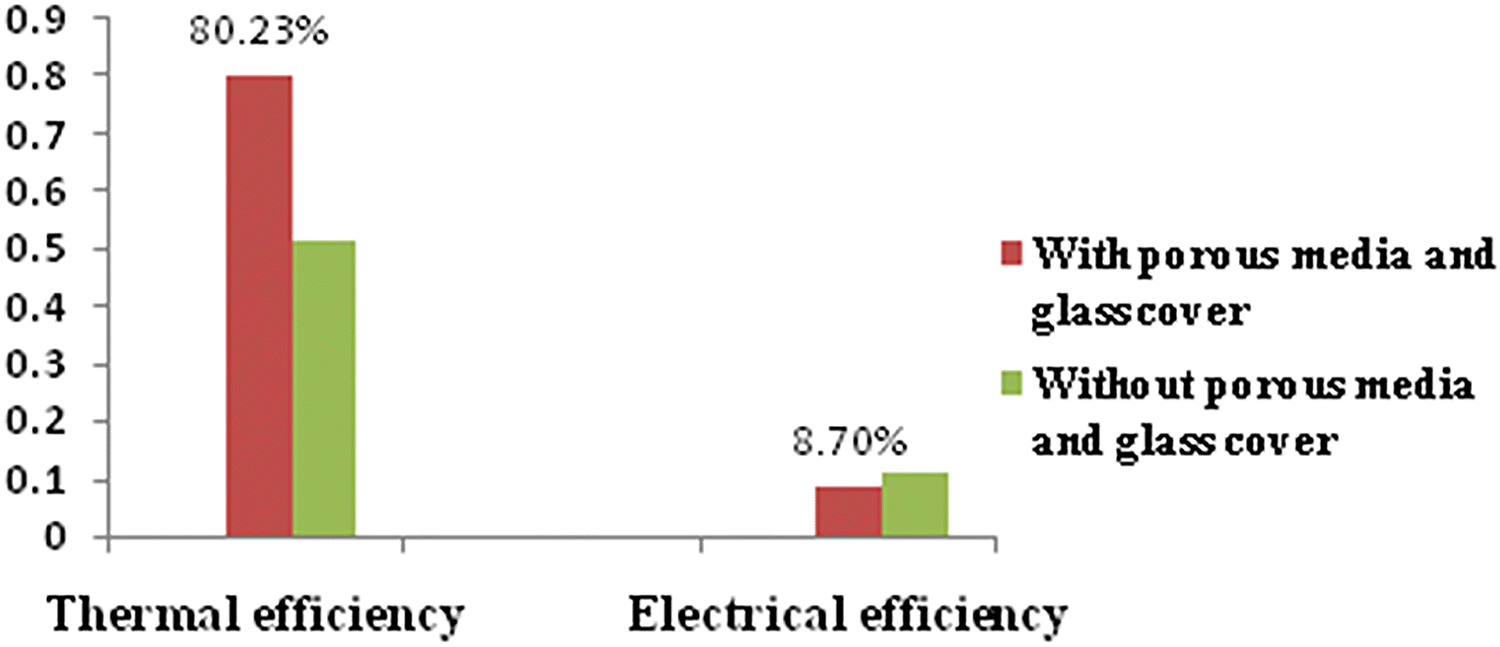
] investigated the performance of the double-pass PV/T air collector with porous media in the channel. An improvement in
η
th and output temperature of the PV/T air collector is observed, but at the same time, the
ηele
of the system reduces with porous media in the channel as shown in Fig.
11
. Prashant et al. [
50
] did an experimental investigation on hybrid double-pass PV/T air collector with porous media in the channel. Two additional glass covers are used over the PV module to entrap the heat energy. The
η
th of the system improves by about 10–12% using porous media. Youssef and Adam [
51
] presented a comparative study between double-pass and single-pass hybrid PV/T air collector, and concluded that the
η
th of the system with porous media increases around 10% as compared to a conventional system.
Fig. 11
Efficiency of the PV/T air collector with porous media [
49
]
Sopian et al. [
52
] worked on double-pass PV/T air collector with porous media in the lower channel. The
η
th of the modified system increases by 10% as compared to conventional PV/T air collector.
A lot of research work has been conducted in the field of hybrid PV/T air collector, but still more efforts are required to further improve the
η
th and
ηele
of the system. As reported in the literature, a maximum
η
th of 87% is reported, while the
ηele
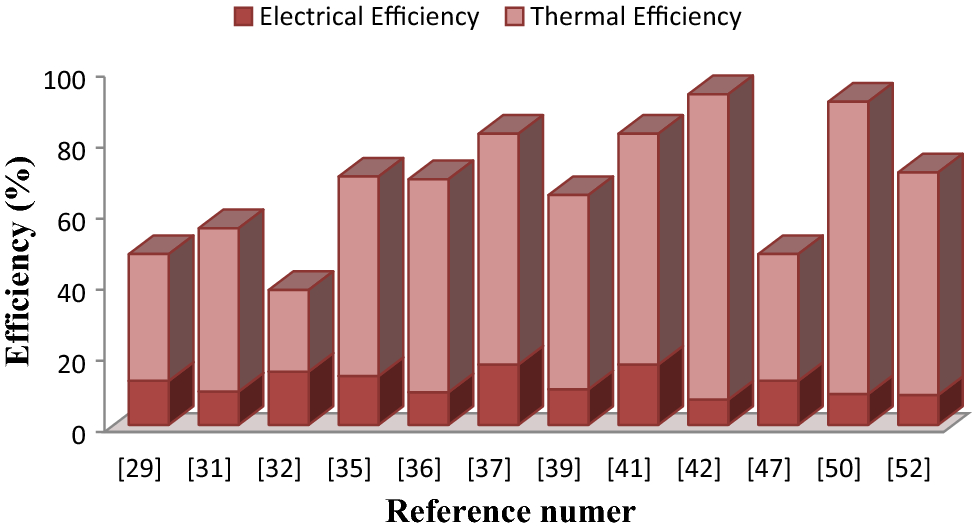
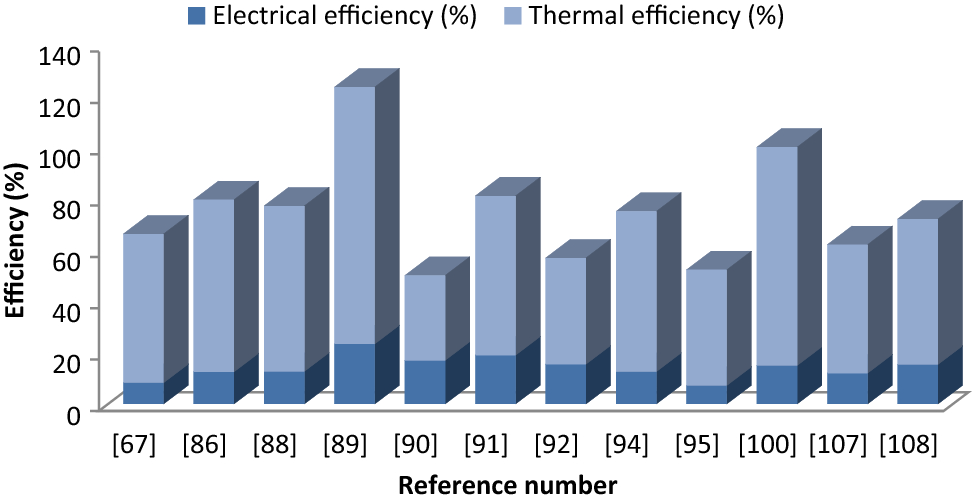
of the system is not much improved as the amount of heat energy pulled by air from the PV module is limited because of low heat capacity of air. The electrical and thermal efficiencies for various references used in the literature are represented in Fig.
12
.
Fig. 12
Electrical and thermal efficiencies of various references
Recent advancement in PV/T air collector
A PV/T system is proficient in producing both thermal energy and electrical energy at the output, but the major portion of energy received at the output is of thermal energy (low-grade energy). A thermoelectric (TE) module is used with PV/T system to convert the low-grade thermal energy into electrical energy (high-grade energy). The working of the thermoelectric is based upon the principle of Seebeck effect and Peltier effects to convert thermal energy into electrical energy [
53
]. A potential difference is created between the hold and cold junctions due to the temperature difference between the junctions. Babu and Ponnambalam [
12
] reviewed the performance of the PV system with a thermoelectric generator (TEG), as depicted in Fig.
13
. Various parameters that affect the performance of PV-TEG such as the method of integration of TEG, location, and properties of TEG and its thermal resistance have been discussed in detail.
Dimri et al. [
54
] worked upon the PVT-TEC model using three different PV modules, viz., opaque, semitransparent, and aluminum-based. The performance of the system with the thermal-based model is then compared with ANN model. From the outcomes, it has been concluded that there is a good agreement in the result between the two models. In another study, Dimri et al. [
55
] developed the mathematical equations for semitransparent PVT-TEC collector, and compared the performance with PV-TEC and semitransparent PV collector. The outcomes of the analysis show that the
ηele
of the semitransparent PVT-TEC is significantly higher than PV-TEC and PV collector. Vorobiev et al. [
56
] developed a hybrid PVT-TEC model in which a thermoelectric generator is integrated with a PV module. Based on theoretical calculations, 30% of
ηT
were achieved from the hybrid system.
In rural areas, there is a need for drying the grains to remove the moisture content. If the moisture is not properly removed, then it will affect the productivity of farmers. Tiwari et al. [
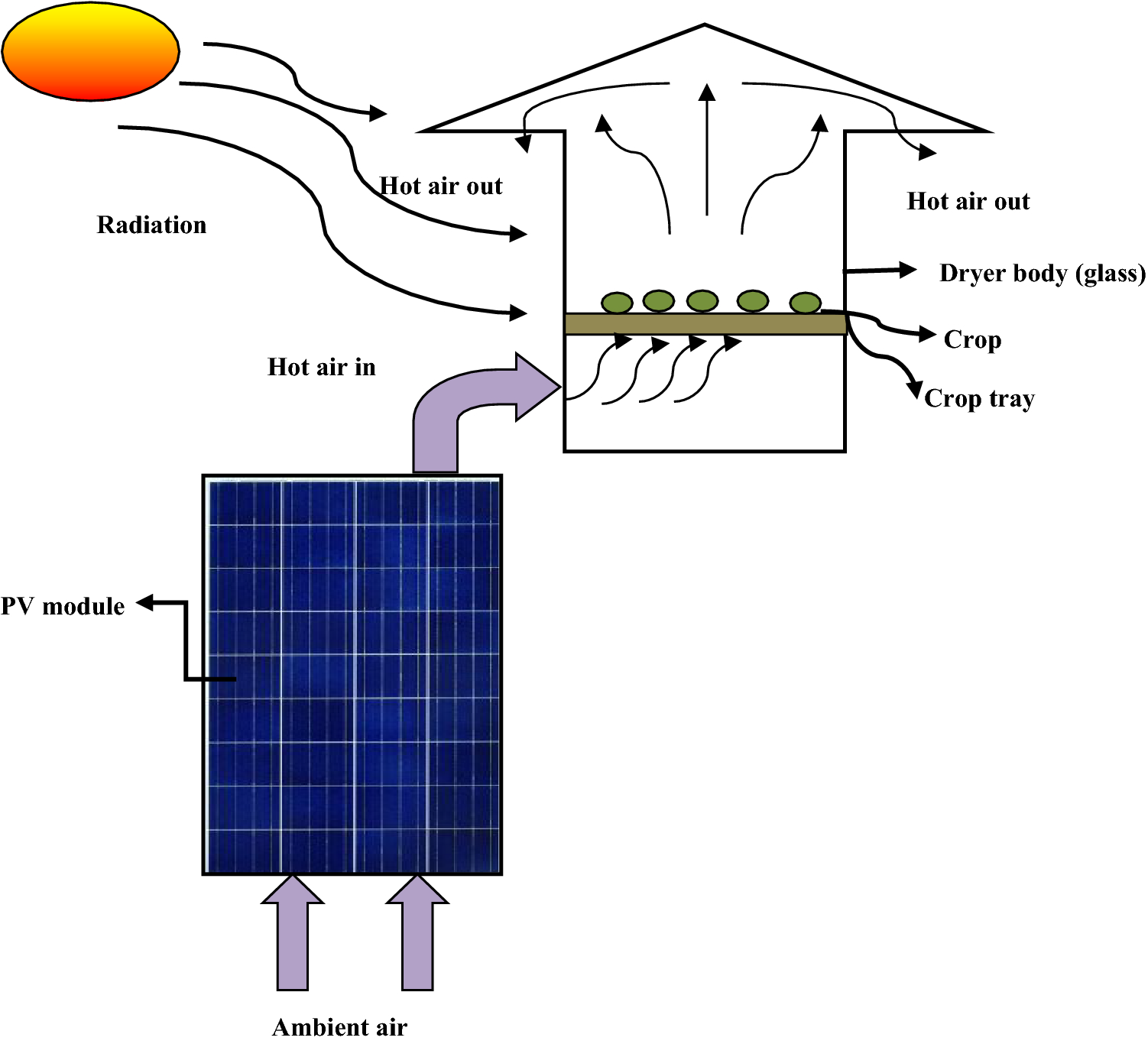
57
] performed an experimental analysis on PV/T air-collector integrated drying system which is useful in preserving the crops, as shown in Fig.
14
. From the experimental analysis, it has been observed that for the crops with high moisture content, the performance is better under forced convection mode, while natural convection mode is better for the drying of crops with low moisture content. Singh et al. [
58
] discussed the benefits of greenhouse solar dryers in terms of energy savings. The mathematical modeling is presented and the performance evaluation has been discussed based on characteristic plots.
Fig. 14
Greenhouse dryer integrated with PV/T air collector [
57
]
Aymen et al. [
59
] investigated the working of a solar drying system connected with FPC under forced convection mode. The experiments were conducted to extract the moisture from red paper and sultana grapes. It has been observed from the analysis that 7 h had taken to dry red paper, while 17 h had taken to dry sultana grapes. The payback period of the solar drying system was found 1.6 years. Lammle et al. [
60
] discussed the impact of highly transparent low emissivity silver coating over the collector. This low emissivity coating helps in reducing up to 80% of heat losses from the collector. Singh and Kumar [
61
] investigated the performance of natural convection mode north wall-insulated greenhouse dryer. The analysis showed that a much higher temperature compared to ambient temperature was achieved with a north wall-insulated solar dryer. Eltawil et al. [
62
] discussed the working STD-FPC for the drying of potato chips. The analysis shows that the thermal performance can be enhanced by maintaining the temperature inside the dryer. Singh et al. [
63
] discussed the role of absorber plate shape factor and mass flow rate on the performance of PV/T air collector. Curved groove absorber is used in the air channel and it has been reported that the performance of PV/T is affected with change in shape of absorber and mass flow rate. The outcome of the investigation shows that the efficiency of the PV/T system is maximized when the shape factor lies in the range of 1.3–2.0 (curved groove absorber).
PV/T water collector
Water is considered as the most vital segment for the presence of living beings on the earth. PV/T water collector satisfies the need of electricity along with hot water. PV/T water collector has almost the similar structure as the PV/T air collector except for the air channel. In the PV/T water collector, water is forced to flow through the tubes beneath the PV module to cool down the PV module which in turn increases the
ηele
of PV/T water collector. Zondag et al. [
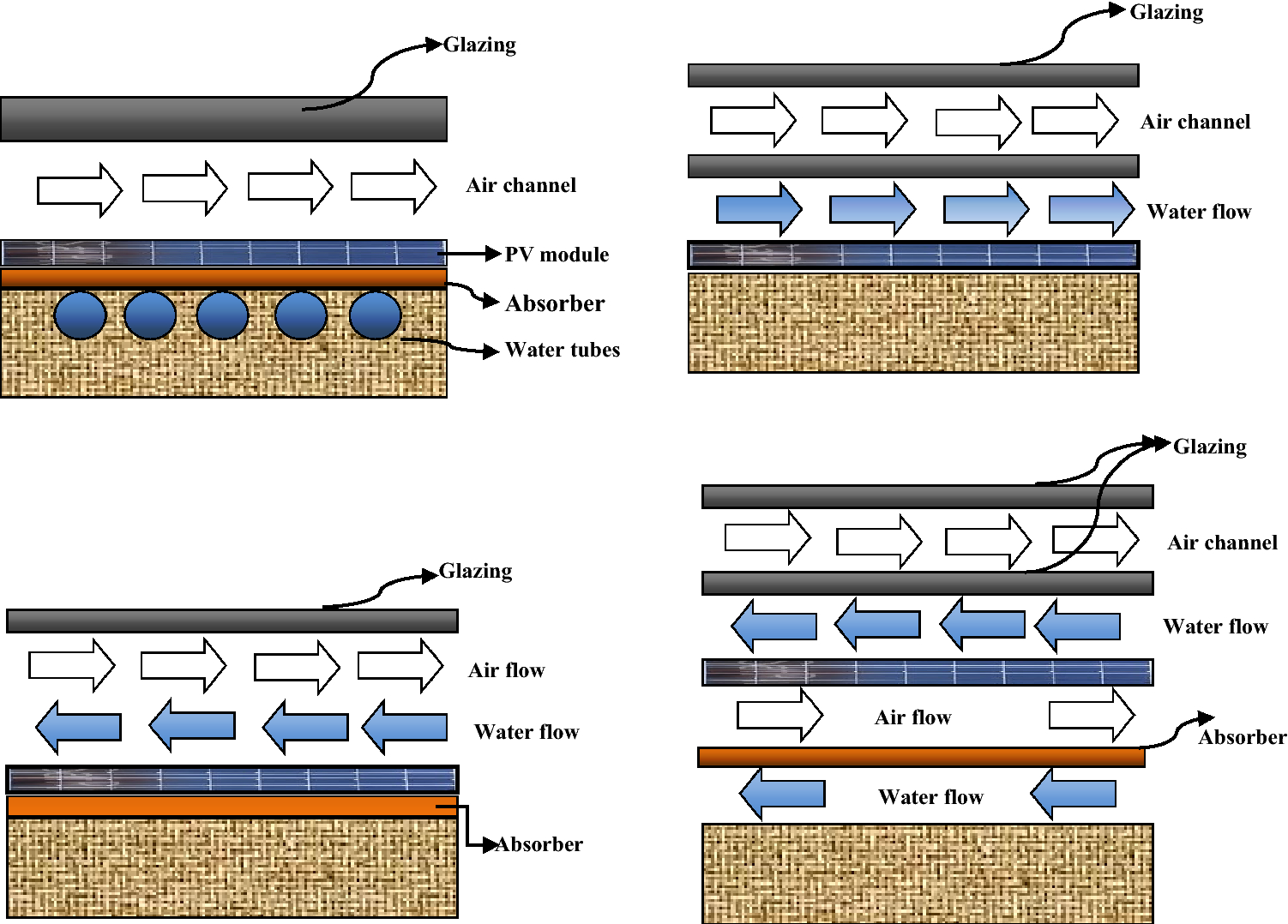
64
] discussed various configurations of PV/T water collector based on water-flow patterns below the PV module, as shown in Fig.
15
.
Fig. 15
Classification of PV/T water collector based on water-flow pattern [
64
]
Chow et al. [
65
] studied the outcomes of additional glass cover on PV/T water collector. From the experimental analysis, it has been concluded that the thermal energy output is higher for glazed design, while the unglazed module is suitable if exergy at the output is of interest. Kiran and Devadiga [
66
] presented the comparative analysis of PV/T water collector with standalone PV and solar water heater. From the experimental analysis, the
ηele
and
η
th of the PV/T system were found to be 8.26% and 57.90%, respectively, which is significantly higher than individual PV and solar water heater. Dorabantu et al. [
67
] performed an experimental analysis PV/T water collector by cooling the active surface of the PV panel with water. This technique helps in reducing the cell temperature to 35.5
°
C from 48
°
C along with decreasing the top-surface reflection losses.
Rodgers and Eveloy [
68
] examined the outcomes of a dynamic water-cooling mechanism on the performance of PV/T water collector. Continuous water flow below the PV panel is not always required to effectively cool the module surface. From the experimental investigation, it has been concluded that intermittent water flow provides a better cooling than the continuous water flow. Daghigh et al. [
69
] performed simulation using TRANSYS software to analyze the overall performance of the PV/T water collector in Malaysian climatic conditions. Rajput et al. [
70
] discussed the concept of cylindrical pin finned heat sink to cool the panel to improve its
ηele
. It has been revealed from the outcomes that the temperature of the rear surface reduces to 58.45
°
C from 88.81
°
C with the proposed modification.
The demand for clean water is increasing day by day, along with the demand for electrical and thermal energy. Solar distillation is the most economical and commonly used method to convert contaminated water into freshwater. Integrated PV/T solar still satisfies the demand for clean water along with thermal and electricity [
71
]. Sotehi et al. [
72
] investigated the performance of a hybrid PV/T module coupled with solar still to achieve the possibility of net-zero energy building. It was reported that solar still coupled with PV/T system earned lots of profit by selling the electricity along with distilled water.
The additional advantage offered by the PV/T water-based system is that the water used as flowing fluid can be further reused in buildings, homes, etc. as hot water. Tripanagnostopoulos et al. [
73
] did the experimental work to analyze the effect of glazing and a reflective coating on the performance of PV/T water collector. It has been concluded from the experimental study that the use of glazing helps in increasing the thermal output. Tiwari and Gaur [
74
] reported that a semitransparent module exhibits better efficiency than an opaque based module.
PV/T combi technology
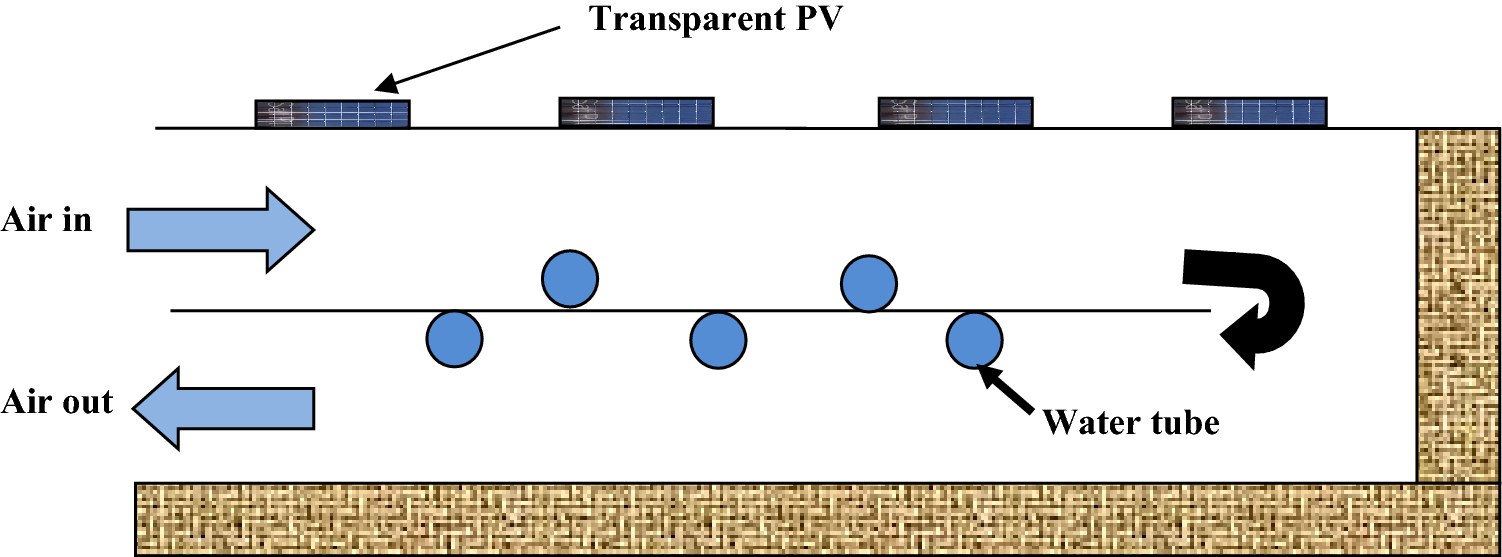
The synchronization of PV/T air-based system and PV/T water-based system led to the development of PV/T combi system which helps in achieving a better efficiency, since water and air both were used as a circulating fluid. The schematic diagram of the PV/T combi collector is shown in Fig.
16
. The concept of the PV/T combi system was first introduced by Tripanagnostopoulos [
75
]. By combining two types of heat collector media, the temperature of PV cells is greatly reduced, and cell efficiency is improved as compared to PV/T water or PV/T air collector.
The experimental setup of the PV/T combi was installed and tested at the solar energy laboratory, Malaysia by Othman et al. [
76
]. The
η
th of the PV/T combi collector was calculated according to the relation given by Duffie and Beckman [
77
]:
ηth=Qu(air)+Qu(water)AcGt.
The PV/T combi system increases the surface area for heat exchange which helps in achieving high
η
th and
ηele
. Nasim et al. [
78
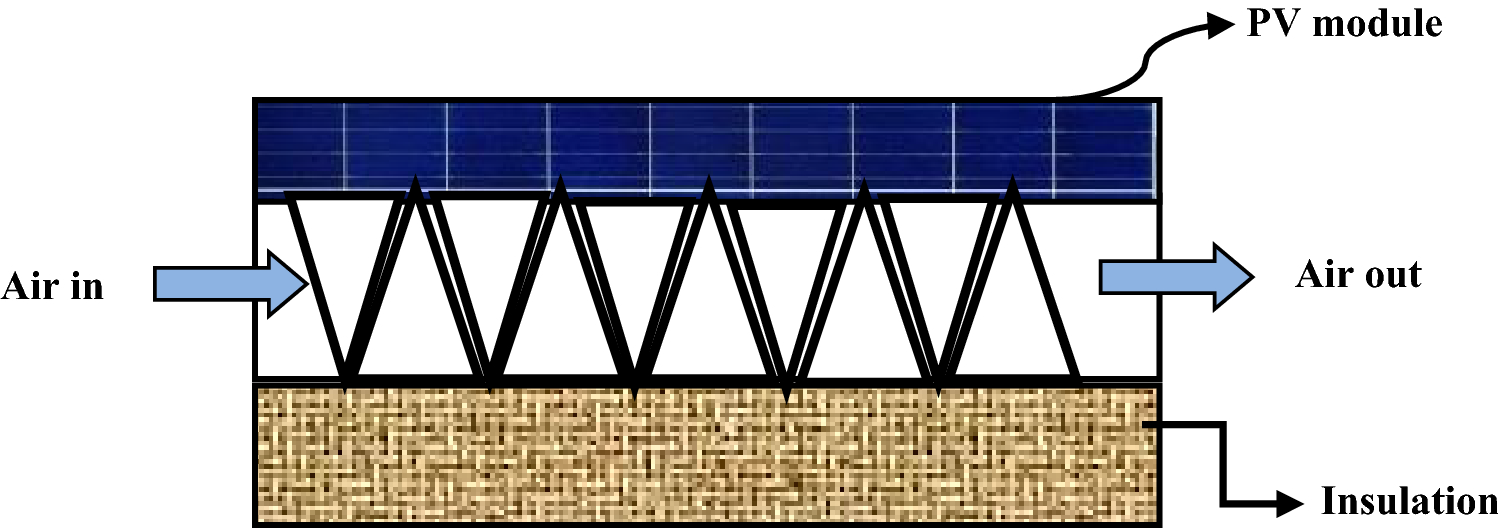
] use a decision tree approach and statistical correlation method to improve the performance of the PV/T combi collector. Thin metallic sheets of various shapes like sinusoidal, triangular, and rectangular were used in the air channel underneath the water tubes to enhance the air heat extraction through the duct. Although PV/T combi system overcomes the disadvantages offered by PV/T air collector and PV/T water collector, the researchers could not appreciate PV/T combi system due to complications in design, high cost, and several maintenance issues.
Recent research in PV/T water collector
Recently, the researchers around the globe took an interest in the use of various nanomaterials along with cooling fluid to improve the thermal conductivity and stability of the fluid. When water is used as a cooling fluid in the channel, it absorbs only 13% of incident solar radiation. Therefore, the focus of research shifts towards the use of nanofluids with direct solar absorption collector [
79
]. The concept of using nanoparticles for cooling was given by Maxwell [
80
] in the late nineteenth century, but manufacturing techniques were very limited at that time. Therefore, this technique did not gain much attention. However, with the advancement in manufacturing techniques, nanofluid with direct absorption solar collector received much attention because of its capability to harness the thermal energy more efficiently as compared to the conventional solar thermal collectors. Thermal and optical properties are significantly improved when direct absorption solar collectors are incorporated with nanofluids. It has been observed from the facts that the thermal properties of nanoparticles are further enhanced when mixed with little concentration of metals and metal oxides. Tyagi et al. [
81
] analyzed the performance of flat-plate PV/T collector and direct absorption solar collector with nanofluid in the channel. It has been observed that nanoparticle increases the absorption of solar radiation as compared to pure water and helps in achieving a better efficiency. The absorption of radiation increases using nanofluid and it helps in achieving better
η
th [
82
]. Yazdanifard et al. [
83
] discussed the effect of the size of nanoparticles, concentration of nanoparticles, and types of nanoparticles on the overall performance of the PV/T system. It has been reported that the performance of Al
2
O
3
nanoparticles with water as a base fluid is better than TiO
2
nanoparticles. Said et al. [
84
] investigated experimentally the effect of Al
2
O
3
nanofluid on the exergetic performance of flat-plate PV/T collector. From the investigations, it has been reported that the exergetic performance of the system improved significantly by mixing nanofluid with water. Bianco et al. [
85
] investigated the effect of Al
2
O
3
nanofluid on PV/T water collector. From the experiments, it is noticed that the temperature of the front surface and backside of the PV panel reduced by the mixing of nanofluid with water as a base fluid. This helps in achieving a better PV conversion efficiency of the system. Barode et al. [
86
] discussed the proficiency of carbon-based nanofluids in improving the
η
th of four different types of solar collectors. The authors highlighted the impact of the concentration of nanofluid, temperature, and flow rate on the solar collector’s performance. The outcome of the experiment shows that at a concentration of 0.3 vol% of carbon nanofluid, the
η
th of hybrid PV/T, parabolic trough, flat plate, and evacuated-tube solar collectors have been improved up to 97.3%, 74.7%, 95.12%, and 93.43%, respectively. At a very low concentration of 0.01 vol% of carbon nanofluid in the base fluid, an improvement up to 122.7% has been observed in the
η
th of direct absorption solar collector. It is also worthy to note that carbon nanofluids also work as excellent anti-corrosion additives for the solar collector. Various authors reported increased electrical and thermal efficiency of PV/T collector using different nanoparticles in the channel with water as a base fluid as depicted in Table
1
.
Table 1
List of references using nanofluid with water in the channel
Author
Year
Base fluid
Type of nanomaterials
Electrical efficiency (%)
Thermal efficiency (%)
Shamani et al. [87]
2017
Water
SiO2
12.70%
64.40
Sardarabadi and Farad [88]
2016
Water
Al2O3
ZnO
TiO
23.2%
23.5%
23.5%
85
110
105
Ghadiri et al. [89]
2015
Water
Fe2O3
17%
33
Radwan et al. [90]
2016
Water
Al2O3
19%
62
Alwaeli et al. [91]
2017
Water
SiC
Al2O3
CuO
16.5%
14
16
49
37
38
Recently, phase-change materials (PCM) are used with PV/T module to minimize the temperature of the solar cell. A PCM material swing between its solid and liquid phases when a change in temperature is observed. When the ambient temperature is higher than that of the PCM, heat transfer is observed from the atmosphere to the PCM material, which changes its state from solid to liquid. When the ambient temperature is lower than that of the PCM, heat transfers from the PCM to the surroundings, creating a warming impact and PCM again changes its state to solid [
92
]. A perfect PCM material must be non-corrosive and it must offer characteristics like high
Lf
and
λ
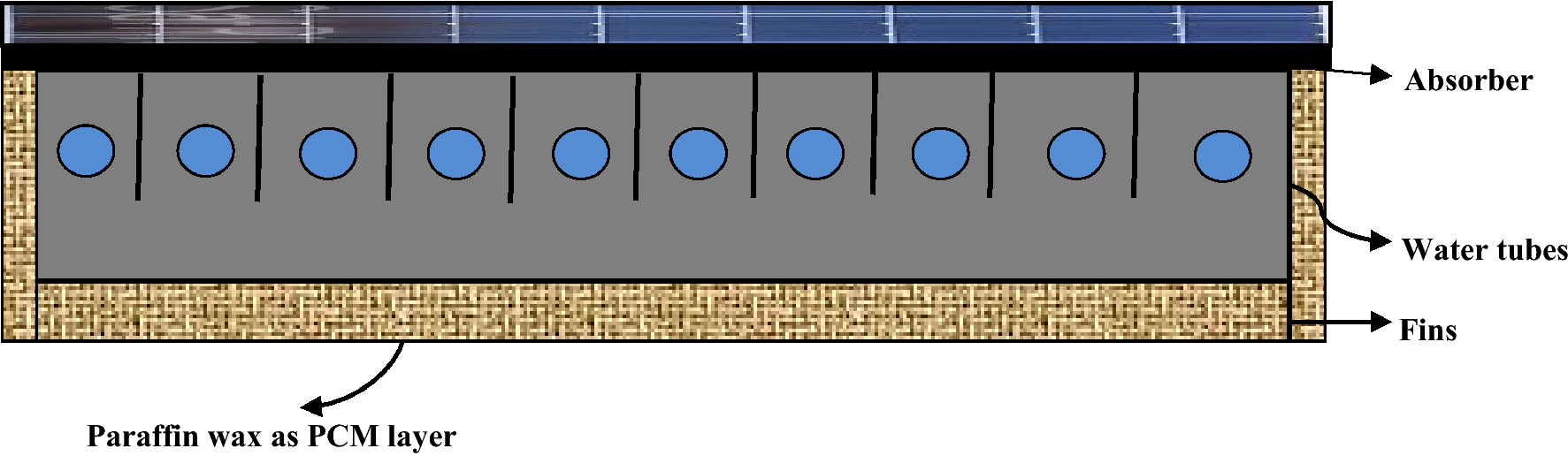
. An experimental analysis has been carried out by Preet et al. [
93
] on the PV/T-PCM system with different mass flow rates to observe the impact of PCM on its performance. The PV/T set up with PCM is shown in Fig.
17
.
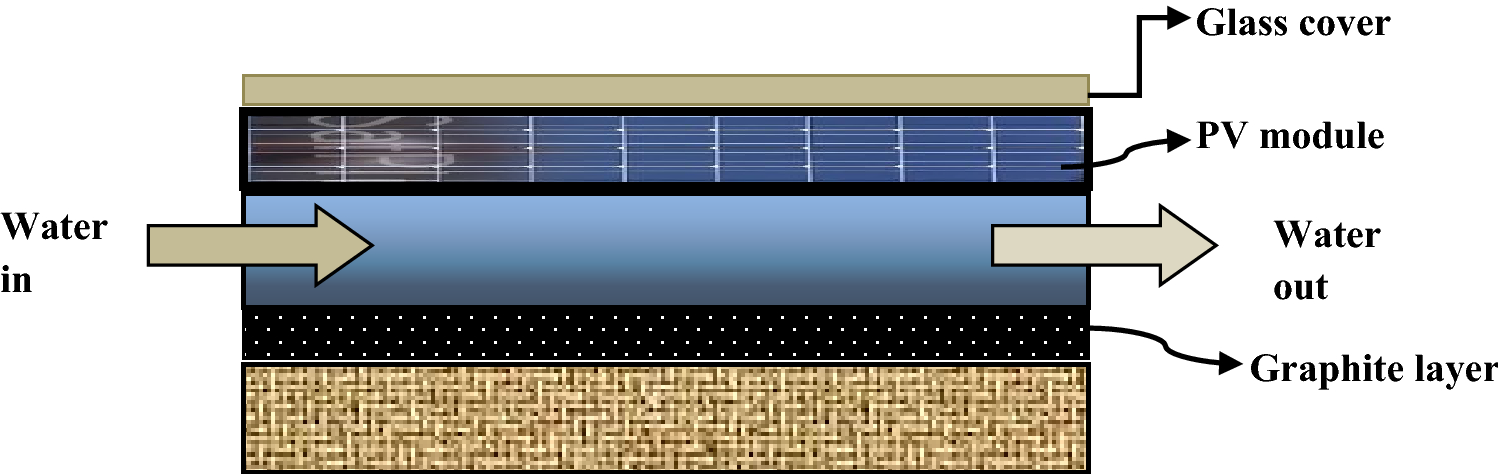
Liang et al. [
94
] proposed a model in which the graphite layer is used underneath the water channel as shown in Fig.
18
and compared the performance with the conventional PV. The average
ηele
reported for the proposed PV/T model and conventional PV system was 6.46% and 5.15%, respectively.
Fig. 18
PV/T water collector with the graphite layer [
94
]
Ong et al. [
95
] worked upon an experimental model in which a solar water heater is integrated with the TE module, which is used for the generation of electrical energy with hot water. The performance of the combined system was evaluated at a different fluid flow rate. From the observations, it has been observed that 0.16% of
ηele
is also achieved along with hot water.
The thermal absorber is the major component in the PV/T system that greatly influences its overall performance. Over the last few years, various changes in design, material, connection methodology, and manufacturing techniques of thermal absorber have been observed. Sheet and tube design is the typical thermal absorber configuration used in PV/T system. The other configurations are roll-bond absorber and fully wetted type absorber. In the roll-bond absorber, channels are embedded between two rolled aluminum sheets, while in conventional sheet and tube design, the channels are welded under the plate. The performance of the flat-plate PV/T collector with roll-bond absorber was investigated by Haurant et al. [
96
]. The modified system is used for hot water production. The performance of PV/T water collector has been compared based on different roll-bond absorber configurations, i.e., serpentine pipe and harp pipe [
97
].
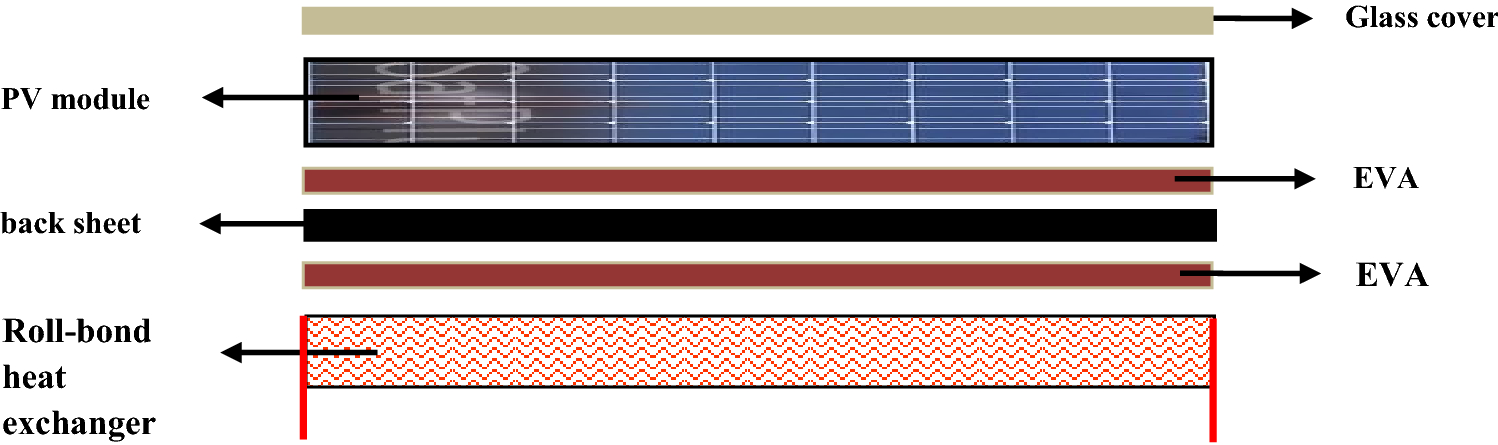
The major technological drawback of the PV/T system lies in the connection technology used to combine PV cells with the thermal absorber. The conventional connection methods include fixing of PV cell with thermal absorber with glue (gluing) and package lamination. In the gluing method, air bubbles are trapped between the thermal absorber with PV cell which causes an increase in thermal resistance between the PV cell and absorber along with irregular distribution of cell temperature. In packing lamination, upper glass, PV cells, and thermal absorber are laminate together in one step to decrease the thermal resistance between the connections. The performance of PV/T system has been compared based on above two connection techniques by Dupeyrat et al. [
98
], and it has been concluded that a significant improvement in thermal and electrical performance of PV/T system has been observed using lamination method as compared to gluing method.
Ying et al. [
99
] investigated the performance of PV/T water collector with roll-bond absorber, as shown in Fig.
19
. The low-cost thermo-laminating method is used for PV-absorber connection which makes the system suitable for the application in rural areas. The test setup was installed at Sichuan Basin, China. The
ηele
and
η
th reported for the installed system were 15% and 85% which ensure the heat transfer capability of the roll-bond absorber plate.
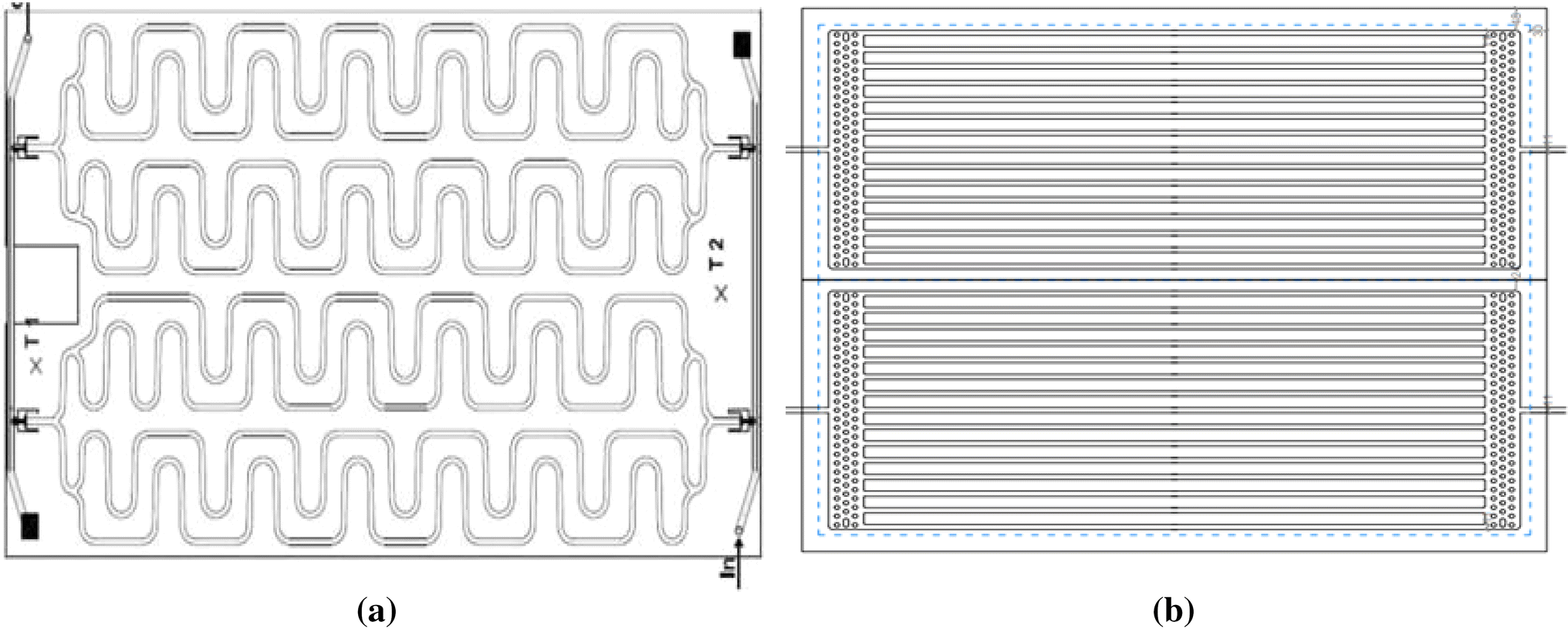
Aste et al. [
100
] analyzed the performance of covered and uncovered PV/T water collectors coupled with two aluminum roll-bond absorbers. The channel configurations used in covered and uncovered PV/T water collector are shown in Fig.
20
. The simulation study carried out based on mathematical modeling and it has been observed that the
ηT
of uncovered PV/T water collector is higher than the covered PV/T water collector.
Fig. 20
Roll-bond channel configuration used for
a
uncovered PV/T and
b
covered PV/T [
100
]
Wu et al. [
101
] presented a critical review of the thermal absorber connection method with PV/T module. EVA lamination method is the best suited for the connection of thermal absorber of PV/T module as compared to another conventional method. The authors further discussed the advantages of the roll-bond absorber, heat pipe array, extruded heat exchanger, and cotton wick design over the conventional thermal absorbers, such as sheet and tube design, rectangular tunnel absorber, fins, and groove absorbers. Song et al. [
102
] discussed the challenges faced by the PV manufacturing industry during lamination. Based on finite-element modeling, it is found that the back surface of the PV cell suffers from more stress during the lamination.
Over the last few decades, coupling of heat pump with PV/T gained a significant attention because of high-energy output and lower power consumption. Ji et al. [
103
] compared the performance of PV/T-SAHP with the conventional PV/T system. The outcome shows that the
ηele
of PV/T-SAHP system improved by 13.4% because of the good heat-absorbing capacity of refrigerant as compared to the conventional PV/T system. A significant improvement in
ηele
of PV/T-SAHP system as compared to PV/T system was reported by Fang et al. [
104
]. In another study, Ji et al. [
105
] presented the mathematical modeling of PV/T-SAHP system. Based on numerical simulation, the performance of the combined system is estimated and the
ηele
of the PV/T-SAHP was 13.4%. Using direct expansion evaporator, further enhancement in electrical and thermal performance of PV/T-SAHP system was observed [
106
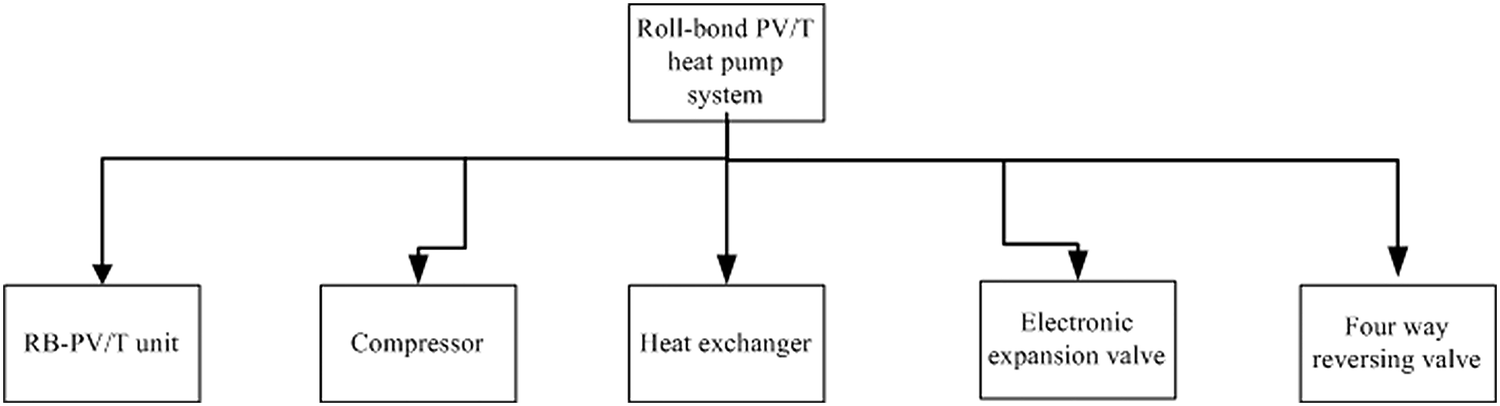
]. Zhou et al. [
107
] developed a roll-bond PV/T heat pump system to investigate the tri-generation (cooling/heating/electricity) operation of the system. The five major parts of the combined system are depicted in Fig.
21
.
Fig. 21
Major parts of RB-PV/T heat pump system
The outcomes of the experimental investigation showed that the RB-PV/T heat pump system is capable of supplying the electricity demand of a building with high efficiency along with space heating and cooling. An experimental investigation was performed by Kong et al. [
108
] to investigate the effect of charge quantity of refrigerant on the COP and efficiency of the direct expansion-solar-assisted heat pump (DX-SAHP) system.
Zhang et al. [
109
] performed simulations on PV/loop-heat-pipe (PV/LHP) system to investigate the effect of operational parameters such as solar intensity, ambient temperature, glazing and number of heat pipe on the efficiency, and COP of the system. Zhang et al. [
110
] continued his work to develop the transient model of PV/LHP system to inspect the dynamic performance of the proposed system. The outcomes of the investigation showed that the COP of the proposed system is 1.5 which is significantly higher than the COP of a conventional heat pump. The summary of the thermal and electrical performance of many studies is shown in Fig.
22
.
Fig. 22
Summary of PV/T water collector
Zarrella et al. [
111
] developed a lumped parameter-based simulation model using the TRASYS software to investigate the performance of PV/T coupled with the roll-bond absorber. A comparative study was presented between the simulation results and experimental data. It is to be noted that simulation results match the experimental measurement when the effect of the thermal capacitance of the element was considered.
PV/T system must be integrated into a building for room heating, space heating, etc. to improve its electrical and thermal performances. The term ‘Building-integration’ refers to the application of PV or PV/T system into the building envelope with or without the orientation to keep track of sunlight [
112
]. In BIPV/T the exhausted fluid is utilized for crop drying or surface heating purposes in buildings and hospitals. The BIPV/T system provides better efficiency and occupies less space and requires lesser maintenance as compared to solar thermal and solar PV systems individually. The possible growth and limitation of BIPV are discussed in the report presented by the International Energy Agency [
113
]. Baljit et al. [
19
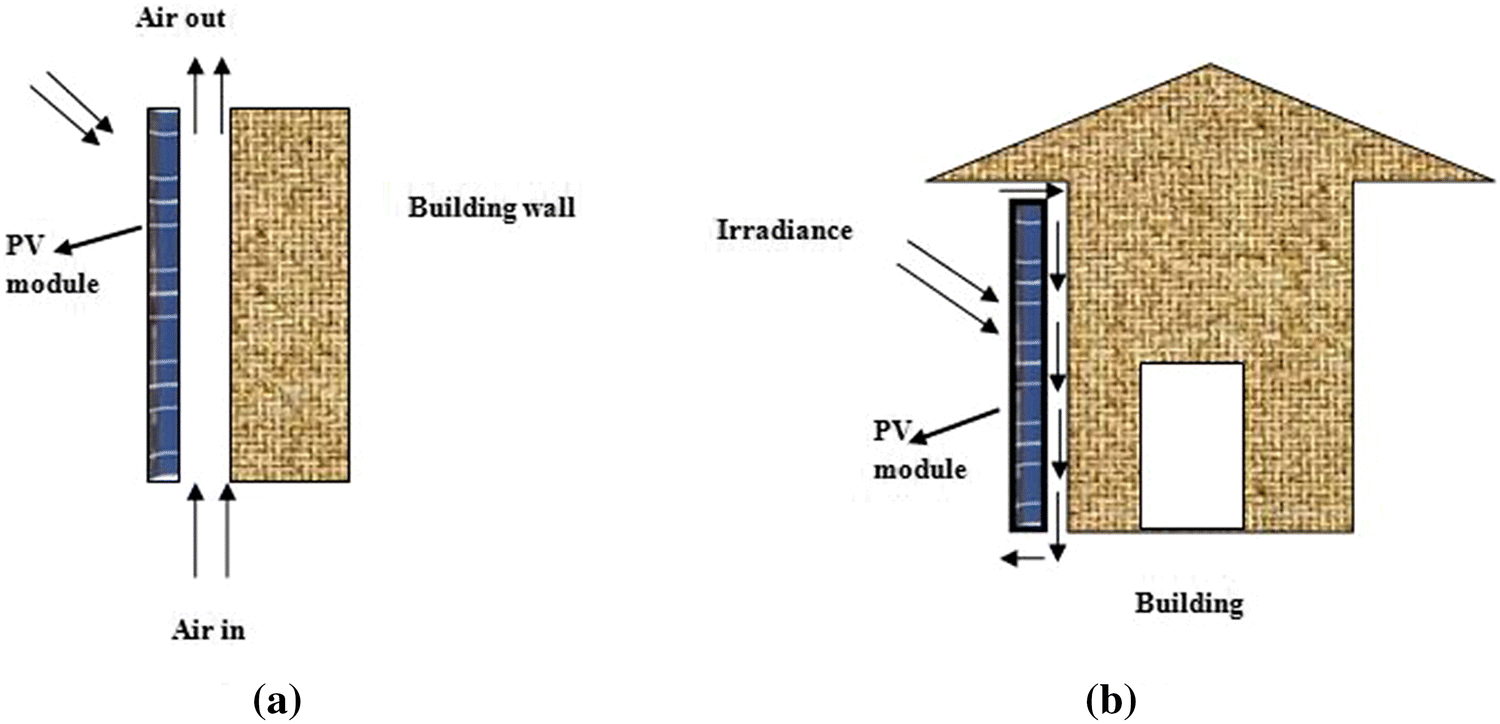
] discussed various building-integrated photovoltaic (BIPV) and BIPV/T technologies and its construction features. One of the configurations was BIPV-Wall/façade in which the PV panel was installed vertically on the wall of a building with an air gap or installed as a part of the building, as shown in Fig.
23
.
Fig. 23
BIPV system:
a
Staggered configuration of BIPV,
b
installed as a part of the building [
19
]
Effect of parameters on the performance of BIPV and BIPV/T
Experimental investigations have been carried out to determine the optimum air gap between the PV module and the wall of the building [
114
]. The size of the air gap decides the heat flow rate. As the air gap increases, the heat transfer through the gap decreases. The speed of airflow through the gap also affects heat transfer performance. The speed of 0.6 m/s reduces the PV module temperature by 38
°
C, while the speed of 1.2 m/s reduces the temperature by 45.3
°
C [
115
].
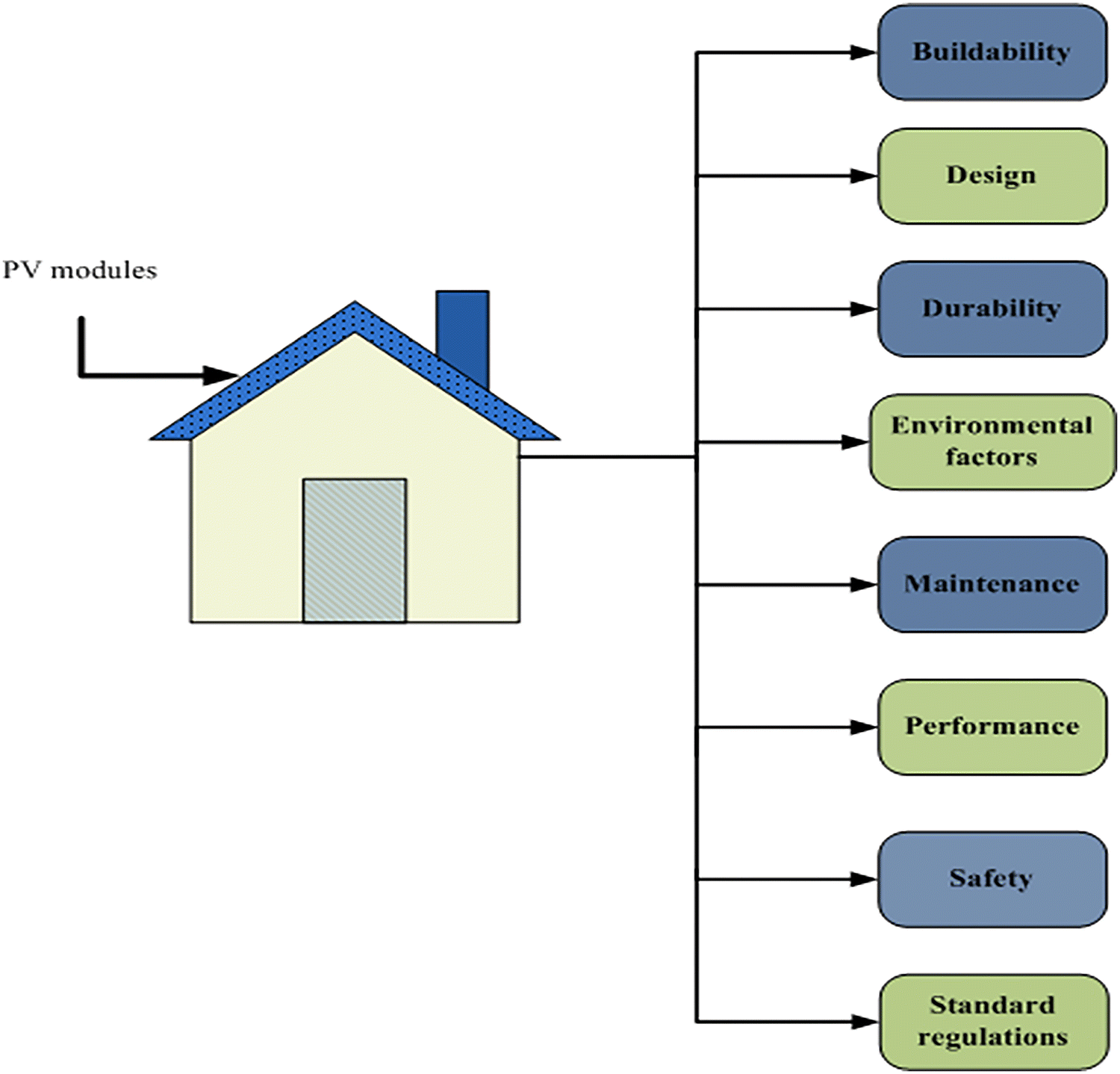
Another configuration of this technology is BIPV-roof. This configuration is used where the speed of natural air is higher, i.e., at high rise buildings. The natural flow of air can effectively cool the PV panel, thereby improving efficiency. Several parameters which are taken into consideration, while incorporating PVs into building roof/facades are shown in Fig.
24
[
116
].
Yang and Athienitis [
117
] compared the performance of the single inlet PV/T air collector attached to a building with two inlets BIPV/T. Based on experimental investigation, the authors conclude that with two inlets, BIPV/T achieved better thermal and electrical efficiencies. Agrawal and Tiwari [
118
] discussed the benefits of the BIPV/T system over BIPV as the additional thermal energy provided by the BIPV/T system.
Lin et al. [
119
] discussed the case study of the BIPV/T air-based rooftop system installed on a solar house in Quebec. Al-damook [
120
] investigated the impact of PAP connected with an unglazed solar air collector for the western Iraq climatic conditions. The experimental and theoretical results show that the use of an unglazed solar air collector is beneficial in terms of economy and thermal performance and PAP helps in achieving lower life cycle costs.
The experimental study shows that the PCM-PVT system can maintain a better output temperature and hence enhanced the
η
th of the system. Elarga et al. [
121
] worked on PV/T-PCM model and presented the mathematical modeling of the system. PCM layer helps in achieving better
η
th and led to a reduction in average cooling demand by 20–30%. With PCM, the
ηele
of the system has increased by 5–8%.
Mengjie et al. [
122
] discussed the importance of various PCMs in buildings to achieve net-zero energy consumption. Various researchers [
123
,
124
–
125
] discussed the importance of PCM gypsum in the inner wall of building to optimize the building performance. The use of PCM gypsum helped in lowering the temperature of the PV up to 4
°
C and helps in improving the electrical performance of the system. Lari et al. [
17
] investigated the performance of PV/T system using nanofluids. It has been observed that the performance of PV/T with nanofluid is significantly better than the conventional PV/T system. The use of metal-based nanoparticles [
126
] is more common in PV/T systems, because it results in a better thermal conductivity of the system as compared to carbon-based nanoparticles [
127
].
Tiwari et al. [
128
] performed an experimental analysis to investigate the effect of length, depth, and airflow rate on the
ηT
of PV/T air collector. The
ηT
is evaluated by considering one parameter fixed at one time. From the experiment analysis, it has been observed that the maximum
ηT
of the system is obtained at the air velocity of 2 m/s and this speed, an increase in collector length leads to an increase in
ηT
of the system. Tonui and Tripanagnostopoulos [
129
] examined the impact of collector length, depth, and air mass flow rate on
ηele
and
η
th of the system and fan input power on various PV/T configurations. Charles and Michael [
130
] presented a theoretical model of BIPV/T collector based on the heat transfer model, and concluded that the performance of the BIPV/T collector depends on thermal resistance and heat transfer coefficients. Mahmut et al. [
131
] experimentally tested a BIPV/T rooftop collector in the UK to analyze the energy, exergy, and techno-economic aspect. From the experimental results, a temperature difference of 16
°
C with a 20.25% improvement in
η
th was observed when a polyethylene heat exchanger is used to extract the heat from the module.
Role of soft-computing techniques in forecasting the performance of PV/T technology
A significant improvement is observed in the design, commercialization, cost, and performance of PV/T system in the recent time. Various parameters such as solar intensity, temperature across various layers, fluid velocity, mass flow rate of fluid, channel dimensions, etc. Different performance tests were conducted by researchers to validate and predict the performance of PV/T system under the influence of changing environmental conditions, collector configuration, channel dimensions, position of channel, etc. Performance testing on PV/T is turned out to be costly. Therefore, recently developed soft computing like NN, GSA, GA, WOA, ANN, ANFIS, and so on is turned out to be a reasonable replacement for the performance prediction of PV/T system. To investigate the performance of PV/T air collector, Varol [
132
] developed the prediction model based on different soft-computing methods, viz., ANN, ANFIS, and SVM. ANN is emerging as most popular among the various soft-computing techniques because of its capability of dealing with complex non-linear problems. Mojumder et al. [
133
] developed the prediction model based on recently developed ELM algorithm to forecast the performance of PV/T system. The results based on ELM model is than compared with GP and ANN results. From the comparative analysis, it has been concluded that ELM is a promising approach in predicting the PV/T system’s performance. Ammar et al. [
134
] developed the thermal energy distribution model based on ANN to calculate the optimum performance operating point of PV/T water collector. Singh et al. [
135
] investigated the performance of PV/T air collector using GA by optimizing its four parameters particularly length of the channel, depth of the channel, heat transfer coefficient and fluid velocity. The overall
ηEx
of the system was reported 16.88% at the optimized value of parameters, as shown in Table
2
. Therefore, the optimization of parameters is necessary to predict the performance.
Singh and Agrawal [
136
] worked upon hybrid GA-FS approach to optimize the parameters of PV/T air collector. The objective of the study is to maximize the
ηEx
. The
ηEx
of the system is 15.82% when the parameters were optimized using hybrid GA-FS approach which is significantly higher than the result obtained using GA. Moreover, the convergence rate of GA-FS approach is faster as compared to GA and it takes much lesser time in recognition of optimum value of parameters to enhance its performance. Evolutionary algorithm (EA) was introduced for hybrid PV/T air collector by Singh et al. [
137
]. The performance of the PV/T system is significantly enhanced using EA. Diwania et al. [
138
] worked upon newly developed WOA to optimize the performance of hybrid PV/T air collector by tuning its variable parameters. The result of WOA is than compared with GSA and GA and it has been concluded that
ηEx
and
ηele
of PV/T system is significantly improved when the parameters are tuned using WOA. Hence, the parameter optimization using soft-computing techniques gives extremely encouraging outcomes and turned out to be imperative in the predicting the performance of hybrid PV/T module.
Conclusion and future direction
In the present article, a comprehensive literature review on PV/T technology has been conducted, which will be very effective and useful for the researcher in this field. The current technology shows the application of PV/T in air collector, water collector, buildings, solar-assisted heat pump, and solar drying, with a major focus on the thermal portion. Furthermore, utilization of nanoparticles with water as a base fluid in the channel, the use of thermoelectric, and PCM is a boost to this technology, as these trends improve the PV/T system’s performance. Recently, optimization of parameters using various soft-computing techniques helped to achieve better performance. Moreover, the following observation can be drawn from the present study:
The exergy efficiency of PV/T air collector increases by parameter optimization using soft-computing techniques.
The thermal and electrical efficiency of PV/T air collector increases by modification in the channel such as using fins and thin metallic sheets, adding porous media in the air channel.
The thermal efficiency of the PV/T water collector increases by adding nanofluid and PCM in the channel.
The thermal efficiency and electrical efficiency of the PV/T water-collector increase with the roll-bond absorber.
An extensive review on PV/T technology has been conducted with certain future scope listed below in the presented research field:
The material used for the fabrication of solar cells plays a vital role in the performance of the PV/T system. It has been found from the previous research that, still, there is a wide future scope of research available in other solar cell technologies such as amorphous silicon and gallium arsenide.
The application of roll-bond absorber in the PV/T system may also be an interesting research field.
It is reported by many researchers that the performance of the PV/T system is improved significantly using a single laminated PVT system, but still there is a wide future scope available PV lamination technology.
Publisher's Note
Springer Nature remains neutral with regard to jurisdictional claims in published maps and institutional affiliations.
References
Basore and Cole (2018) Comparing supply and demand models for future photovoltaic power generation in the USA (pp. 414-418)
Sharma (2011) A comprehensive study of solar power in India and world (pp. 1767-1776)
Bhubaneswari and Goicranco (2011) A review of solar photovoltaic technologies (pp. 1623-1636)
Branker and Pearce (2010) Financial return for government support of large scale thin-film solar photovoltaic manufacturing in Canada (pp. 4291-4303)
Liou (2010) Overview of the PV technology status and perspective in Taiwan (pp. 1202-1215)
Schindler et al. (2017) How to achieve efficiencies exceeding 22% with multi-crystalline n-type silicon solar cells (pp. 777-780)
Tiwari et al. (2011) Photovoltaic modules and their applications: a review on thermal modelling (pp. 2287-2304)
Debberma et al. (2017) Thermal modeling, exergy analysis, performance of BIPV and BIPVT: a review (pp. 1276-1288)
Xie et al. (2015) Enhanced efficiencies in thin and semi-transparent dye-sensitized solar cells under low photon flux conditions using TiO2 nanotube photonic crystal (pp. 170-177)
Good et al. (2015) Hybrid photovoltaic/thermal systems in buildings—a review (pp. 683-690)
Babu and Ponnambalam (2017) The role of thermoelectric generators in the hybrid PV/T systems: a review (pp. 368-385)
Tian and Zhao (2013) A review of solar collectors and thermal energy storage in solar thermal applications (pp. 538-553)
Ibrahim et al. (2011) Recent advances in flat plate photovoltaic/thermal (PV/T) solar collectors (pp. 352-365)
Lamnatou and Chemisana (2017) Photovoltaic/thermal (PVT) systems: a review with emphasis on environmental issues (pp. 270-297)
Michael et al. (2015) Flat plate solar photovoltaic-thermal (PV/T) systems: a reference guide (pp. 62-88)
Muhammad and Sahin (2017) Design, performance and economic analysis of a nano-fluid based photovoltaic/thermal system for residential applications (pp. 467-484)
Kandilli (2013) Performance analysis of a novel concentrating photovoltaic combined system (pp. 186-196)
Baljit et al. (2016) Review of building integrated applications of photovoltaic and solar thermal systems (pp. 677-689)
Bazilian and Prasad (2002) Modelling of a photovoltaic heat recovery system and its role in a design decision support tool for building professionals (pp. 57-68)
Kern and Russell (1978) Massachusetts Institute of Technology
Bhargava et al. (1991) Study of a hybrid solar system—solar air heater combined with solar cell 31(5) (pp. 471-479)
Bergene and Lovvik (1995) Model calculations on a flat-plate solar heat collector with integrated solar cells (pp. 453-462)
Fujisawa and Tani (1997) Annual exergy evaluation on photovoltaic-thermal hybrid collector (pp. 135-148)
Unknown ()
Agrawal and Tiwari (2011) Energy and exergy analysis of hybrid micro-channel photovoltaic–thermal module (pp. 356-370)
Kalogirou et al. (2016) Exergy energy of solar thermal collectors and processes (pp. 106-137)
Petela (2003) Exergy of undiluted thermal radiation 74(6) (pp. 469-488)
Agarwal et al. (2012) Indoor experimental analysis of glazed hybrid PVT tiles air collector connected in series (pp. 145-151)
Agrawal and Tiwari (2011) Energy and exergy analysis of hybrid micro-channel photovoltaic–thermal module 85(2) (pp. 356-370)
Amori and Abd-Al Raheem (2014) Field study of various air based photovoltaic/thermal hybrid solar collectors (pp. 402-414)
Slimani et al. (2017) A detailed thermal-electrical model of three photovoltaic/thermal (PV/T) hybrid air collectors and photovoltaic module: comparative study under Algiers climate condition (pp. 458-476)
Sopian et al. (1996) Performance analysis of photovoltaic–thermal air heaters (pp. 1657-1670)
Tonui and Tripanagnostopoulos (2008) Performance improvement of PV/T solar collectors with natural air flow operation 82(1) (pp. 1-12)
Mojumdera et al. (2016) An experimental investigation on performance analysis of air type PV thermal collector system integrated with cooling fins design (pp. 272-285)
Kumar and Rosen (2011) Performance of a double pass PV/T solar air heater with and without fins (pp. 1402-1410)
Shahsavar and Ameri (2010) Experimental investigation and modeling of a direct coupled PV/T air collector (pp. 1938-1958)
Unknown ()
Jin et al. (2010) Evaluation of single-pass photovoltaic-thermal air collector with rectangle tunnel absorber (pp. 277-282)
Hussain et al. (2012) Comparison study of air base photovoltaic/thermal (PV/T) collector with different design of heat exchanger (pp. 189-194)
Othman et al. (2009) Performance study of photovoltaic-thermal (PV/T) solar collector with ∇-grooved absorber plate (pp. 537-541)
Vats et al. (2012) Effect of packing factor on the performance of a building integrated semitransparent photovoltaic–thermal (BIPVT) system with air duct (pp. 159-165)
Wu et al. (2011) A heat pipe photovoltaic/thermal (PV/T) hybrid system and its performance evaluation (pp. 3558-3567)
Unknown ()
Zondag (2008) Flat plate PV-thermal collectors and systems: a review 12(4) (pp. 891-959)
Unknown ()
Chow et al. (2009) Energy and exergy analysis of photovoltaic-thermal collector with and without glass cover (pp. 310-316)
Rajeb et al. (2015) Parameters effect analysis of a photovoltaic–thermal collector: case study for climate conditions of Monastir, Tunisia (pp. 409-419)
Ahmed and Mohammed (2017) Influence of porous media on the performance of hybrid PV/thermal collector (pp. 378-387)
Prashant et al. (2011) An analytical model to predict the thermal performance of a novel parallel flow packed bed solar air heater (pp. 2157-2167)
Yousef and Adam (2008) Performance analysis for flat plate collector with and without porous media 19(4) (pp. 32-42)
Sopian et al. (2009) Evaluation of thermal efficiency of double-pass solar collector with porous–non porous media (pp. 640-645)
Lon (2008) Cooling, heating, generating power, and recovering waste heat with thermoelectric systems 321(80) (pp. 1457-1461)
Dimri et al. (2018) Comparative study of photovoltaic–thermal (PVT) integrated thermoelectric cooler (TEC) fluid collectors
Dimri et al. (2017) Thermal modelling of semitransparent photovoltaic–thermal (PVT) with thermoelectric cooler (TEC) collector (pp. 68-77)
Vorobiev et al. (2006) Thermal-photovoltaic solar hybrid system for efficient solar energy conversion (pp. 170-176)
Tiwari et al. (2018) PVT air collector integrated green house dryers (pp. 142-159)
Chauhan et al. (2017) A review on thermal models for greenhouse dryers (pp. 548-558)
Aymen et al. (2015) Experimental investigation and economic evaluation of a new mixed mode solar greenhouse dryer for drying of red pepper and grape (pp. 1-8)
Lammle et al. (2016) Development and modelling of highly-efficient PVT collectors with low-emissivity coatings (pp. 161-173)
Singh and Kumar (2017) Heat transfer analysis of north wall insulated greenhouse dryer under natural convection mode (pp. 1264-1274)
Eltawil et al. (2017) Solar PV powered mixed-mode tunnel dryer for drying potato chips10.1016/j.renene.2017.10.007
Singh et al. (2019) Influence of absorber plate shape factor and mass flow rate on the performance of PVT system
Zondag et al. (2003) The yield of different combined PV-thermal collector designs (pp. 253-269)
Chow et al. (2009) Energy and exergy analysis of photovoltaic-thermal collector with and without glass cover 86(3) (pp. 310-316)
Kiran and Devadiga (2014) Performance analysis of hybrid PV/thermal systems (pp. 80-86)
Unknown ()
Unknown ()
Unknown ()
Rajput and Yang (2017) Comparison of heat sink and water type PV/T collector for polycrystalline photovoltaic panel cooling
Monakar et al. (2017) Integrated PV/T solar still: a mini-review (pp. 259-267)
Sotehi et al. (2016) Hybrid PV/T solar collector net zero energy building and fresh water production: a theoretical approach (pp. 1-11)
Unknown ()
Unknown ()
Unknown ()
Othman et al. (2016) Performance analysis of PV/T combi with water and air heating system (pp. 716-722)
Duffie and Beckman (1991) Wiley
Nasim et al. (2017) Decision tree based approach to control the efficiency of a hybrid PV/T solar system in Bangladesh (pp. 17-48)
Chamsa-ard et al. (2017) Nanofluids types, their synthesis, properties and their incorporation in direct solar thermal collectors: a review (pp. 1-31)
Maxwell (1873) Clarendon Press
Tyagi et al. (2009) Predicted efficiency of a low-temperature nanofluid-based direct absorption solar collector 131(4) (pp. 41-47)
Yousefia et al. (2012) An experimental investigation on the effect of Al2O3–H2O nanofluid on the efficiency of flat-plate solar collectors (pp. 293-298)
Yazdanifard et al. (2017) Performance of nanofluid-based photovoltaic/thermal systems: a review 2017(76) (pp. 323-352)
Said et al. (2016) Energy and exergy analysis of a flat plate solar collector using different sizes of aluminium oxide based nanofluid (pp. 518-530)
Bianco et al. (2018) Numerical analysis of Al2O3–water nanofluid forced laminar convection in an asymmetric heated channel for application in flat plate PV/T collector (pp. 9-21)
Al-Shamani et al. (2018) Mathematical and experimental evaluation of thermal and electrical efficiency of PV/T collector using different water based nano-fluids
Sardarabadi and Farad (2016) Experimental and numerical study of metal-oxides/water nanofluids as coolant in photovoltaic–thermal systems (PVT) (pp. 533-542)
Ghadiri et al. (2015) Experimental investigation of a PVT system performance using nano ferrofluids (pp. 468-476)
Radwan et al. (2016) Performance enhancement of concentrated photovoltaic systems using a microchannel heat sink with nanofluids (pp. 289-303)
Al-Waeli et al. (2017) Comparative study to use nano-(Al2O3, CuO and SiC) with water to enhance photovoltaic–thermal PV/T collectors (pp. 963-973)
Gunther et al. (2009) Enthalpy of phase change materials as a function of temperature: required accuracy and suitable measurement methods (pp. 1257-1269)
Preet et al. (2017) Experimental investigation of water based photovoltaic/thermal PV/T system with and without phase change material (pp. 1104-1120)
Liang et al. (2015) Performance evaluation of new type hybrid photovoltaic/thermal solar collector by experimental study (pp. 487-492)
Ong et al. (2017) Thermal and electrical performance of a hybrid design of a solar thermoelectric system (pp. 31-40)
Haurant et al. (2014) The PHOTOTHERM project: full scale experimentation and modelling of a photovoltaic-thermal (PV-T) hybrid system for domestic hot water applications (pp. 581-587)
Aste et al. (2012) Thermal-electrical optimization of the configuration a liquid PVT collector (pp. 1-7)
Dupeyrat et al. (2011) Improvement of PV module optical properties for PV-thermal hybrid collector applications (pp. 2028-2036)
Ying et al. (2019) Testing and modelling an unglazed photovoltaic–thermal collector for application in Sichuan Basin (pp. 931-941)
Aste et al. (2017) PV/T water collector performance comparison (pp. 961-966)
Wu et al. (2017) A review of thermal absorber and their integration methods for the combined solar PV/T module (pp. 839-854)
Song et al. (2018) Effect of interconnect geometry on the evolution of stresses in a solar photovoltaic laminate during and after lamination (pp. 241-248)
Ji et al. (2008) Experimental study of photovoltaic solar assisted heat pump system (pp. 43-52)
Fang et al. (2010) Experimental investigation on the photovoltaic-thermal solar heat pump air-conditioning system on water-heating mode 2010(34) (pp. 736-743)
Ji et al. (2008) Performance analysis of a photovoltaic heat pump (pp. 680-693)
Ji et al. (2009) Distributed dynamic modeling and experimental study of PV evaporator in a PV/T solar-assisted heat pump (pp. 1365-1373)
Zhou et al. (2019) Experimental investigation on the tri-generation performance of roll-bond photovoltaic–thermal heat pump system during summer (pp. 91-106)
Kong et al. (2017) Modeling evaluation of a direct-expansion solar assisted heat pump water heater using R410A (pp. 136-146)
Zhang et al. (2013) Characterization of a solar photovoltaic/loop-heat pipe heat pump water heating system (pp. 1229-1245)
Zhang et al. (2014) Dynamic performance of a novel solar photovoltaic/loop-heat-pipe heat pump system (pp. 335-352)
Zarrella et al. (2019) The validation of a novel lumped parameter model for photovoltaic–thermal hybrid solar collectors: a new TRANSYS type (pp. 414-428)
Gan (2009) Effect of air gap on the performance of building integrated photovoltaic’s (pp. 913-921)
Unknown ()
Kalogirou et al. (2014) Effect of air flow on a building integrated PV-panel (pp. 89-97)
Kim and Kim (2012) A simulation study of air type building integrated photovoltaic–thermal system (pp. 1016-1024)
Bloem et al. (2012) An outdoor test reference environment for double skin applications of building integrated photovoltaic systems (pp. 63-73)
Yang and Athienitis (2012) A study of design options for a building integrated photovoltaic/thermal (BIPV/T) system with glazed air collector with multiple inlets (pp. 177-186)
Agrawal and Tiwari (2010) Life cycle cost assessment of building integrated PV thermal (BIPVT) systems 42(9) (pp. 1472-1481)
Lin et al. (2014) Development and evaluation of ceiling ventilation system enhanced by solar PVT collectors and phase change materials (pp. 218-230)
Al-damook (2018) Experimental evaluation for an unglazed solar air collector for building space heating in Iraq
Elarga et al. (2016) Thermal and electrical performance of an integrated PV-PCM system in double skin facades. A numerical study (pp. 112-124)
Mengjie et al. (2018) Review on building energy performance using phase change materials (pp. 776-793)
Schossig et al. (2005) Micro-encapsulated phase change materials integrated into construction materials (pp. 297-306)
Voelker et al. (2008) Temperature reduction due to the application of phase change materials (pp. 937-944)
Unknown ()
Saidur et al. (2011) A review on applications and challenges of nanofluids (pp. 1646-1668)
Xu et al. (2016) Experimental thermal evaluation of a novel solar collector using magnetic nano-particles (pp. 252-259)
Tiwari et al. (2006) Performance evaluation of photovoltaic–thermal solar air collector for composite climate of India 90(2) (pp. 175-189)
Tonui and Tripanagnostopoulos (2007) Air cooled PV/T solar collectors with low cost performance improvements 81(4) (pp. 498-511)
Unknown ()
Mehmut et al. (2014) Performance evaluation and techno-economic analysis of a novel building integrated PV/T roof collector: an experimental validation (pp. 164-175)
Varol (2010) Forecasting of thermal energy storage performance of phase change material in a solar collector using soft computing techniques 37(4) (pp. 2724-2732)
Mojumder et al. (2018) The intelligent forecasting of the performance in PV/T collectors based on soft computing methods
Ammar et al. (2013) Artificial neural network based control for PV/T panel to track optimum thermal and electrical power (pp. 372-380)
Singh et al. (2015) Application of genetic algorithm with multi-objective function to improve the efficiency of glazed PVT system for New Delhi (India) climate conditions (pp. 153-166)
Singh and Agrawal (2015) Parameter identification of the glazed PVT system using Genetic Algorithm–Fuzzy System (GA–FS) approach and its comparative study (pp. 763-771)
Singh et al. (2015) Optimization of single channel glazed PVT array using evolutionary algorithm (EA) and carbon credit earned by the optimized array (pp. 303-312)