
 10.57647/ijc.2026.1602.14
Effect of Hematite Crystallinity on Catalytic Performance in the Heterogeneous Photo-Fenton Degradation of para-Nitrophenol
- Nurul Hidayat Aprilita *
 1
1
- Department of Chemistry, Universitas Gadjah Mada, Faculty of Mathematics and Natural Sciences, Bulaksumur, Yogyakarta 55281, Indonesia

Received: 2025-09-05
Revised: 2026-02-08
Accepted: 2026-02-14
Published Online: 2026-04-07

This work is licensed under a Creative Commons Attribution 4.0 International License.
How to Cite




PDF views: 59





Abstract
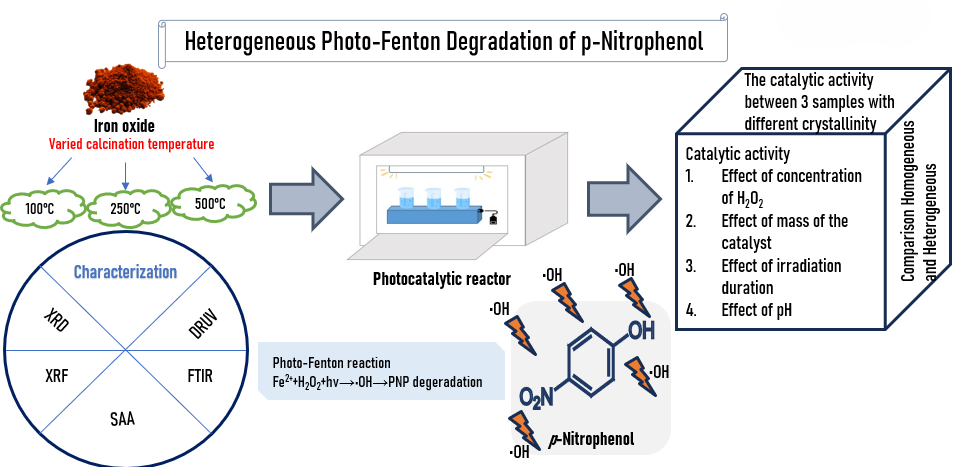
This study explores the effect of hematite (α-Fe₂O₃) crystallinity on the heterogeneous photo-Fenton degradation of para-nitrophenol (PNP). Hematite was synthesized by precipitating FeCl₃ with NaOH, followed by oven drying at 100°C and calcination at 250°C and 500°C to obtain catalysts with different crystallinity levels. The degradation was carried out under UV irradiation in the presence of H₂O₂ and hematite, with optimization of catalyst dosage, H₂O₂ concentration, initial pH, and irradiation time. The catalysts were characterized by XRF, XRD, BET, FTIR, and UV-Vis DRS. XRD and FTIR confirmed that higher calcination temperatures promoted crystallinity and phase purity, while BET analysis showed that elevated temperatures reduced surface area due to particle growth and sintering. UV-Vis DRS revealed band gap narrowing with increased crystallinity. Among the catalysts, hematite calcined at 250°C displayed moderate crystallinity, mesoporosity (2.9 nm), and the largest surface area (70.89 m²/g), achieving the highest PNP degradation (98.89%) at pH 6. In contrast, the oven-dried and highly crystalline (500°C) hematite exhibited lower catalytic performance. The 250°C catalyst also showed stability with minimal Fe leaching. These results highlight that moderate crystallinity optimizes catalytic activity and demonstrate the potential of engineered hematite as an efficient and reusable catalyst for sustainable water treatment.
Highlights
- Hematite crystallinity controlled by calcination influences photo-Fenton activity
- Hematite calcined at 250 °C shows highest PNP degradation efficiency (98.89%)
- Moderate crystallinity balances surface area and band gap for optimal performance
- Catalyst stable with minimal Fe leaching, effective at near-neutral pH (3–6)
- Demonstrates potential of hematite as low-cost, reusable water treatment catalyst
Keywords
- Hematite,
- Heterogeneous catalyst,
- Photodegradation,
- Photo-Fenton,
- Para-nitrophenol
References
- K. Tiar, A. Soualah, C. Bisio, M. Guidotti, Effect of Initial Solution pH on 4-Nitrophenol Oxidation Through Homogeneous/Heterogeneous Photo-Fenton Process Using Goethite/H2O2 System, J. Photochem. Photobiol. A Chem. 447 (2024) 115184. https://doi.org/10.1016/j.jphotochem.2023.115184.
- F. Li, K. Zhu, B. Liu, N. Wang, H. Liu, R. Chen, Comprehensive Effect of P-Nitrophenol Degradation in the Iron Oxide/Oxalate Suspension, Water, Air, Soil Pollut. 229 (2018) 91. https://doi.org/10.1007/s11270-018-3748-7.
- V.N. Lima, C.S.D. Rodrigues, Y.B. Brandão, M. Benachour, L.M. Madeira, Optimisation of the Degradation of 4-Nitrophenol by Fenton’s Process, J. Water Process Eng. 47 (2022) 102685. https://doi.org/10.1016/j.jwpe.2022.102685.
- Y. Wu, R. Chen, H. Liu, Y. Wei, D. Wu, Feasibility and Mechanism of p-nitrophenol Decomposition in Aqueous Dispersions of Ferrihydrite and H2O2 under Irradiation, React. Kinet. Mech. Catal. 110 (2013) 87–99. https://doi.org/10.1007/s11144-013-0571-4.
- C.S.D. Rodrigues, R.A.C. Borges, V.N. Lima, L.M. Madeira, p-Nitrophenol Degradation by Fenton’s Oxidation in a Bubble Column Reactor, J. Environ. Manag. 206 (2018) 774–785. https://doi.org/https://doi.org/10.1016/j.jenvman.2017.11.032.
- T. Liu, N. Chen, Y. Deng, F. Chen, C. Feng, Degradation of p-Nitrophenol by Nano-Pyrite Catalyzed Fenton Reaction with Enhanced Peroxide Utilization, RSC Adv. 10 (2020) 15901–15912. https://doi.org/10.1039/D0RA01177K.
- L. Clarizia, D. Russo, I. Di Somma, R. Marotta, R. Andreozzi, Homogeneous Photo-Fenton Processes at Near Neutral pH: A Review, Appl. Catal. B Environ. 209 (2017) 358–371. https://doi.org/10.1016/j.apcatb.2017.03.011.
- M. Ahmad, A.R.A. Aziz, S.A. Mazari, A.G. Baloch, S. Nizamuddin, Photocatalytic Degradation of Methyl Orange from Wastewater Using A Newly Developed Fe-Cu-Zn-ZSM-5 Catalyst, Environ. Sci. Pollut. Res. 27 (2020) 26239–26248. https://doi.org/10.1007/s11356-020-08940-9.
- K. O’Dowd, S.C. Pillai, Photo-Fenton Disinfection at Near Neutral pH: Process, Parameter Optimization and Recent Advances, J. Environ. Chem. Eng. 8 (2020) 104063. https://doi.org/10.1016/j.jece.2020.104063.
- J. Herney-Ramirez, M.A. Vicente, L.M. Madeira, Heterogeneous Photo-Fenton Oxidation with Pillared Clay-based Catalysts for Wastewater Treatment: A Review, Appl. Catal. B Environ. 98 (2010) 10–26. https://doi.org/10.1016/j.apcatb.2010.05.004.
- A. Barwal, R. Chaudhary, Effectiveness of Solar Photo‐Fenton Process for Simultaneous Detoxification of Heavy Metals and Disinfection in Municipal Wastewater by Using Response Surface Method, Environ. Prog. Sustain. Energy 36 (2017) 448–459. https://doi.org/10.1002/ep.12486.
- A. Choquehuanca, J.G. Ruiz-Montoya, A. La Rosa-Toro Gómez, Discoloration of methylene blue at neutral pH by heterogeneous photo-Fenton-like reactions using crystalline and amorphous iron oxides, Open Chem. 19 (2021) 1009–1020. https://doi.org/10.1515/chem-2021-0077.
- M. Silva, J. Baltrusaitis, Destruction of emerging organophosphate contaminants in wastewater using the heterogeneous iron-based photo-Fenton-like process, J. Hazard. Mater. Lett. 2 (2021) 100012. https://doi.org/10.1016/j.hazl.2020.100012.
- E.T. Wahyuni, A. Sabrina, N.H. Aprilita, Enhancement of Fenton Performance at Near-Neutral pH by Using Ethylene Diamine Tetra Acetic Acid for Anionic Surfactant Removal from a Laundry Wastewater, Key Eng. Mater. 920 (2022) 57–62. https://doi.org/10.4028/p-6652l7.
- L. Zhou, L. Wang, J. Zhang, J. Lei, Y. Liu, Well‐Dispersed Fe2O3 Nanoparticles on g‐C3N4 for Efficient and Stable Photo‐Fenton Photocatalysis under Visible‐Light Irradiation, Eur. J. Inorg. Chem. 2016 (2016) 5387–5392. https://doi.org/10.1002/ejic.201600959.
- T. Guo, K. Wang, G. Zhang, X. Wu, A novel α-Fe2O3@g-C3N4 Catalyst: Synthesis Derived from Fe-based MOF and its Superior Photo-Fenton Performance, Appl. Surf. Sci. 469 (2019) 331–339. https://doi.org/10.1016/j.apsusc.2018.10.183.
- D. Liu, C. Li, T. Ni, R. Gao, J. Ge, F. Zhang, W. Wu, J. Li, Q. Zhao, 3D Interconnected Porous g-C3N4 Hybridized with Fe2O3 Quantum Dots for Enhanced Photo-Fenton Performance, Appl. Surf. Sci. 555 (2021) 149677. https://doi.org/10.1016/j.apsusc.2021.149677.
- H. Zhao, C. Tian, J. Mei, S. Yang, P.K. Wong, Faster Electron Injection and Higher Interface Reactivity in g-C3N4/Fe2O3 Nanohybrid for Efficient Photo-Fenton-like Activity toward Antibiotics Degradation, Environ. Res. 195 (2021) 110842. https://doi.org/10.1016/j.envres.2021.110842.
- X. Qian, M. Ren, Y. Zhu, D. Yue, Y. Han, J. Jia, Y. Zhao, Visible Light Assisted Heterogeneous Fenton-Like Degradation of Organic Pollutant via α-FeOOH/Mesoporous Carbon Composites, Environ. Sci. Technol. 51 (2017) 3993–4000. https://doi.org/10.1021/acs.est.6b06429.
- J. Hu, J. Li, J. Cui, W. An, L. Liu, Y. Liang, W. Cui, Surface Oxygen Vacancies enriched FeOOH/Bi2MoO6 Photocatalysis-Fenton Synergy Degradation of Organic Pollutants, J. Hazard. Mater. 384 (2020) 121399. https://doi.org/10.1016/j.jhazmat.2019.121399.
- L. Xu, J. Wang, Fenton-like Degradation of 2,4-Dichlorophenol Using Fe3O4 Magnetic Nanoparticles, Appl. Catal. B Environ. 123–124 (2012) 117–126. https://doi.org/10.1016/j.apcatb.2012.04.028.
- L. Xu, J. Wang, Magnetic Nanoscaled Fe3O4/CeO2 Composite as an Efficient Fenton-Like Heterogeneous Catalyst for Degradation of 4-Chlorophenol, Environ. Sci. Technol. 46 (2012) 10145–10153. https://doi.org/10.1021/es300303f.
- P.K. Boruah, B. Sharma, I. Karbhal, M. V. Shelke, M.R. Das, Ammonia-modified Graphene Sheets Decorated with Magnetic Fe3O4 Nanoparticles for the Photocatalytic and Photo-Fenton Degradation of Phenolic Compounds under Sunlight Irradiation, J. Hazard. Mater. 325 (2017) 90–100. https://doi.org/10.1016/j.jhazmat.2016.11.023.
- R. Saleh, A. Taufik, Degradation of Methylene Blue and Congo-Red Dyes Using Fenton, Photo-Fenton, Sono-Fenton, and Sonophoto-Fenton Methods in the Presence of Iron(II,III) Oxide/Zinc Oxide/Graphene (Fe3O4/ZnO/Graphene) Composites, Sep. Purif. Technol. 210 (2019) 563–573. https://doi.org/10.1016/j.seppur.2018.08.030.
- X. Li, K. Cui, Z. Guo, T. Yang, Y. Cao, Y. Xiang, H. Chen, M. Xi, Heterogeneous Fenton-like Degradation of Tetracyclines Using Porous Magnetic Chitosan Microspheres as An Efficient Catalyst Compared with Two Preparation Methods, Chem. Eng. J. 379 (2020) 122324. https://doi.org/10.1016/j.cej.2019.122324.
- R. Wang, Y. Chu, H. Zhang, Comprehensive Evaluation of the Catalytic Activity of alpha-Ferric Oxide in Photocatalysis, Fenton-like and Photo-Fenton Systems for Organics Degradation: Performance and in-depth Mechanism Consideration, J. Environ. Chem. Eng. 12 (2024) 112479. https://doi.org/10.1016/j.jece.2024.112479.
- L. Guo, F. Chen, X. Fan, W. Cai, J. Zhang, S-doped α-Fe2O3 as a Highly Active Heterogeneous Fenton-like Catalyst towards the Degradation of Acid Orange 7 and Phenol, Appl. Catal. B Environ. 96 (2010) 162–168. https://doi.org/10.1016/j.apcatb.2010.02.015.
- K. Tiar, A. Soualah, C. Bisio, S. Marchesi, V. Pappalardo, S. Econdi, M. Guidotti, Tuning iron loading and specific surface area in iron-containing clays for the oxidative photodegradation of 4-nitrophenol, Appl. Catal. A Gen. 707 (2025). https://doi.org/10.1016/j.apcata.2025.120522.
- S.-P. Sun, A.T. Lemley, p-Nitrophenol Degradation by a Heterogeneous Fenton-like Reaction on Nano-Magnetite: Process Optimization, Kinetics, and Degradation Pathways, J. Mol. Catal. A Chem. 349 (2011) 71–79. https://doi.org/10.1016/j.molcata.2011.08.022.
- J. Xu, Q. Ma, W. Feng, X. Zhang, Q. Lin, C. You, X. Wang, Removal of Methyl Orange from Water by Fenton Oxidation of Magnetic Coconut-Clothed Biochar, RSC Adv. 12 (2022) 24439–24446. https://doi.org/10.1039/d2ra03545f.
- A.R. Chakraborty, F.T. Zohora Toma, K. Alam, S.B. Yousuf, K.S. Hossain, Influence of Annealing Temperature on Fe2O3 Nanoparticles: Synthesis Optimization and Structural, Optical, Morphological, and Magnetic Properties Characterization for Advanced Technological Applications, Heliyon 10 (2024) e40000. https://doi.org/10.1016/j.heliyon.2024.e40000.
- M.K. Ghosh, G.E.J. Poinern, T.B. Issa, P. Singh, Arsenic Adsorption on Goethite Nanoparticles Produced through Hydrazine Sulfate Assisted Synthesis Method, Korean J. Chem. Eng. 29 (2012) 95–102. https://doi.org/10.1007/s11814-011-0137-y.
- S. Guo, G. Zhang, J. Wang, Photo-Fenton Degradation of Rhodamine B using Fe2O3-Kaolin as Heterogeneous Catalyst: Characterization, Process Optimization and Mechanism, J. Colloid Interface Sci. 433 (2014) 1–8. https://doi.org/10.1016/j.jcis.2014.07.017.
- M. Habran, P.I. Pontón, L. Mancic, O. Pandoli, K. Krambrock, M.E.H. Maia, S. Letichevsky, A.M.L.M. Costa, E. Morgado, B.A. Marinkovic, Journal of Photochemistry & Photobiology A : Chemistry Visible Light Sensitive Mesoporous Nanohybrids of Lepidocrocite-like Ferrititanate Coupled to a Charge Transfer Complex : Synthesis, Characterization and Photocatalytic Degradation of NO, J. Photochem. Photobiol. A Chem. 365 (2018) 133–144. https://doi.org/https://doi.org/10.1016/j.jphotochem.2018.07.038.
- A. Hakim, M.A. Yarmo, T.S. Marliza, M.N.A. Tahari, W.Z. Samad, M.R. Yusop, M.W.M. Hisham, N. Dzakaria, The Influence of Calcination Temperature On Iron Oxide (α-Fe2O3) Towards CO2 Adsorption Prepared By Simple Mixing Method, Malaysian J. Anal. Sci. 20 (2016) 1286–1298. https://doi.org/10.17576/mjas-2016-2006-07.
- M. Mohammadikish, Hydrothermal Synthesis, Characterization and Optical Properties of Ellipsoid Shape α-Fe2O3 Nanocrystals, Ceram. Int. 40 (2014) 1351–1358. https://doi.org/10.1016/j.ceramint.2013.07.016.
- M. Dutt, K. Suhasini, A. Ratan, J. Shah, R.K. Kotnala, V. Singh, Mesoporous Silica Mediated Synthesis of α-Fe2O3 Porous Structures and their Application as Humidity Sensors, J. Mater. Sci. Mater. Electron. 29 (2018) 20506–20516. https://doi.org/10.1007/s10854-018-0186-7.
- W. Salama, M. El Aref, R. Gaupp, Spectroscopic Characterization of Iron Ores Formed in Different Geological Environments Using FTIR, XPS, Mössbauer Spectroscopy and Thermoanalyses, Spectrochim. Acta Part A Mol. Biomol. Spectrosc. 136 (2015) 1816–1826. https://doi.org/10.1016/j.saa.2014.10.090.
- Y. Wang, Y. Gao, L. Chen, H. Zhang, Goethite as an efficient heterogeneous Fenton catalyst for the degradation of methyl orange, Catal. Today 252 (2015) 107–112. https://doi.org/10.1016/j.cattod.2015.01.012.
- M. Zain, K.A. Yasin, S. Haq, W. Rehman, S.U. Din, S. Shujaat, A. Syed, M.K. Hossain, B.A. Paray, J. Razzokov, A. Samad, Effect of Calcination Temperature Induced Structural Modifications on the Photocatalytic Efficacy of Fe2O3-ZrO2 Nanostructures: Mechanochemical Synthesis, RSC Adv. 14 (2024) 15085–15094. https://doi.org/10.1039/d4ra01944j.
- S.S. Abdullahi, S. Güner, Y. Koseoglu, I.M. Musa, B.I. Adamu, M.I. Abdulhamid, Simple Method for the Determination of Band Gap of A Nanopowdered Sample Using Kubelka Munk Theory, J. Niger. Assoc. Math. Phys. 35 (2016) 241–264. https://www.researchgate.net/profile/Bala-Adamu/publication/305810656_Simple_Method_For_The_Determination_of_Band_Gap_of_a_Nanopowdered_Sample_Using_Kubelka_Munk_Theory/links/57a2f3e408aeb16048366032/Simple-Method-For-The-Determination-of-Band-Gap-of-a-Na.
- A. Saidani, R. Boudraa, K. Fendi, L. Benouadah, A. Benabbas, A. Djermoune, S. Salvestrini, J.-C. Bollinger, A.A. Alayyaf, L. Mouni, Effect of Calcination Temperature on the Photocatalytic Activity of Precipitated ZnO Nanoparticles for the Degradation of Rhodamine B Under Different Light Sources, Water 17 (2024) 32. https://doi.org/10.3390/w17010032.
- M. Hojamberdiev, G. Zhu, A. Eminov, K. Okada, Template-Free Hydrothermal Synthesis of Hollow α-FeOOH Urchin-Like Spheres and Their Conversion to α-Fe2O3 Under Low-Temperature Thermal Treatment in Air, J. Clust. Sci. 24 (2013) 97–106. https://doi.org/10.1007/s10876-012-0522-7.
- Y. Zhu, Q. Xie, F. Deng, Z. Ni, Q. Lin, L. Cheng, X. Chen, R. Qiu, R. Zhu, The differences in heterogeneous Fenton catalytic performance and mechanism of various iron minerals and their influencing factors: A review, Sep. Purif. Technol. 325 (2023) 124702. https://doi.org/10.1016/j.seppur.2023.124702.
- Y. Li, Z. Lv, S. Zhang, Y. Zhang, S. Wu, R. Liu, Controlled Fabrication and Characterization of α-FeOOH Nanorods, J. Inorg. Organomet. Polym. Mater. 32 (2022) 1400–1408. https://doi.org/10.1007/s10904-021-02190-z.
- S.R. Pouran, A.R.A. Aziz, W.M.A.W. Daud, Review on the Main Advances in Photo-Fenton Oxidation System for Recalcitrant Wastewaters, J. Ind. Eng. Chem. 21 (2015) 53–69. https://doi.org/10.1016/j.jiec.2014.05.005.
- W.S. Hamd, J. Dutta, Heterogeneous Photo-Fenton Reaction and its Enhancement upon Addition of Chelating Agents, in: Nanomater. Detect. Remov. Wastewater Pollut., Elsevier, 2020: pp. 303–330. https://doi.org/10.1016/B978-0-12-818489-9.00011-6.
- Y. Ahmed, Z. Yaakob, P. Akhtar, Degradation and mineralization of methylene blue using a heterogeneous photo-Fenton catalyst under visible and solar light irradiation, Catal. Sci. Technol. 6 (2016) 1222–1232. https://doi.org/10.1039/c5cy01494h.
- H. Ghazzaf, B. Nechchadi, A. Jouali, A. Salhi, M. El Krati, S. Tahiri, Synthesis of Heterogeneous Photo-Fenton Catalyst from Iron Rust and its Application to Degradation of Acid Red 97 in Aqueous Medium, J. Environ. Chem. Eng. 10 (2022). https://doi.org/10.1016/j.jece.2022.107570.
- A.N. Soon, B.H. Hameed, Heterogeneous Catalytic Treatment of Synthetic Dyes in Aqueous Media Using Fenton and Photo-Assisted Fenton Process, Desalination 269 (2011) 1–16. https://doi.org/10.1016/j.desal.2010.11.002.
- X. Liu, H.-L. Liu, K.-P. Cui, Z.-L. Dai, B. Wang, X. Chen, Heterogeneous Photo-Fenton Removal of Methyl Orange Using the Sludge Generated in Dyeing Wastewater as Catalysts, Water 14 (2022) 629. https://doi.org/10.3390/w14040629.
- M. Mishra, D.M. Chun, α-Fe2O3 as a photocatalytic material: A review, Appl. Catal. A Gen. 498 (2015) 126–141. https://doi.org/10.1016/j.apcata.2015.03.023.
- N. Thomas, D.D. Dionysiou, S.C. Pillai, Heterogeneous Fenton Catalysts: A Review of Recent Advances, J. Hazard. Mater. 404 (2021) 124082. https://doi.org/10.1016/j.jhazmat.2020.124082.
- L. Demarchis, M. Minella, R. Nisticò, V. Maurino, C. Minero, D. Vione, Photo-Fenton reaction in the presence of morphologically controlled hematite as iron source, J. Photochem. Photobiol. A Chem. 307–308 (2015) 99–107. https://doi.org/10.1016/j.jphotochem.2015.04.009.