A Window onto the Eocene (Cenozoic): The Palaeontological Record of the Sobrarbe-Pirineos UNESCO Global Geopark (Huesca, Aragon, Spain)
- Jose Ignacio Canudo * Email ORCID 1
- Ainara Badiola 2
- Anchel Belmonte 3
- Jesús Cardiel 4
- Gloria Cuenca-Bescos 1
- Ester Diaz Berenguer 1
- Fernando Ferratges 1
- Miguel Moreno Azanza 5
- Adan Perez Garcia 6
- Manuel Perez Pueyo 1
- Roi Silva Casal 7
- Samuel Zamora Iranzo 1, 8
Abstract
The Sobrarbe-Pirineos UNESCO Global Geopark, located in the Central Pyrenees, is a region of remarkable geodiversity that includes extensive Eocene fossil-bearing sites and constitutes an important archive of paleobiodiversity. The Sobrarbe-Pirineos Geopark hosts outcrops of Eocene formations bearing an unusual abundance and diversity of fossils from marine and continental sedimentary environments, making the Sobrarbe-Pirineos Geopark a perfect window for learning about tropical ecosystems of the Eocene of southern Europe. These environments were in part tectonically controlled and offer a unique opportunity to understand how faunas changed in an active area. Here, we outline the main groups of fossils from the Sobrarbe-Pirineos Geopark, including popular examples such as the âCrocodile of Ordesa-Vioâ and the sirenian Sobrarbesiren. The Geopark has been a major tool in the geoconservation of Eocene fossils.Introduction
The Sobrarbe-Pyrenees UNESCO Global Geopark was created in 2006. This Geopark coincides geographically with Sobrarbe County, a historical region in the north of the province of Huesca (Central Pyrenees, Aragon, Spain) that includes the world-famous Ordesa y Monte Perdido National Park. The Geopark is remarkable for its landscape, modeled by spectacular geology; indeed, a rich geodiversity exists within its territory, manifest in a range of geomorphological, paleontological, mineralogical, petrographical, stratigraphic, structural and tectonic features. It is currently a key engine of development for the Sobrarbe, a hidden gem of the Pyrenees.
The most interesting and complete initiative for diffusion of geological heritage in the Sobrarbe Geopark is called âDiscover the Geoparkâ. It includes various tourist routes for those who want to know the geological features of the Geopark (Carcavilla et al. 2015; Fernández-MartÃnez et al. 2015). These routes and other proposals can be consulted on the website of the Geopark (http://www.geoparquepirineos.es). The fossils are noted for their heritage, didactic and geotourism interest, which is why there are many initiatives in which the paleontological heritage is a resource for promoting geotourism (Audije-Gil et al. 2018 Cobos & Alcalá 2018 Rabal-Garcés et al. 2018).
Â
Fossils are abundant in the sedimentary rocks of the Geopark. In the Paleozoic there are diverse but poorly preserved invertebrate fossils; among vertebrate fossils, only conodonts have been described. Cretaceous fossils are scarce, and only invertebrates are known, rudists being the most abundant group. The Eocene is the interval with the most significant and diverse fossil record. Visitors to the Geopark can see Eocene fossils at the Paleontological Museum located in Lamata (Abizanda) in its 120-square-meter permanent exhibition (Cardiel Lalueza 2009). The museum is open all year by appointment ([email protected]). Also noteworthy are sites with fossils of Pleistocene vertebrates, the most important being the Tella Bear Cave. This is one of the most important sites of the late Pleistocene of the Pyrenees, possessing a broad representation of Ursus spelaeus (Rabal-Garcés et al. 2012). A great effort has been made in geoconservation and public outreach at this site, with the establishment of the Tella Cave Bear Museum and the adaptation of the cave bear site for visitors (Canudo & Cuenca-Bescós 2006).
Rather like the region itself, the paleontological record of the Sobrarbe-Pirineos UNESCO Global Geopark has not attracted international attention, with very few exceptions listed below. Nevertheless, in the last decade, a large effort has been made to explore this record, revealing an exceptional hidden diversity that has brought Sobrarbe into the spotlight, providing key information on different groups, including large benthic foraminifera, crustaceans and aquatic mammals (Table 1). The aim of the present paper is thus to provide an overview of the paleobiodiversity of the Eocene in the Geopark, placing special emphasis on some of the most significant fossils.
Â
Table 1. Fossil taxa described in the Sobrarbe-Pirineos UNESCO Global Geopark (Moliner 2019). The author's name in parentheses is for taxa in which the initially assigned genus has been changed.
Â
Taxa | Author | Group | Locality |
Nummulites messiniae | Schaub 1981 | Foraminifera | Formigales |
Cyathoseris cortazari | Mallada 1878 | Hexacorallia | Mediano |
Ostrea rouaulti | Mallada 1878 | Bivalvia | Fiscal |
Crassostrea medianensis | Carez 1881 | Bivalvia | Mediano |
Macropneustes trutati | Cotteau 1889 | Echinoidea | RañÃn |
Septachaetetes eocenus | Almela & RÃos 1944 | Porifera | Samitier |
Periacanthus tatracornis | Ferratges et al. 2014 | Decapoda | Atiart |
Peltarion pirenaicus | Aguilar & Castillo 2016 | Decapoda | Santa MarÃa de Nuez |
Sobrarbesiren cardieli | DÃaz Berenguer et al. 2018 | Mammalia | Castejón de Sobrarbe |
Â
Geological Setting
The Sobrarbe-Pirineos Geopark preserves the geological record of the last 550 million years, from the Cambrian to the present day. In general, the large geological units are distributed in east-west-running bands that are younger towards the south (Fig. 1). The oldest rocks crop out to the north (Axial Pyrenees area) near the border with France. These are mainly Paleozoic units of plutonic origin, metamorphic rocks of different degrees and types of metamorphism, and sedimentary rocks in the areas furthest from the metamorphism (Fig. 1). In some areas, such as in the headwaters of Ordesa, Tertiary rocks emerge as a consequence of the tectonic thrust of the Tertiary (Pujalte et al. 2016).
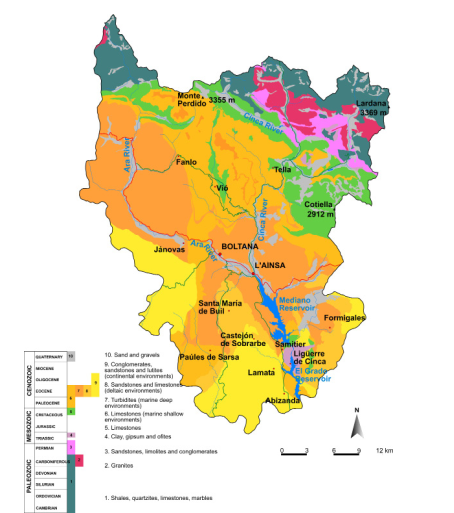
Figure 1. Geological map of Sobrarbe-Pirineos UNESCO Global Geopark.
Towards the south of the axial area are extensive sets of Triassic to Quaternary materials belonging to the South Pyrenean Zone. The Upper Cretaceous to the Eocene is the best-represented interval, with carbonate platform facies, detrital materials with slope facies, canyon filling and large turbidite fans. The southernmost areas of the Geopark abound with marine carbonate facies as well as siliciclastic, deltaic and continental fluvial facies (Mochales et al. 2012). As a whole, these represent the regression associated with the tectonics that formed the Pyrenean mountain chain.
Â
Many of the geological formations of the Geopark present a major tectonic deformation that records the main events that built the Pyrenean orogen, providing excellently preserved examples of the relationship between tectonics and sedimentation (Mochales et al. 2012) and how this is reflected in the fossils preserved through time. The relief, with a marked structural character, is built around the Cinca River. Glacial, periglacial and karst landforms predominate in the high mountains, whereas terraces, glacis, gullies and bedrock rivers are characteristic of the central and southern areas.
Â
Geoheritage of the Fossils of Geopark
 Larger Foraminifera
Larger benthic foraminifera are especially abundant in the Eocene of the Sobrarbe-Pirineos Geopark. These single-celled organisms were very widespread during the Paleogene, particularly the Eocene (Hottinger 1998). The larger benthic foraminifera are notable for having developed a K-type ecological strategy consisting of symbiosis with single-cell algae, strong sexual dimorphism and great specialization based on the bathymetry and energy of the medium (Hallock 1985). This strategy allowed them to proliferate in nutrient-poor (oligotrophic) seas throughout Tethys and in nearby regions such as the north of the present-day Iberian Peninsula. Starting in the early Eocene, due in part to the marked global warming that occurred at the beginning of this period (PETM, Paleocene-Eocene Thermal Maximum), the larger foraminifera underwent great evolutionary radiation (Pujalte et al. 2003).
Â
Larger benthic foraminifera are very abundant in the early and middle Eocene of the Geopark. The genera Nummulites, Assilina, Alveolina and Orbitolites are found in large accumulations that can form layers of several meters. Evidence of the evolutionary radiation undergone by the larger foraminifera in the early Eocene is recorded in the limestone peaks of the Inner Sierras of the Ordesa y Monte Perdido National Park. The Faja de las Flores Member (La Pardina Formation, Pujalte et al. 2016) marks the beginning of the early Eocene. Great quantities of Alveolina are observed in the limestone rocks belonging to the Goriz Formation (at the top of the sandstones of La Pardina Formation). In the Rio Ara Canyon, between the villages of Boltaña and Jánovas, we also find a great variety of larger foraminifera from the early Eocene (Mochales et al. 2012), which are somewhat more modern than the aforementioned ones in the National Park. Larger foraminifera are the most abundant fossils in the Boltaña Formation, the geological unit that forms the spectacular Boltaña anticline.
Â
The southwest of the Geopark (Ainsa Basin) is an area of great interest for the study of larger foraminifera. Schaub (1981) identified large numbers of outcrops with these fossils from the Cuisian and Lutetian between the Ãsera and the Cinca Rivers. The index fossil of the lower Lutetian, Nummulites messiniae, has been described in the locality of Formigales (Schaub 1981). Furthermore, Samsó et al. (1994) identified in the Mediano anticline large foraminifera dating to the Lutetian that are of great importance globally. Serra-Kiel et al. (1998) proposed the Mediano outcrops and the locality of Samitier as global references for the study of the macroforaminiferal biozones of the middle Lutetian. Also noteworthy are the spectacular nummulitic beds in the upper Lutetian 'Buil Level' (Fig. 2) in Santa Maria de Buil (Mateu-Vicens et al. 2012), intercalated between the deltaic materials of the Sobrarbe Formation.
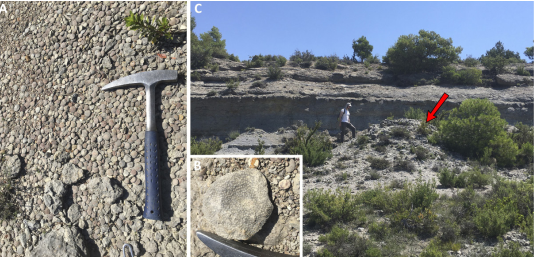
Figure 2. A) Detail of the nummulite beds in the Santa Maria de Buil area. B) Coral colony. C) Coral biostromes close to the top of the nummulite sequences.
Invertebrates
The Ainsa Basin records important invertebrate faunas from the Lutetian (middle Eocene). These faunas have been known since the classic works of Mallada (1878), although they are in general poorly understood in systematic terms and appear scattered in local monographs (Cardiel Lalueza 2009) or systematic papers (Carrasco & Cardiel Lalueza 2015). In these works, the invertebrate faunas are disconnected from the geological units in which they occur, which hampers our ability to gain a full understanding of the ecological evolution of such faunas through time. Other works have treated invertebrate faunas more generally to reconstruct the paleoecology of specific outcrops, especially those associated with the development of reefs (Mateu-Vicens et al. 2012; Pomar et al. 2017).
Â
Invertebrate fossils from the Geopark appear in different intervals, especially the marine Grustan Formation and its lateral equivalent, the San Vicente Formation, as well as the younger Sobrarbe Formation (Pomar et al. 2017). In the western flank of the Mediano anticline, three successive carbonate ramp units from the Grustan Formation occur (Arbués et al. 2011), harboring invertebrate faunas at several levels that usually appear very fragmented. According to Arbués et al. (2011) and Pomar et al. (2017), the unstable Grustan ramps consist of medium- to fine-grained bioclastic carbonates rich in large benthic foraminifers, molluscs, echinoderms, small benthic foraminifers and red algae (often in the form of rhodoids). Branching and solitary corals are found in shallower lithofacies, and discrete mounds capped by irregular massive corals occur in deeper positions, commonly affected by early sliding and brecciation. Fragments of these carbonate platforms were produced and transported during the deformation of the Mediano anticline. Their remains occur resedimented in the deeper, laterally equivalent San Vicente Formation, in the western part of the Mediano reservoir. They contain a rich and diverse invertebrate assemblage within their coral-red algae boulders, including decapod crustaceans, echinoderms (both crinoids and echinoids) and molluscs (Fig. 3). In the area of Paules de Sarsa, the San Vicente Formation also contains a low-diversity but rich fauna of autochthonous decapod crustaceans dominated by the crab Harpactoxanthopsis quadrilobata (Fig. 3), first mentioned by Garrido (1943). Other minor components include the crab âPeltarion pirenaicusâ (Aguilar & Castillo 2017), echinoids and molluscs.
Â
The overlying Sobrarbe Formation in the Mediano area close to Ligüerre de Cinca represents a discrete carbonate unit composed of calcarenites, small mounds with corals, and nummulitic beds interbedded with the laminated, pro-delta silt and clays of the Sobrarbe complex (Pomar et al. 2017). The nummulitic beds in this area have provided rare decapods including pagurids and Lophoranina, as well as rare echinoids and molluscs. Nummulitic beds (Fig. 2A) dominate the top of the same formation in Santa Maria de Buil (Mateu-Vicens et al. 2012). Towards the top of the sequence coral biostromes occur (Fig. 3), and according to Mateu-Vicens et al. (2012), these contain a rich invertebrate fauna including coelenterates, echinoids, molluscs, very rare bryozoans, ostracods and decapods.
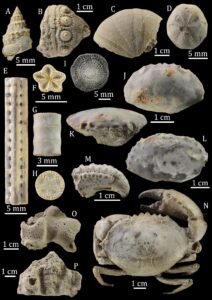
Figure 3. Invertebrate fauna from the Grustan (A-M, O, P) and San Vicente Formations (N). A) Indeterminate gastropod. B-D) Fragments of echinoids (Cidaridae; Cassiduloida indet. Spatangoida? respectively). E-H) Isselicrinus sp.? I) Nummulites sp. J-K) indeterminate carpiliid, in frontal and dorsal views, respectively. L) Indeterminate xanthid, in dorsal view. M) Dactyl of indeterminate decapod. N) Harpactoxanthopsis quadrilobata (Desmarest 1822). O) Millepora sp.P) Leptoseris santaciliaensis?
Aquatic Mammals
Sirenia is the most abundant and significant group of mammal fossils found in the Geopark (DÃaz-Berenguer et al. 2018b). This order of mammals is exclusively aquatic, feeding on angiosperm seagrass in coastal areas at warm latitudes. The present-day sirenians comprise the manatees (Trichechidae) and the dugongs (Dugongidae). Sirenians originated from an undetermined clade of terrestrial afrotherian mammals in the Paleocene (Springer et al. 2015). Throughout the Eocene, they diversified and colonized the tropical seas of the planet (Domning et al. 2010). Until recently, the Eocene fossil record of sirenians in Europe was thought to consist only of species belonging to the Dugongidae. In the Iberian Peninsula, Eocene sirenians are only present in the Pyrenees (DÃaz-Berenguer et al. 2018a,b and references therein).
Â
The Sobrarbe-Pirineos Geopark has become a benchmark for the study of Lutetian sirenians in the last few years. In the Ainsa Basin, numerous localities with sirenian fossils (Fig. 4) have been located in the delta plain facies of the Sobrarbe Formation (DÃaz-Berenguer et al. 2020a,b). The most important site is Castejón de Sobrarbe-41 (CS-41), the type-site of the stem sirenian Sobrarbesiren cardieli described by DÃaz-Berenguer et al. (2018a) (Fig. 4AâD). Sobrarbesiren is the oldest sirenian species in Western Europe, the first non-dugongid from this continent, and the first quadrupedal sirenian from Eurasia. The Sobrarbesiren fossils are not only important for their age, abundance, and good state of preservation, but also for making it possible to understand different aspects of the process by which sirenians transitioned from terrestrial to aquatic life (DÃaz-Berenguer et al. 2020b). The holotype is exhibited at the Museo de Ciencias Naturales de la Universidad de Zaragoza (Canudo 2018).
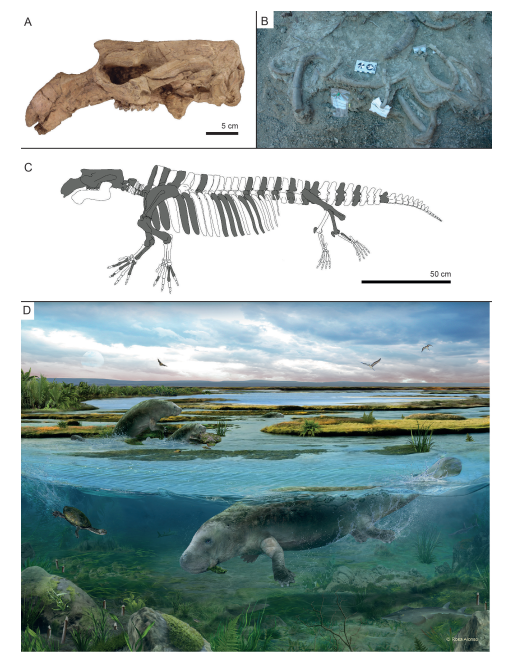
Figure 4. A) Skull of the basal sirenian Sobrarbesiren cardieli (holotype, MPZ 2017/1), in lateral view. B) Bone accumulation of Sobrarbesiren in the Castejón de Sobrarbe-41 fossil site. Photograph: Ainara Badiola. C) Reconstructed composite skeleton of Sobrarbesiren cardieli. Grey elements represent the fossils known (from DÃaz-Berenguer et al. 2018). D) Life restoration of Sobrarbesiren, which inhabited a deltaic plain in the Comarca of Sobrarbe (Huesca, Spain). Palaeoillustration by Rosa Alonso. Reproduced by permission of the Museo de Ciencias Naturales de la Universidad de Zaragoza.
Testudines
The Eocene is an epoch of great interest for the study of European fossil turtles, because the diversity of the group in this continent was radically different from that recorded in previous periods. A relatively high diversity of turtles is identified in the Lutetian of the Sobrarbe Formation (Pérez-GarcÃa et al. 2020). Partial or reasonably complete turtle shells found at various sites, as well as other elements of the postcranial skeleton and even some cranial elements are known. Only one of these turtles corresponds to a terrestrial form (Pérez-GarcÃa et al. 2013). Although it is so far only represented by scarce material, it can be attributed to Testudinidae (Cryptodira). This lineage is the only group of totally terrestrial turtles that forms part of the current biodiversity. It continues to be present today in the Iberian Peninsula. The hitherto undetermined taxon from the Sobrarbe Formation could thus correspond to a basal form of this successful lineage.
Â
Two aquatic clades of Cryptodira have been identified in the Eocene of the Geopark: Carettochelyidae and Trionychidae (Pérez-GarcÃa et al. 2013). The former is represented by Allaeochelys sp. Although this group is known in Asia from the Late Cretaceous, the European record is limited to the Eocene (see Pérez-GarcÃa 2017 and references therein). Carettochelyidae is currently represented by a single extant species, restricted to Oceania. The trionychid from the Sobrarbe Formation also corresponds to an undetermined species (Pérez-GarcÃa et al. 2013). Two members of Pleurodira have been identified in the Geopark. Both belong to Podocnemididae, a group of African origin (Pérez-GarcÃa et al. 2013, 2020). In fact, they represent the dispersal of two lineages from that group to Europe, which occurred in the early Eocene: the lineage of the freshwater turtle Neochelys and that of the littoral form Eocenochelus. Both genera are exclusive to the Eocene record (see Pérez-GarcÃa 2017 and references therein). Neochelys is a very diverse genus, represented by some species with a shell of less than 20 cm, but also by rather large species such as the Spanish Neochelys salmanticensis. Neochelys cf. salmanticensis is identified in the Geopark by a partial shell (Pérez-GarcÃa et al. 2013). Moreover, the shell of another pleurodiran turtle found in the same basin, Eocenochelus eremberti, is the most complete shell currently known for this species. (Pérez-GarcÃa et al. 2020).
Skeletal remains are not the only turtle fossils from the Geopark. Abundant eggshell fragments can be recovered by washing-sieving the shale levels of the Sobrarbe Formation (Lutetian). Especially important and diverse are the eggshell fragments from the CS-41 deposit discussed above. This is an extremely rich site, with more than 300 eggshell fragments recovered per kilogram of rock processed in the most productive grids. All the fragments have been attributed to the ootaxon Testudoolithidae produced by turtles (Moreno-Azanza et al. 2021), characterized by cylindrical shell units highly interconnected with each other, which preserve relicts of their original radial ultrastructure although their aragonitic composition when deposited was replaced by a calcite composition during the processes of fossil diagenesis, suggesting an extremely slow fossilization process.
Â
Several thousand eggshell fragments have been recovered, most of them smaller than 4 mm2, suggesting that CS-41 was very close to the nesting area of these turtles. In addition, several articulated fossils have been recovered in CS-41, including a complete shell of the Eocenochelus turtle whose closest living relatives lay eggs with a shell very similar to those recovered in CS-41 (Pérez-GarcÃa et al. 2020). All current turtles bury their eggs, and studies of fossil nests and the gas exchange capacity of fossil eggs suggest that this behavior has existed since the Jurassic. This has been interpreted as suggesting that the CS-41 turtles nested in the sandy parts of the delta plain, such as mouth bars, and that the dynamics of the Sobrarbe delta itself, as well as storms, would have dismantled, broken and dragged the eggs to nearby depressed areas, such as an abandoned channel in the case of CS-41 (DÃaz-Berenguer et al 2017a).
Â
Crocodylomorphs
Fragmentary remains of crocodylomorphs, in particularly isolated teeth, tend to be found when washing-sieving the Lutetian sediments of the Sobrarbe Formation. Various taxa have been recognized (DÃaz-Berenguer et al. 2017b). Also noteworthy are the two mandibles of an as yet unstudied individual currently housed in the Museo de Lamata (Cardiel Lalueza 2009). The most significant and best-known crocodylomorph fossil in the Sobrarbe-Pirineos Geopark is popularly known as the âCrocodile of Ordesa-Vioâ. This is the cranium and the mandibles of a marine crocodilian from the base of the Eocene (Goriz Formation limestones). It was recovered in 1992 by members of the Catalan Institute of Paleontology (ICP) in the municipality of Fanlo in Ordesa National Park (Costa et al. 1993). First, the ICP team carried out a CT scan, revealing that the cranium was indeed complete inside the rock, even though the quality of the scan did not allow accurate identification. The cranium is preserved within extremely hard rock precluding proper study, yet at present teams are suitably preparing it from the ICP and the University of Zaragoza. In due course, this will make it possible to describe it.
Â
Discussion and Conclusions
The Eocene fossils of the Sobrarbe-Pirineos UNESCO Global Geopark are outstanding in terms of paleontological diversity and the sedimentary environments represented, from deep marine to continental facies. To date, eight fossils have been described from the Geopark that have aroused considerable media interest, including the sirenian Sobrarbesiren and the as yet undescribed crocodylomorph of Ordesa-Vio. All this indicates that the Geopark is a unique place for studying the tropical life of the Eocene in southern Europe and that a special effort should thus continue to be made to document such an important geological heritage.
The Law of Cultural Heritage of Aragon only allows the collection of fossils in the Geopark for use in research or to prevent their possible destruction (due to erosion or public works), so observation of the fossils by visitors to the Geopark must take place "in situ" or in the museums where they are exhibited, such as the Lamata Museum or the Museum of Natural Sciences of the University of Zaragoza. The Geopark has proved to be a very important tool in the geoconservation of Eocene fossils, drawing the attention of researchers to chance discoveries by visitors to the Geopark, as well as helping in the excavation of Sobrarbesiren and the diffusion of the paleontological heritage through a range of activities for all the public.
Â
Acknowledgments
This study was subsidized in part by Project CGL2017-85038-P of the Spanish Ministerio de EconomÃa y Competitividad-ERDF, as well as by the Aragón Regional Government (âGrupo de Referencia Aragosaurus: reconstrucciones paleoambientales y recursos geológicosâ). Rupert Glasgow edited the English.