
 10.57647/tpr.2025.0903.18
The first report on the screening of the GC/MS profiles of the hydrodistilled essential oils and volatile components from the aerial parts of Verbascum sinuatum L. (Scrophulariaceae)
- Majid Mohammadhosseini*
 1,2
1,2
- Herbal Drugs Raw Materials Research Center (HDRMRC), Sha.C., Islamic Azad University, Shahrood, Iran
- Department of Chemistry and Biochemistry, Sha.C., Islamic Azad University, Shahrood, Iran

Received: 2025-07-12
Revised: 2025-08-23
Accepted: 2025-09-27
Published in Issue 2025-09-30

This work is licensed under a Creative Commons Attribution 4.0 International License.
How to Cite




PDF views: 44





Abstract
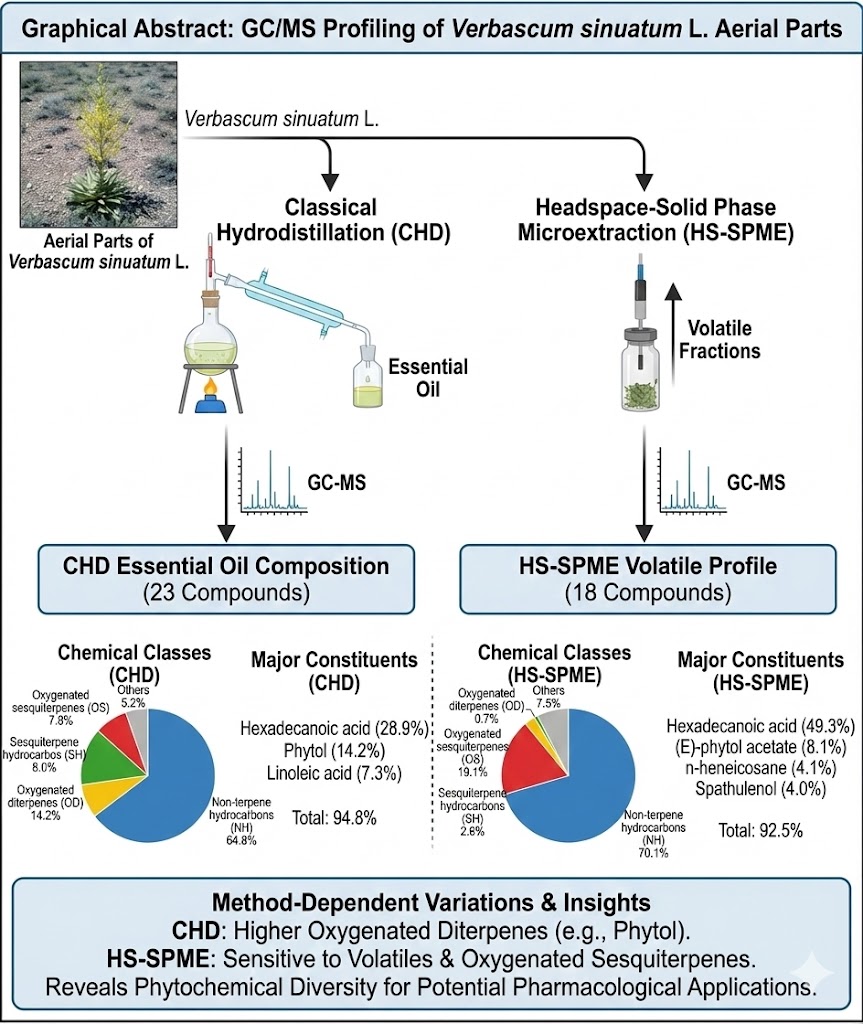
This study elucidates the chemical composition of the essential oil and volatile fractions from the aerial parts of Verbascum sinuatum L. using classical hydrodistillation (CHD) and headspace-solid phase microextraction (HS-SPME) techniques, identifying 23 compounds via GC-MS analysis. In the CHD essential oil, non-terpene hydrocarbons (NH) predominated at 64.8%, followed by oxygenated diterpenes (OD) at 14.2%, sesquiterpene hydrocarbons (SH) at 8.0%, and oxygenated sesquiterpenes (OS) at 7.8%. The principal constituents were hexadecanoic acid (28.9%), phytol (14.2%), and linoleic acid (7.3%), accounting for 94.8% of the total. On the other hand, HS-SPME profiles emphasized NH (70.1%) and OS (19.1%), with hexadecanoic acid (49.3%), (E)-phytol acetate (8.1%), n-heneicosane (4.1%), and spathulenol (4.0%) comprising 92.5% overall. These findings reveal method-dependent variations in terpenoid and fatty acid content, highlighting CHD's efficacy in extracting higher quantities of oxygenated diterpenes and HS-SPME's sensitivity to volatiles, offering insights into phytochemical diversity for potential pharmacological applications.
Keywords
- Classical hydrodistillation (CHD), Essential oils, GC/MS, Headspace-solid phase microextraction (HS-SPME), Scrophulariaceae, Verbascum sinuatum L.
References
- A.M. Abdel-Rahman, I., E. Raslan, A., Dawy, A., Wail, A., Ahmed, F., Hany, K., M. Al-Monair, M., Ahmed, O., I. Rushdi, M., A.E. Allam, A. (2022) Cymbopogon schoenanthus (L.) Spreng: A comprehensive review on phytochemical and pharmacological biodiversity. Trends Phytochem. Res. 6(4):259-281. DOI: https://doi.org/10.30495/tpr.2022.1966529.1276.
- Al-Khayri, J.M., Sudheer, W.N., Lakshmaiah, V.V., Mukherjee, E., Nizam, A., Thiruvengadam, M., Nagella, P., Alessa, F.M., Al-Mssallem, M.Q., Rezk, A.A., Shehata, W.F. (2022) Biotechnological approaches for production of artemisinin, an anti-malarial drug from Artemisia annua L. Molecules 27(9):3040. DOI: https://doi.org/10.3390/molecules27093040.
- Alamgir, A.N. (2017) Medicinal, Non-Medicinal, Biopesticides, Color-And Dye-Yielding Plants; Secondary Metabolites and Drug Principles; Significance of Medicinal Plants; Use of Medicinal Plants in the Systems of Traditional and Complementary and Alternative Medicines (CAMs). In Therapeutic Use of Medicinal Plants and Their Extracts: Volume 1: Pharmacognosy Cham: Springer International Publishing, DOI: https://doi.org/10.1007/978-3-319-63862-1.
- Alipieva, K.I., Orhan, I.E., Cankaya, I.I.T., Kostadinova, E.P., Georgiev, M.I. (2014) Treasure from garden: Chemical profiling, pharmacology and biotechnology of mulleins. Phytochem. Rev. 13(2):417-444. DOI: https://doi.org/10.1007/s11101-014-9361-5.
- Amini, S., Hassani, A., Alirezalu, A., Maleki, R. (2022) Phenolic and flavonoid compounds and antioxidant activity in flowers of nine endemic Verbascum species from Iran. J. Sci. Food Agric. 102(8):3250-3258. DOI: https://doi.org/10.1002/jsfa.11667.
- Bejenaru, C., Radu, A., Mogoşanu, G.D., Bejenaru, L.E., Biţă, A., Segneanu, A.-E. (2024) Scrophulariaceae Juss. Family, Natural Products and Medicinal Properties of Carpathian (Romanian) Plants. CRC Press, pp. 404-429.
- Bianco, A., Guiso, M., Iavarone, C., Passacantilli, P., Trogolo, C. (1981) 6-O-α-Sinuatosylaucubin from Verbascum sinuatum. Phytochemistry 20(3):465-468. DOI: https://doi.org/10.1016/S0031-9422(00)84167-9.
- Blanco-Salas, J., Hortigón-Vinagre, M.P., Morales-Jadán, D., Ruiz-Téllez, T. (2021) Searching for scientific explanations for the uses of Spanish folk medicine: A review on the case of mullein (Verbascum, Scrophulariaceae). Biology 10(7):618. DOI: https://doi.org/10.3390/biology10070618.
- Boğa, M., Ertaş, A., Haşimi, N., Demirci, S., Yılmaz, M., Temel, H., Kolak, U. (2016a) Phenolic profile, fatty acid and essential oil composition analysis and antioxidant, antialzheimer and antibacterial activities of Verbascum flavidum extracts. Chiang Mai J. Sci. 43(5):1090-1101.
- Boğa, M., Ertaş, A., Yılmaz, M.A., Kızıl, M., Çeken, B., Haşimi, N., Özden, T.Y., Demirci, S., Yener, İ., Deveci, Ö. (2016b) UHPLC-ESI-MS/MS and GC-MS analyses on phenolic, fatty acid and essential oil of Verbascum pinetorum with antioxidant, anticholinesterase, antimicrobial and DNA damage protection effects. Iran. J. Pharm. Res. 15(3):393. DOI: https://doi.org/10.22037/ijpr.2016.1887.
- Bohman, B., Weinstein, A.M., Mozuraitis, R., Flematti, G.R., Borg-Karlson, A.-K. (2020) Identification of (Z)-8-heptadecene and n-pentadecane as electrophysiologically active compounds in Ophrys insectifera and its Argogorytes pollinator. Int. J. Mol. Sci. 21(2):620. DOI: https://doi.org/10.3390/ijms21020620.
- Dodoš, T., Rajčević, N., Janaćković, P., Vujisić, L., Marin, P.D. (2019) Essential oil profile in relation to geographic origin and plant organ of Satureja kitaibelii Wierzb. ex Heuff. Ind. Crops Prod. 139:111549. DOI: https://doi.org/10.1016/j.indcrop.2019.111549.
- Donn, P., Barciela, P., Perez-Vázquez, A., Cassani, L., Simal-Gandara, J., Prieto, M.A. (2023) Bioactive compounds of Verbascum sinuatum L.: Health benefits and potential as new ingredients for industrial applications. Biomolecules 13(3). DOI: https://doi.org/10.3390/biom13030427.
- Fabricant, D.S., Farnsworth, N.R. (2001) The value of plants used in traditional medicine for drug discovery. Environ. Health Perspect. 109(Suppl 1):69-75. DOI: https://doi.org/10.1289/ehp.01109s169.
- Farid, M.M., Ragheb, A.Y., El Shabrawy, M., Marzouk, M.M., Hussein, S.R., Soliman, A.A.F., Taha, H., Kawashty, S.A. (2020) GC-MS and LC-ESI-MS analysis of biologically active fractions from Verbascum letourneuxii; efficient protocol for in vitro propagation. Biocatal. Agric. Biotechnol. 29:101817. DOI: https://doi.org/10.1016/j.bcab.2020.101817.
- Garcia-Oliveira, P., Carreira-Casais, A., Pereira, E., Dias, M.I., Pereira, C., Calhelha, R.C., Stojković, D., Sokovic, M., Simal-Gandara, J., Prieto, M.A. (2022) From tradition to health: Chemical and bioactive characterization of five traditional plants. Molecules 27(19):6495. DOI: https://doi.org/10.3390/molecules27196495.
- Georgiev, M., Pastore, S., Lulli, D., Alipieva, K., Kostyuk, V., Potapovich, A., Panetta, M., Korkina, L. (2012) Verbascum xanthophoeniceum-derived phenylethanoid glycosides are potent inhibitors of inflammatory chemokines in dormant and interferon-gamma-stimulated human keratinocytes. J. Ethnopharmacol. 144(3):754-760. DOI: https://doi.org/10.1016/j.jep.2012.10.035.
- Georgiev, M.I., Ali, K., Alipieva, K., Verpoorte, R., Choi, Y.H. (2011) Metabolic differentiations and classification of Verbascum species by NMR-based metabolomics. Phytochemistry 72(16):2045-2051. DOI: https://doi.org/10.1016/j.phytochem.2011.07.005
- Ghorbani, A. (2005) Studies on pharmaceutical ethnobotany in the region of Turkmen Sahra, north of Iran:(Part 1): General results. J. Ethnopharmacol. 102(1):58-68. DOI: https://doi.org/10.1016/j.jep.2005.05.035.
- Gondal, H.Y., Zamir, R., Nisar, M., Choudhary, M.I. (2020) Verbascum sinaiticum: A rich source of antioxidant phenylethanoid glycosides. Nat. Prod. J. 10(2):158-162. DOI: https://doi.org/10.2174/2210315509666190129160405.
- https://en.wikipedia.org/wiki/Verbascum_sinuatum.
- Iskender, N.Y., Yayli, N., Yildrim, N., Cansu, T.B., Terzioglu, S. (2009) The volatile constituents of the flower, leaf, and stem of Verbascum wiedemannianum grown in Turkey. J. Oleo Sci. 58(3):117-121. DOI: https://doi.org/10.5650/jos.58.117
- Jan, F., Jan, B., Akbar Dar, M., Sofi, F.A., Alsuwayni, B.M., Afzal, S., Fawzi Mahomoodally, M. (2022) A Review on Traditional Uses, Phytochemistry, and Pharmacological Activities of Verbascum thapsus, Edible Plants in Health and Diseases: Volume II: Phytochemical and Pharmacological Properties, pp. 483-500, DOI: https://doi.org/410.1007/1978-1981-1016-4959-1002_1016.
- Juergens, L.J., Worth, H., Juergens, U.R. (2020) New perspectives for mucolytic, anti-inflammatory and adjunctive therapy with 1,8-cineole in COPD and asthma: Review on the new therapeutic approach. Adv. Ther. 37(5):1737-1753. DOI: https://doi.org/10.1007/s12325-020-01279-0
- Lee, S., Hung, R., Bennett, J.W. (2024) An Overview of Fungal Volatile Organic Compounds (VOCs), Fungal Associations, pp. 83-111, DOI: https://doi.org/110.1007/1978-1003-1031-41648-41644_41644.
- Melliou, E., Magiatis, P., Kalpoutzakis, E., Tsitsa, E. (2007) Composition of the essential oil of Verbascum undulatum from Greece. J. Essent. Oil Res. 19(1):28-29. DOI: https://doi.org/10.1080/10412905.2007.9699222.
- Mihailović, V., Kreft, S., Benković, E.T., Ivanović, N., Stanković, M.S. (2016) Chemical profile, antioxidant activity and stability in stimulated gastrointestinal tract model system of three Verbascum species. Ind. Crops Prod. 89:141-151. DOI: https://doi.org/10.1016/j.indcrop.2016.04.075.
- Mirhaidar, H. (2005) Plant Sciences Nashre Farhange Eslami.
- Morteza-Semnani, K., Saeedi, M., Akbarzadeh, M. (2012) Chemical composition and antimicrobial activity of the essential oil of Verbascum thapsus L. J. Essent. Oil-Bear. Plants 15(3):373-379. DOI: https://doi.org/10.1080/0972060X.2012.10644063.
- Murgia, V., Ciprandi, G., Votto, M., De Filippo, M., Tosca, M.A., Marseglia, G.L. (2021) Natural remedies for acute post-viral cough in children. Allergol. Immunopathol. (Madr). 49(3):173-184. DOI: https://doi.org/10.15586/aei.v49i3.71.
- Németh-Zámbori, É. (2020) Natural Variability of Essential Oil Components, 3rd Edition, Handbook of Essential Oils. CRC Press, pp. 85-124.
- Pansini, A., Beca-Carretero, P., González, M.J., La Manna, G., Medina, I., Ceccherelli, G. (2023) Sources of variability in seagrass fatty acid profiles and the need of identifying reliable warming descriptors. Sci. Rep. 13(1):10000. DOI: https://doi.org/10.1038/s41598-023-36498-2.
- Pardeshi, P.U., Kapile, C.R., Kulkarni, A.D., Gulecha, V.S., Zalte, A.G., Gedam, S.S. (2022) Phytochemical-based vesicular system for the treatment of vitiligo: A review. Trends Phytochem. Res. 6(3):224-241. DOI: https://doi.org/10.30495/tpr.2022.1955013.1249.
- Périno, S., Chemat-Djenni, Z., Petitcolas, E., Giniès, C., Chemat, F. (2019) Downscaling of industrial turbo-distillation to laboratory turbo-clevenger for extraction of essential oils. Application of concepts of green analytical chemistry. Molecules 24(15):2734. DOI: https://doi.org/10.3390/molecules24152734.
- Rechinger, K. (1981) Flora Iranica. Scrophulariaceae, Volume 147. Academic Printing and Publishing House, Austria Graz.
- Riaz, M., Zia-Ul-Haq, M., Jaafar, H.Z. (2013.) Common mullein, pharmacological and chemical aspects. Rev. Bras. Farmacogn. 23(6):948-959. DOI: https://doi.org/10.1590/S0102-695X2013000600012.
- Roldán-Gutiérrez, J.M., Ruiz-Jiménez, J., De Castro, M.L. (2008) Ultrasound-assisted dynamic extraction of valuable compounds from aromatic plants and flowers as compared with steam distillation and superheated liquid extraction. Talanta 75(5):1369-1375. DOI: https://doi.org/10.1016/j.talanta.2008.01.057.
- Sanseera, D., Niwatananun, W., Liawruangrath, B., Liawruangrath, S., Baramee, A., Pyne, S.G. (2012) Chemical composition and biological activities of the essential oil from leaves of cleidion javanicum bl. J. Essent. Oil-Bear. Plants 15(2):186-194. DOI: https://doi.org/10.1080/0972060X.2012.10644035.
- Scala, A., Allmann, S., Mirabella, R., Haring, M.A., Schuurink, R.C. (2013) Green leaf volatiles: A plant’s multifunctional weapon against herbivores and pathogens. Int. J. Mol. Sci. 14(9):17781-17811. DOI: https://doi.org/10.3390/ijms140917781.
- Selseleh, M., Nejad Ebrahimi, S., Aliahmadi, A., Sonboli, A., Mirjalili, M.H. (2020) Metabolic profiling, antioxidant, and antibacterial activity of some Iranian Verbascum L. species. Ind. Crops Prod. 153:112609. DOI: https://doi.org/10.1016/j.indcrop.2020.112609.
- Sharif, N., Jabeen, H. (2024) Natural sources for coumarins and their derivatives with relevance to health-promoting properties: A systematic review. Trends Phytochem. Res. 8(3):149-162. DOI: https://doi.org/10.71596/tpr.2024.1103148.
- Sher, H. (2011) Ethnoecological evaluation of some medicinal and aromatic plants of Kot Malakand Agency, Pakistan. Sci. Res. Essays 6(10):2164-2173. DOI: https://doi.org/10.5897/sre10.1114.
- Shinwari, Z.K., Gilani, S.S. (2003) Sustainable harvest of medicinal plants at Bulashbar Nullah, Astore (northern Pakistan). J. Ethnopharmacol. 84(2-3):289-298. DOI: https://doi.org/10.1016/S0378-8741(02)00333-1.
- Singh, S., Nair, V., Jain, S., Gupta, Y.K. (2008) Evaluation of anti-inflammatory activity of plant lipids containing α-linolenic acid. Indian J. Exp. Biol. 46(6):453-456.
- Singh, Z. (2023) Health with hotness. Trends Phytochem. Res. 7(2):86-88. DOI: https://doi.10.30495/tpr.2023.1986066.1343.
- Sotoodeh, A., Attar, F., Civeyrel, L. (2017) Verbascum songaricum subsp. subdecurrens: A new record, typification and the true identity of V. aspinum as a new synonym of V. stachydiforme in the Flora of Iran. Kew Bull. 72(2):24. DOI: https://doi.org/10.1007/s12225-017-9696-3.
- Tank, D.C., Beardsley, P.M., Kelchner, S.A., Olmstead, R.G. (2006) Review of the systematics of Scrophulariaceae sl and their current disposition. Aust. Syst. Bot. 19(4):289-307.
- Tatli, I.I., Akdemir, Z.S. (2004) Chemical constituents of Verbascum L. species. Fabad J. Pharm. Sci. 29:93-107.
- Tetik, F., Civelek, S., Cakilcioglu, U. (2013) Traditional uses of some medicinal plants in Malatya (Turkey). J. Ethnopharmacol. 146(1):331-346. DOI: https://doi.org/10.1016/j.jep.2012.12.054.
- Turker, A.U., Gurel, E. (2005) Common mullein (Verbascum thapsus L.): Recent advances in research. Phytother. Res. 19(9):733-739. DOI: https://doi.org/10.1002/ptr.1653
- Vaglica, A., Porrello, A., Ilardi, V., Bruno, M. (2025) The essential oil chemical composition of a rare ethnopharmacoligical plant: Verbascum creticum (L.) Cav. Nat. Prod. Res. 39(19):5687-5693. DOI: https://doi.org/10.1080/14786419.2024.2377310.
- Xu, W.Q., Losh, J., Chen, C., Li, P., Wang, R.H., Zhao, Y.P., Qiu, Y.X., Fu, C.X. (2019) Comparative genomics of figworts (Scrophularia, Scrophulariaceae), with implications for the evolution of Scrophularia and Lamiales. J. Syst. Evol. 57(1):55-65.
- Yan, D., Wen, S., Chen, M., Huang, J., Zhang, G., Li, R., Lu, J., Yao, Z., Gao, F., You, J. (2025) Analysis of pharmacological activities and mechanisms of essential oil in flowers of Citrus grandis ‘Tomentosa’ by GC-MS/MS and network pharmacology. Curr. Issues Mol. Biol. 47(7):541. DOI: https://doi.org/10.3390/cimb47070541.
- Yu, Y., Ma, Y., Ouyang, Z., Huang, L. (2025) Mentha essential oils: Unraveling chemotype-dependent biosynthesis and assessing evidence for health-promoting activities. Nutrients 17(20):3258. DOI: https://doi.org/10.3390/nu17203258.