
 10.57647/tpr.2025.0903.15
Unveiling the potential antidiabetic, antidyslipidemic, and antimicrobial effects of methanolic root extracts of Nymphaea pubescens Willd. plant: Evidence from in-vitro and in-vivo approaches
- Sahid Ahmad Santo

 1
1 - Tanmay Deb1
- Md. Abdus Salam1
- Arafat Miah1
- Md. Saddam Hussain1
- Anamika Datta2
- Mohammad Nurul Amin3
- Mohammad Sarowar Uddin1
- Mohammad Safiqul Islam1
- Md. Shalahuddin Millat*1
- Department of Pharmacy, Noakhali Science and Technology University, Noakhali, Bangladesh
- Department of Pharmacy, R. P. Shaha University, Narayanganj, Bangladesh
- Department of Pharmacy, Atish Dipankar University of Science and Technology, Dhaka, Bangladesh

Received: 2024-12-27
Revised: 2025-09-26
Accepted: 2025-09-27
Published in Issue 2025-09-30

This work is licensed under a Creative Commons Attribution 4.0 International License.
How to Cite




PDF views: 48





Abstract
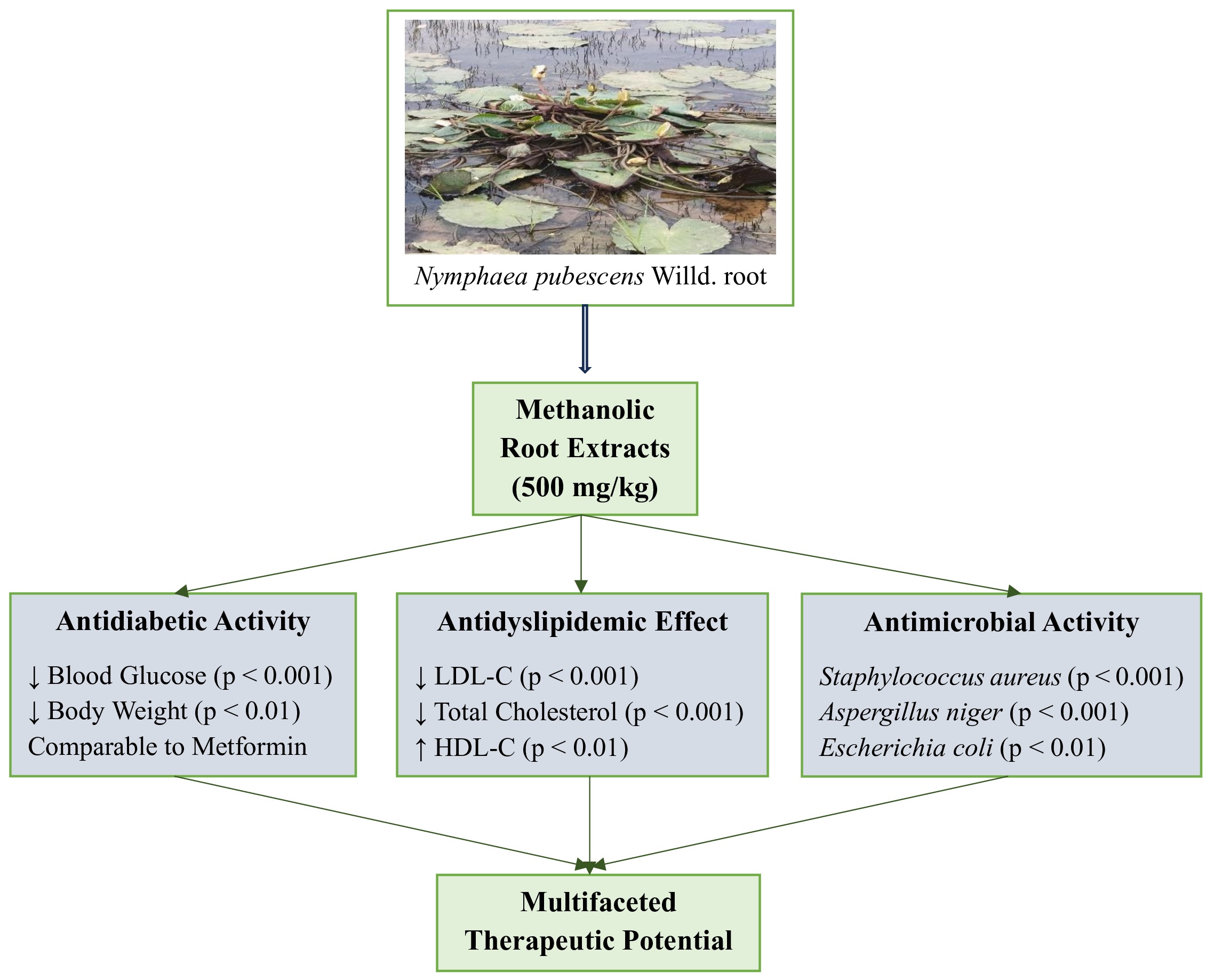
This study investigated the therapeutic potential of methanolic root extracts of Nymphaea pubescens Willd. with a focus on their antidiabetic, antilipidemic, and antimicrobial properties. The methanolic root extracts of the N. pubescens at higher doses (500 mg/kg) exhibited a pronounced serum blood glucose-lowering activity (p < 0.001) and also demonstrated remarkable outcomes in body weight loss (p < 0.01), closely resembling the effects of the standard metformin. The same experiment displayed a noticeable reduction in low-density lipoprotein cholesterol (LDL-C) and total cholesterol (TC) levels (p < 0.001), along with a notable elevation in high-density lipoprotein cholesterol (HDL-C) levels (p < 0.01). Furthermore, the plant extract at 500 mg/kg unveiled significant antimicrobial activities (p < 0.001) against both Staphylococcus aureus and Aspergillus niger and also exhibited significant (p < 0.01) inhibition of Escherichia coli. In summary, these findings highlight the multifaceted therapeutic potential of N. pubescens root extracts, warranting further investigation for their possible development into novel therapeutic agents.
Keywords
- Antidiabetic; Antihyperlipidemic; Antimicrobial; In vitro; In vivo; Nymphaea pubescens Willd.; Nymphaeaceae
References
- Acharjee, M., Zerin, N., Ishma, T., Mahmud, M.R. (2023) In-vitro anti-bacterial activity medicinal plants against urinary tract infection (UTI) causing bacteria along with their synergistic effects with commercially available antibiotics. New Microbes New Infect. 51:1–11. DOI: https://doi.org/10.1016/j.nmni.2022.101076.
- Akinjogunla, O., Adegoke, A., Udokang, I., Adebayo-Tayo, B. (2009) Antimicrobial potential of Nymphaea lotus (Nymphaeaceae) against wound pathogens. J. Med. Plant Res. 3(3):138–141.
- Akinyemi, K.O., Oladapo, O., Okwara, C.E., Ibe, C.C., Fasure, K.A. (2005) Screening of crude extracts of six medicinal plants used in South-West Nigerian unorthodox medicine for anti-methicillin resistant Staphylococcus aureus activity. BMC Complement. Altern. Med. 5:1–7. DOI: https://doi.org/10.1186/1472-6882-5-6.
- Al-Ishaq, R.K., Abotaleb, M., Kubatka, P., Kajo, K., Büsselberg, D. (2019) Flavonoids and their anti-diabetic effects: Cellular mechanisms and effects to improve blood sugar levels. Biomolecules. 9(430):1–35. DOI: https://doi.org/10.3390/biom9090430.
- Angadi, K.K., Gundampati, R.K., Jagannadham, M.V., Kandru, A. (2013) Molecular docking studies of guggultetrol from Nymphaea pubescens with target glucokinase (GK) related to type-II diabetes. J. Appl. Pharm. Sci. 3(2):127–131. DOI: https://doi.org/10.7324/JAPS.2013.30222.
- Angadi, K.K., Kandru, A., Rahaman, A., (2013) Antihyperglycaemic, antihyperlipidaemic and antioxidant assays (in vivo) of Nymphaea pubescens leaf extract. Int. J. Pharma. Bio. Sci. 4(2):(B)624–630.
- Artha, I.M.J.R., Bhargah, A., Dharmawan, N.K., Pande, U.W., Triyana, K.A., Mahariski, P.A., Yuwono, J., Bhargah, V., Prabawa, I.P.Y., Manuaba, I.B.A.P. (2019) High level of individual lipid profile and lipid ratio as a predictive marker of poor glycemic control in type-2 diabetes mellitus. Vasc. Health Risk Manag. 15:49–157. DOI: https://doi.org/10.2147/VHRM.S209830.
- Arya, A.K., Durgapal, M., Bachheti, A., Joshi, K.K., Gonfa, Y.H., Bachheti, R.K., Husen, A. (2022) Ethnomedicinal use, phytochemistry, and other potential application of aquatic and semiaquatic medicinal plants. Evid.-Based Complementary Altern. Med. 2022:1–19. DOI: https://doi.org/10.1155/2022/4931556.
- Auwal, M.S., Saka, S., Mairiga, I.A., Sanda, K.A., Shuaibu, A., Ibrahim, A. (2014) Preliminary phytochemical and elemental analysis of aqueous and fractionated pod extracts of Acacia nilotica (Thorn mimosa). Vet. Res. Forum. 5(2):95–100.
- Banso, A., Adeyemo, S. (2006) Phytochemical screening and antimicrobial assessment of Abutilon mauritianum, Bacopa monnifera and Datura stramonium. Biokemistri. 18(1):39–44. DOI: https://doi.org/10.4314/biokem.v18i1.56390.
- Bassalat, N., Kadan, S., Melamed, S., Yaron, T., Tietel, Z., Karam, D., Kmail, A., Masalha, M., Zaid, H. (2023) In vivo and in vitro antidiabetic efficacy of aqueous and methanolic extracts of Orthosiphon stamineus Benth. Pharmaceutics. 15(3):1–14. DOI: https://doi.org/10.3390/pharmaceutics15030945.
- Bouhrim, M., Daoudi, N.E., Ouassou, H., Benoutman, A., Loukili, E.H., Ziyyat, A., Mekhfi, H., Legssyer, A., Aziz, M., Bnouham, M. (2020) Phenolic content and antioxidant, antihyperlipidemic, and antidiabetogenic effects of Opuntia dillenii seed oil. Sci. World J. 2020:1–8. DOI: https://doi.org/10.1155/2020/5717052.
- Calheiros, D., Dias, M.I., Calhelha, R.C., Barros, L., Ferreira, I.C., Fernandes, C., Gonçalves, T. (2023) Antifungal activity of spent coffee ground extracts. Microorganisms. 11(242):1–20. DOI: https://doi.org/10.3390/microorganisms11020242.
- Chehade, J.M., Gladysz, M., Mooradian, A.D. (2013) Dyslipidemia in type 2 diabetes: Prevalence, pathophysiology, and management. Drugs. 73:327–339. DOI: https://doi.org/10.1007/s40265-013-0023-5.
- Chukiatsiri, S., Wongsrangsap, N., Ratanabunyong, S., Choowongkomon, K. (2023) In vitro evaluation of antidiabetic potential of Cleistocalyx nervosum var. paniala fruit extract. Plants. 12(112):1–13. DOI: https://doi.org/10.3390/plants12010112.
- Cushnie, T.P.T., Lamb, A.J. (2005) Antimicrobial activity of flavonoids. Int. J. Antimicrob. Agents. 26(5):343–356. DOI: https://doi.org/10.1016/j.ijantimicag.2005.09.002.
- Dodamani, S., Sanakal, R., Kaliwal, B. (2012) Antidiabetic efficacy of ethanolic leaf extract of Nymphaea odorata in alloxan induced diabetic mice. Int. J. Pharm. Pharm. Sci. 4:338–341.
- Fisher, M.C., Gurr, S.J., Cuomo, C.A., Blehert, D.S., Jin, H., Stukenbrock, E.H., Stajich, J.E., Kahmann, R., Boone, C., Denning, D.W. (2020) Threats posed by the fungal kingdom to humans, wildlife, and agriculture. MBio. 11(3):e00449–20. DOI: https://doi.org/10.1128/mbio.00449-20.
- Gueye, F.K., Niang, L., Dieng, B., Gueye, M.F., Ayessou, N.C., Mbaye, M.S., Noba, K. (2022) Phytochemical screening and antioxidant activities of water lilies seeds neglected and underused species in the delta and lower valley of the Senegal river. Am. J. Plant Sci. 13(6):756–765. DOI: https://doi.org/10.4236/ajps.2022.136051.
- Hossain, M.M., Uddin, M.S., Baral, P.K., Ferdus, M., Bhowmik, S. (2022) Phytochemical screening and antioxidant activity of Ipomoea hederifolia stems: A potential medicinal plant. Asian J. Nat. Prod. Biochem. 20(2):41–47. DOI: https://doi.org/10.13057/biofar/f200201.
- Hui, Z., Zhou, X., Li, R., Bin Wang, Y., Ma, J. (2015) Studies on the extraction process of total flavonoids in Radix puerariae and their hypoglycemic effect in mice. Biomed. Res. 26(1):51–54.
- Hussain, M.S., Jahan, N., Rashid, M.M.O., Hossain, M.S., Chen, U., Rahman, N. (2019) Antihyperlipidemic screening and plasma uric acid reducing potential of Momordica charantia seeds on Swiss albino mice model. Heliyon 5(5):e01739. DOI: https://doi.org/10.1016/j.heliyon.2019.e01739.
- Ifesan, B., Fashakin, J., Ebosele, F., Oyerinde, A. (2013) Antioxidant and antimicrobial properties of selected plant leaves. European J. Med. Plants 3(3):465–473. DOI: https://doi.org/10.5555/20133287109.
- Kancherla, N., Dhakshinamoothi, A., Chitra, K., Komaram, R.B. (2019) Preliminary analysis of phytoconstituents and evaluation of anthelminthic property of Cayratia auriculata (in vitro). Maedica. 14(4):350–356. DOI: https://doi.org/10.26574/maedica.2019.14.4.350.
- Marzan, S., Bulbul, L., Halim, M.A., Alam, M.Z. (2023) In-vivo assessment of hypoglycemic and anxiolytic activities on Swiss albino mice and anthelmintic activity on earthworm of methanolic extract of Microcos paniculata leaves. EPRA IJRD. 8(3):91–96. DOI: https://doi.org/10.53365/nrfhh/177626.
- Mazumder, T., Mamun, I.P., Zaman, M.S., Islam, A.K., Chowdhury., S., Reza, M.S., Hussain, M.S. (2021) Comparative lipid and uric acid suppressing properties of four common herbs in high fat-induced obese mice with their total phenolic and flavonoid index. Biochem Biophys. Rep. 26:1–8. DOI: https://doi.org/10.1016/j.bbrep.2021.100990.
- Mokha, J.S., Srinivasan, S.R., DasMahapatra, P., Fernandez, C., Chen, W., Xu, J. (2010) Berenson GS. utility of waist-to-height ratio in assessing the status of central obesity and related cardiometabolic risk profile among normal weight and overweight/obese children: The Bogalusa Heart Study. BMC Pediatr. 10:1–7. DOI: https://doi.org/10.1186/1471-2431-10-73.
- Organization, W.H. (2019) New report calls for urgent action to avert antimicrobial resistance crisis. Joint News Release. https://www.who.int/news/item/29-04-2019-new-report-calls-for-urgent-action-to-avert-antimicrobial-resistance-crisis.
- Pokhrel, T., Shrestha, D., Dhakal, K., Yadav, P.M., Adhikari, A. (2022) Comparative analysis of the antioxidant and antidiabetic potential of Nelumbo nucifera Gaertn. and Nymphaea lotus L. var. pubescens (Willd.). J. Chem. 2022:1–5. DOI: https://doi.org/10.1155/2022/4258124.
- Prodhan, A., Mridu, F.S. (2023) Antidiabetic properties of nymphaea species (water lilies): A review. Nat. Prod. J. 13(1):78–112. DOI: https://doi.org/10.2174/2210315512666220405083207.
- Raja, M.M.M., Sethiya, N.K., Mishra, S. (2010) A comprehensive review on Nymphaea stellata: A traditionally used bitter. J. Adv. Pharm. Technol. Res. 1(3):311–319. DOI: https://doi.org/10.4103/0110-5558.72424.
- Rajagopal, K., Sasikala, K. (2008) Antihyperglycaemic and antihyperlipidaemic effects of Nymphaea stellata in alloxan-induced diabetic rats. Singap. Med. J. 49(2):137–141.
- Salam, M.A., Rana, M.F., Baral, P.K., Rahman, M.O., Ahmed, S.R.R., Jahan, N., Mazumder, T., Islam, M.S., Hussain, M.S. (2023) Glipizide has low influences on lipid index and major organs weight variation and considerable anxiolytic properties: An in vivo Investigation. J. Med. Sci. 23:7–17. DOI: https://doi.org/10.3923/jms.2023.7.17.
- Selvakumari, E., Shantha, A., Kumar, C.S., Prabhu, T.P. (2016) Phytochemistry and pharmacology of the genus Nymphaea. J. Acad. Ind. Res. 5(7):98–108.
- Shajeela, P.S., Kalpanadevi, V., Mohan, V.R. (2012) Potential antidiabetic, hypolipidaemic and antioxidant effects of Nymphaea pubescens extract in alloxan induced diabetic rats. J. Appl. Pharm. Sci. 02(02):83–88. DOI: https://doi.org/10.5555/20123336960.
- Shams-Ghahfarokhi, M., Shokoohamiri, M-R., Amirrajab, N., Moghadasi, B., Ghajari, A., Zeini, F., Sadeghi, G., Razzaghi-Abyaneh, M. (2006) In vitro antifungal activities of Allium cepa, Allium sativum and ketoconazole against some pathogenic yeasts and dermatophytes. Fitoterapia. 77(4):321–323. DOI: https://doi.org/10.1016/j.fitote.2006.03.014.
- Sharmin, T., Sultana, R., Hossain, F., Shakil, S.K., Hossen, F., Rashid, M.M.O. (2018) Neuropharmacological and antibacterial effects of the ethyl acetate extract of Diospyros malabarica (Ebenaceae) seeds. Clin. phytosci. 4:1–8. DOI: https://doi.org/10.1186/s40816-018-0083-x.
- Sundaram, T., Napagoda, M., Wijesekera, K., Wijayaratne, G.B. (2020) Determination of Total Phenolic Content (TPC) of Nymphaea nouchali and Nymphaea pubescens by Folin-Ciocalteu Method. International Conference on Frontiers in Chemical Technology. IchemC. pp. 58.
- Taskinen, M.R. (2002) Diabetic dyslipidemia. Atheroscler. Suppl. 3(1):47–51. DOI: https://doi.org/10.1016/S1567-5688(01)00006-X.
- Thawabteh, A., Juma, S., Bader, M., Karaman, D., Scrano, L., Bufo, S.A., Karaman, R. (2019) The biological activity of natural alkaloids against herbivores, cancerous cells and pathogens. Toxins. 11(656):1-28. DOI: https://doi.org/10.3390/toxins11110656.
- Vinayagam, R., Jayachandran, M., Xu, B. (2016) Antidiabetic effects of simple phenolic acids: A comprehensive review. Phytother. Res. 30(2):184–199. DOI: https://doi.org/10.1002/ptr.5528.