
 10.57647/pibm.2025.1403.73
Revealing Structural Diversity of Ultra-High Dilutions through Visualizing Geometry and Surface Texture Complexity with Composite Morphological Scoring
- Fateme Mirzajani*
 1,2
1,2
- Faculty of Life Sciences and Biotechnology, Shahid Beheshti University, Tehran, Iran
- Protein Research Center, Shahid Beheshti University, Tehran, Iran
- Homeopathy Multipurpose Center (HMC), Tehran, Iran
- Department of Psychology, Faculty of Human Science, Islamic Azad University, Science and Research Branch, Tehran, Iran
- Academic Center for Education, Culture and Research, University of Science and Culture. Tehran, Iran

Received: 2025-06-13
Accepted: 2025-08-26
Published in Issue 2025-12-31
Copyright (c) 2025 Fateme Mirzajani, Saba Hosseinian, Fariba Rahimi (Author)

This work is licensed under a Creative Commons Attribution 4.0 International License.
How to Cite









Abstract
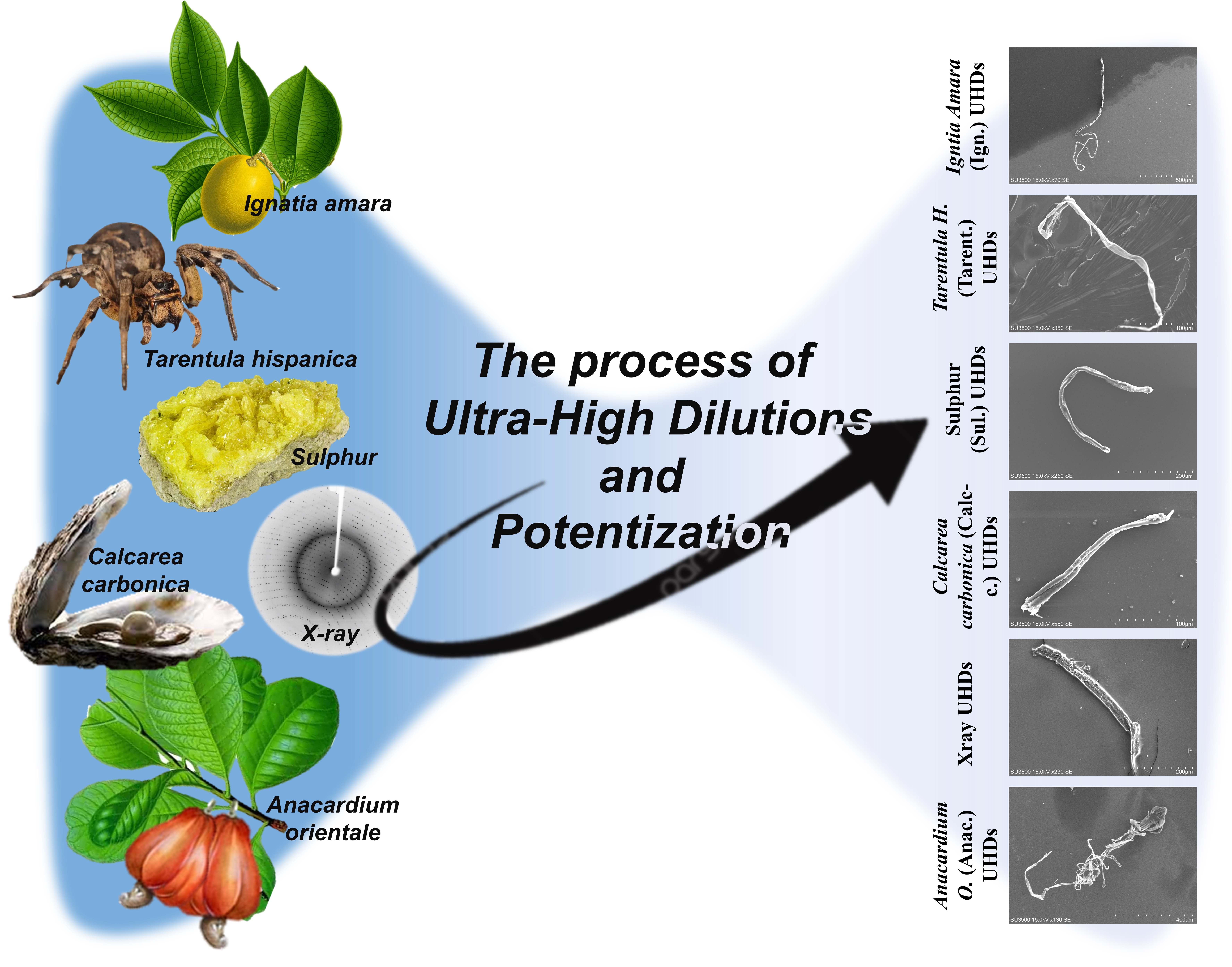
Ultra-high dilutions (UHDs), obtained through processes of sequential dilutions and mixing beyond the Avogadro limit, have been found to possess some residual solid phase with microand nano-scale ordering differing from that of solvent controls. In this research, scanning electron microscopy (SEM) has been employed to examine and identify the residues derived from eight different formulation samples of UHD to determine their morphology and microscopic structural features. In order to facilitate comparisons, a Composite Morphological Scoring system has been formulated that combines various nano-morphological features into a single, measurable unit. The search for reproducible microstructural patterns, referred to as Essential Original Matter (EOM), which were found within UHD samples, but absent within potentized controls and placebos, was an important aspect of this research. It was found by SEM analysis that EOMs have peculiar geometric shapes, like fractal aggregations, layered structures, and nano-particulate agglomerates, with characteristic surface topography that may vary from smooth compact areas to highly corrugated porous interfaces. At higher magnification levels, the EOMs were found to have nano-scale detail including granular subdomains, interfaces, and multi-scale textural variability indicative of a non-random organization and hierarchical assembly process in the residual material. Morphological analysis was performed on four levels: overall geometry, external texture, internal variability, and complexity. These four levels combined created the Composite Morphological Index. With respect to micro- and nanomorphological complexity, Anacardium orientale 200CH (CMI = 20) and Tarentula hispanica 200CH (CMI = 18) were found to possess higher values, followed by Sulphur (CMI = 5), Staphysagria 200CH, and Medorrhinum 200CH (CMI = 6 for all three) as those showing simpler forms. Taken together, these results suggest that the UHD preparations are capable of retaining formulation-specific residual patterns with unique micro- to nano-scale characteristics. The CMS framework presents a reproducible and scalable way to compare these systems, and it represents a materials science platform for future research studies into the physicochemical nature of ultra-highly diluted systems.
Keywords
- Ultra-high dilutions,
- Essential Original Matter,
- Scanning electronic microscope,
- Composite Morphological Index