
 10.57647/pibm.2025.1403.01
In-vitro Evaluation of Hydroxyapatite Reinforced Glass-ceramic Composites for Biomedical Applications
- Khushi Bijalwan
 1
1 - Karthiga Parthiban1,2
- Sutanu Dutta1
- Debolina Saha1
- Sumana Ghosh*1,2
- Biomaterials and Medical Devices Division, CSIR-Central Glass and Ceramic Research Institute (CSIR-CGCRI), Kolkata-700032, India
- Academy of Scientific and Innovative Research (AcSIR), Ghaziabad- 201002, India

Received: 2025-03-04
Accepted: 2025-07-20
Published in Issue 2025-09-30
Copyright (c) 2025 Khushi Bijalwan, Karthiga Parthiban, Sutanu Dutta, Debolina Saha, Sumana Ghosh (Author)

This work is licensed under a Creative Commons Attribution 4.0 International License.
How to Cite









Abstract
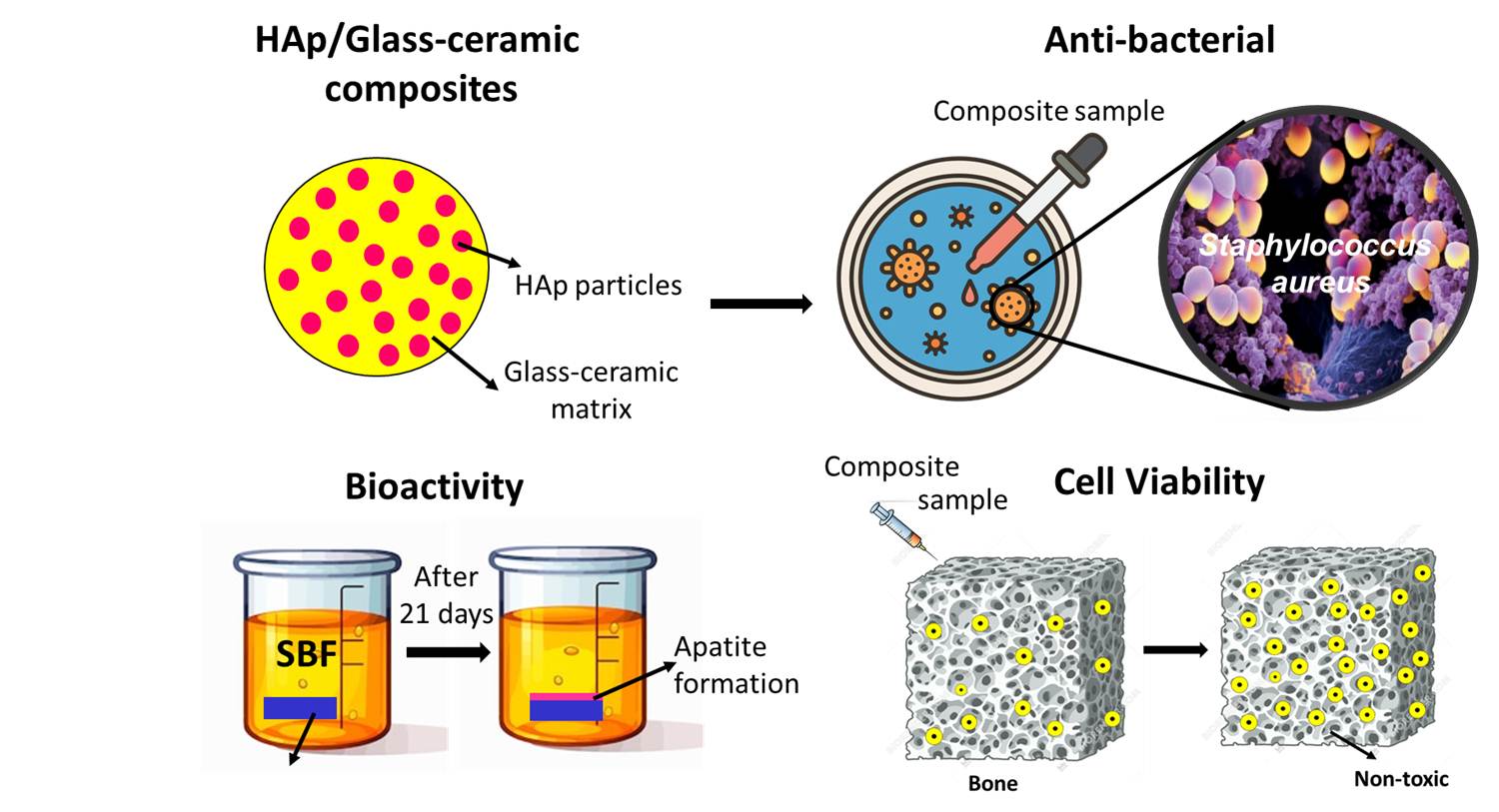
Current study investigated the effect of hydroxyapatite inclusion in apatite based glass-ceramic matrix on mechanical properties, bioactivity, biocompatibility and antibacterial property of the resultant composites. Density, hardness and compressive strength of 50 wt.% hydroxyapatite reinforced apatite-diopside glass-ceramic composites were 2.433 g.cm-3, 1.374 GPa and 1.0305 GPa whereas these values were 2.179 g.cm-3, 1.833 GPa and 1.374 GPa for 50 wt.% hydroxyapatite reinforced apatite-wollastonite glass-ceramic composites, respectively. The bioactivity study showed that the developed glass-ceramics and composites were bioactive in nature. In antibacterial study it was found that all the glass-ceramics and composites were capable of resisting bacterial attack efficiently. However, glass-ceramics had the best antibacterial efficacy. In vitro cytotoxicity assessment showed non-toxicity of glass-ceramics and composites. Thus, the experimental studies indicated that the developed glass-ceramics and composites might be used for bone filler as well as dental filler applications. However, in-vivo study was essential to confirm their suitability for the said applications.
Keywords
- Hydroxyapatite,
- Glass-ceramic,
- Composites,
- Characterization,
- Dental filler application
References
- Siddiqui, HA, Pickering, KL, Mucalo, MR (2018) A review on the use of hydroxyapatite- carbonaceous structure composites in bone replacement materials for strengthening purposes. Mater (Basel) 11: 1–3. https://doi.org/10.3390/ma11101813
- Gautam, CR, Kumar, S, Mishra, VK, Biradar, S (2017) Synthesis, structural and 3-D architecture of lanthanum oxide added hydroxyapatite composites for bone implant applications: Enhanced microstructural and mechanical properties. Ceram Int 43: 14114–14121. http://dx.doi.org/10.1016/j.ceramint.2017.07.150
- Gautam, A, Gautam, C, Mishra, M, Sahu, S, Nanda, R, Kisan, B, Gautam, RK, Prakash, R, Sharma, K, Singh, D, Gautam, SS (2021) Synthesis, structural, mechanical, and biological properties of HAp-ZrO2-hBN biocomposites for bone regeneration applications. Ceram Int 47: 30203–30220. https://doi.org/10.1016/j.ceramint.2021.07.200
- Shweta, Gautam, C, Dey, KK, Ghosh, M, Prakash, R, Sharma, K, Singh, D (2021) Influence of carbon nanotubes reinforcement on the structural feature and bioactivity of SiO2–Al2O3–MgO–K2CO3–CaO–MgF2 bioglass. Appl Phys A 127:545. https://doi.org/10.1007/s00339-021-04708-1
- Avinashi, SK, Singh, P, Shweta, Sharma, K, Hussain, A, Singh, D, Gautam C (2022) Morphological, mechanical, and biological evolution of pure hydroxyapatite and its composites with titanium carbide for biomedical applications. Ceram Int 48 (2022) 18475–18489. https://doi.org/10.1016/j.ceramint.2022.03.117
- Avinashi, SK, Shweta, Bohra, B, Mishra, RK, Kumari, S, Fatima, Z, Hussain, A, Saxena, B, Kumar, S, Banerjee, M, Gautam, CR (2024) Fabrication of novel 3‑D nanocomposites of HAp−TiC−h-BN−ZrO2: enhanced mechanical performances and in vivo toxicity study for biomedical applications. ACS Biomater Sci Eng 10: 2116−2132. https://doi.org/10.1021/acsbiomaterials.3c01478
- Avinashi, SK, Mishra, RK, Shweta, Kumar, S, Shamsad, A, Parveen, S, Sahu, S, Kumari, S, Fatima, Z, Yadav, SK, Banerjee, M, Mishra, M, Mehta, N, Gautam, CR (2025) 3D nanocomposites of β-TCP-H3BO3-Cu with improved mechanical and biological performances for bone regeneration applications. Sci Rep 15:3224. https://doi.org/10.1038/s41598-025-87988-4
- Fu, L, Engqvist, H, Xia, W (2020) Glass-ceramics in dentistry: A review. Mater (Basel) 13:1–23. https://doi.org/10.3390/ma13051049
- Osuchukwu, OA, Salihi, A, Abdullahi, I, Abdulkareem, B, Nwannenna, CS (2021) Synthesis techniques, characterization and mechanical properties of natural derived hydroxyapatite scaffolds for bone implants: a review. SN Appl Sci 3: 822-845. https://doi.org/10.1007/s42452-021-04795-y
- Greish, YE, Brown, PW (2001) Characterization of bioactive glass–reinforced HAP–polymer composites. J Biomed Mater Res 52: 687-694. https://doi.org/10.1002/1097-4636(20001215)52:4<687::AID-JBM13>3.0.CO;2-K
- Ha, NR, Yang, ZX, Hwang, KH, Kim,TS, Lee, JK (2010) Improvement of the stability of hydroxyapatite through glass ceramic reinforcement. J Nanosci Nanotechnol 10: 3459–3462. https://doi.org/10.1166/jnn.2010.2342
- Yazdanpanah, Z, Bahrololoom, ME, Hashemi, B (2015) Evaluating morphology and mechanical properties of glass-reinforced natural hydroxyapatite composites. J Mech Behav Biomed Mater 41: 36–42. https://doi.org/10.1016/j.jmbbm.2014.09.021
- Papynov, EK, Shichalin, OO, Belov, AA, Buravlev, IY, Mayorov, VY, Fedorets, A N, Buravleva, AA, Lembikov, AO, Gritsuk, DV, Kapustina, OV, Kornakova, ZE (2023) CaSiO3-HAp metal-reinforced biocomposite ceramics for bone tissue engineering. J Funct Biomater 14: 259-270. https://doi.org/10.3390/jfb14050259
- Greish, YE, Brown, PW (2001) Characterization of wollastonite-reinforced HAp-Ca polycarboxylate composites. J Biomed Mater Res 55: 618–628. https://doi.org/10.1002/1097-4636(20010615)55:4<618::AID-JBM1056>3.0.CO;2-9
- Knowles JC, Bonfield, W (1993) Development of a glass reinforced hydroxyapatite with enhanced mechanical properties. The effect of glass composition on mechanical properties and its relationship to phase changes. J Biomed Mater Res. 27: 1591–1598. https://doi.org/10.1002/jbm.820271217.
- Rahaman, SH, Bodhak, S, Balla, VK, Bhattacharya, D (2025) Role of in-situ electrical stimulation on early-stage mineralization and in-vitro osteogenesis of electroactive bioactive glass composites. Biomater Adv, 166: 214062. https://doi.org/10.1016/j.bioadv.2024.214062
- Kobayashi, M et al. (1998) Bioactive bone cement: Comparison of apatite and wollastonite containing glass-ceramic, hydroxyapatite, and β-tricalcium phosphate fillers on bone- bonding strength. J Biomed Mater Res. 42: 223–237. https://doi.org/10.1002/(SICI)1097-4636(199811).
- Kokubo, T, Kushitani, H, Ohtsuki, C, Sakka, S, Yamamuro,T (1992) Chemical reaction of bioactive glass and glass-ceramics with a simulated body fluid. J Mater Sci: Mater Med 3: 79–83. https://doi.org/10.1007/BF00705272
- Kumar P, Nagarajan A, Uchil PD (2018) Analysis of cell viability by the MTT assay. Cold Spring Harb Protoc 2018: 6. doi: 10.1101/pdb.prot095505.
- Das, P, Ghosal, K, Jana, NK, Mukherjee, A, Basak, P (2019) Green synthesis and characterization of silver nanoparticles using belladonna mother tincture and its efficacy as a potential antibacterial and anti-inflammatory agent. Mater Chem Phys 228: 310–317. https://doi.org/10.1016/j.matchemphys.2019.02.064
- Swamy, ARK, Ramesha, A., Veeresh Kumar, G.B., Prakash, JN (2011) Effect of Particulate Reinforcements on the Mechanical Properties of Al6061-WC and Al6061-Gr MMCs. J Minerals Mater Charac Eng 10: 1141-1152. https://doi.org/10.4236/jmmce.2011.1012087
- Beyene Z, Ghosh, R (2019) Effect of zinc oxide addition on antimicrobial and antibiofilm activity of hydroxyapatite: a potential nanocomposite for biomedical applications. 21:100612. https://doi.org/10.1016/j.mtcomm.2019.100612
- Muralithran, G, Ramesh, S (2000) The effects of sintering temperature on the properties of hydroxyapatite. Ceram Int 26: 221-230. https://doi.org/10.1016/S0272-8842(99)00046-2
- Huanga, SM, Naumanb, EA, Stanciu, LA (2019) Investigation of porosity on mechanical properties, degradation and in-vitro cytotoxicity limit of Fe30Mn using space holder technique. Mater Sci Eng C 99 1048–1057. https://doi.org/10.1016/j.msec.2019.02.055
- Wahab, RMA, Abdullah, N, Shahrul Hisham Zainal Ariffin, Abdullah, CAC, Yazid, F (2020) Effects of the sintering process on nacre-derived hydroxyapatite scaffolds for bone engineering. Mol 25: 3129. https://doi.org/10.3390/molecules25143129
- Specchia, N, Pagnotta, A, Cappella, M, Tampieri, A, Greco, F (2002) Effect of hydroxyapatite porosity on growth and differentiation of human osteoblast-like cells. J Mater Sci 37: 577– 584. https://doi.org/10.1023/A:1013725809480