
 10.57647/pibm.2025.16771
Novel Biocompatible Nanocomposites Based on Gelatin and Green-Synthesized Graphene Quantum Dots for Enhanced Wound Healing
- Asmaa M. Abd El-Aziz*

 3
3
- Department of Materials Science, Institute of Graduate Studies and Research, Alexandria University, Alexandria, Egypt
- Department of Substitutive Dental Sciences, College of Dentistry, Imam Abdulrahman Bin Faisal University, Dammam, Saudi Arabia
- Fabrication Technology Research Department, Advanced Technology and New Materials Research Institute, City of Scientific Research and Technological Applications (SRTA-City), Alexandria, Egypt

Received: 2025-06-25
Accepted: 2025-09-03
Published in Issue 2025-09-30
Copyright (c) 2025 Wessam S. Omara, Noha Taymour, Sherif H. Kandil, Maram A. AlGhamdi, Asmaa M. Abd El-Aziz (Author)

This work is licensed under a Creative Commons Attribution 4.0 International License.
How to Cite
Omara, W. S., Taymour, N., Kandil, S. H., AlGhamdi, M. A., & Abd El-Aziz, A. M. (2025). Novel Biocompatible Nanocomposites Based on Gelatin and Green-Synthesized Graphene Quantum Dots for Enhanced Wound Healing. Progress in Biomaterials, 14(03). https://doi.org/10.57647/pibm.2025.16771




Share:





Abstract
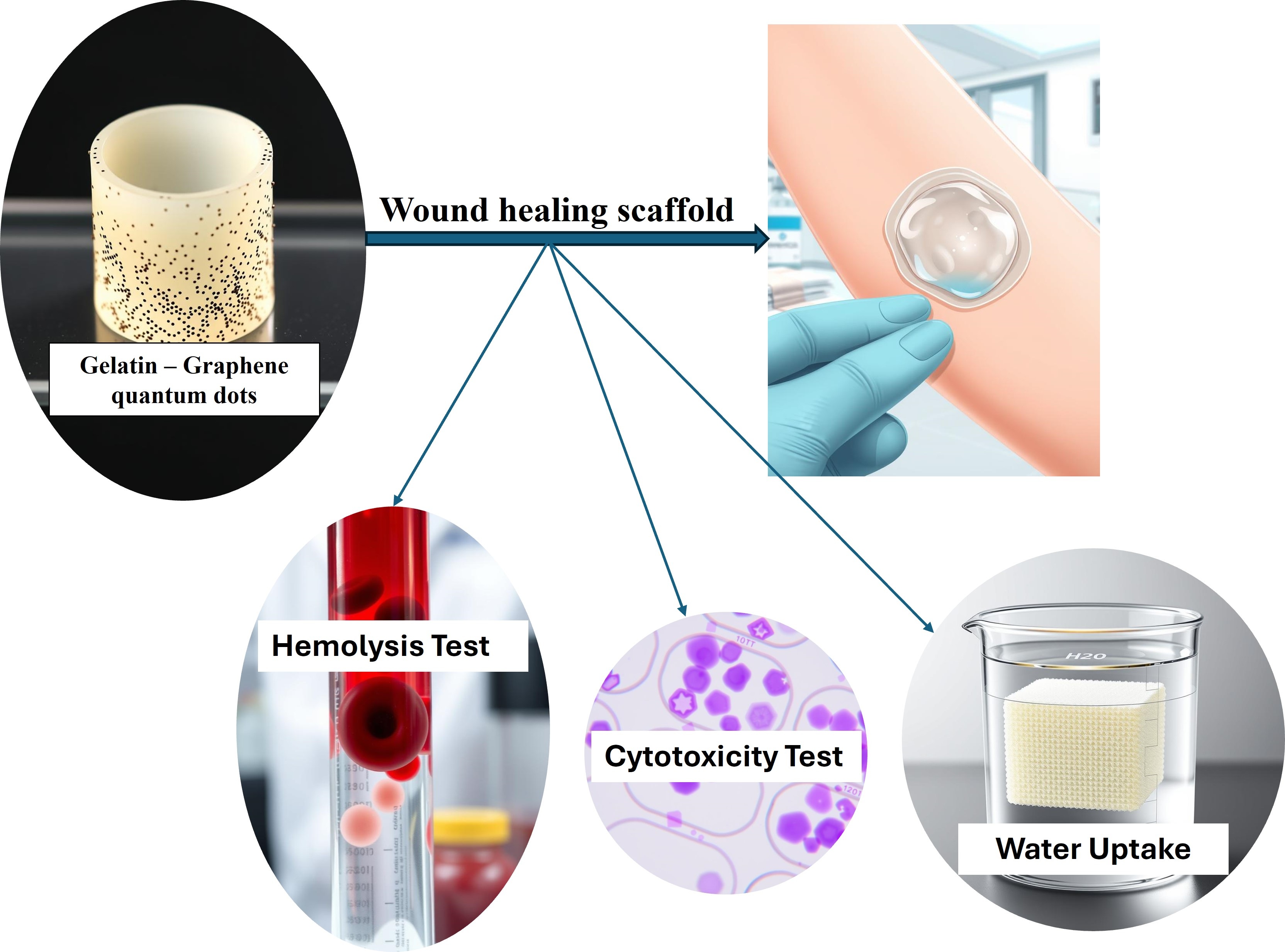
Material biology has emerged as a transformative field aimed at addressing biomedical challenges through the development of advanced therapeutic materials that surpass conventional treatment modalities. Biocompatible and highly water-retentive hydrogels have demonstrated significant potential in accelerating diabetic wound healing, mitigating the limitations of traditional wound dressings. This study presents the design and fabrication of a novel gelatin-based hydrogel integrated with graphene quantum dots (GQDs) synthesized via an environmentally sustainable green chemistry approach using natural precursors. The incorporation of GQDs as nanofillers into the gelatin matrix enhanced the physicochemical and biological performance of the resultant nanocomposites hydrogel. FTIR spectra confirmed successful integration of GQDs within the gelatin matrix through characteristic chemical interactions, while XRD analysis demonstrated increased crystallinity reflecting homogeneous GQDs dispersion. Spectroscopic measurements confirmed the exceptional optical properties of GQDs. FESEM images revealed a highly porous morphology with well-distributed GQDs, and TEM analysis verified nanoscale size (~5 nm) and uniform dispersion of GQDs within the hydrogel network. These structural improvements enhanced water uptake and mechanical stability of the hydrogels. Cytotoxicity assessed by MTT assay showed over 90% viability of human skin fibroblast cells, indicating excellent biocompatibility, alongside potent antibacterial activity against E. coli assessed by micro-broth dilution. Furthermore, hemocompatibility and thrombogenicity assessments demonstrated the material's safety profile suitable for direct blood contact during wound healing. The findings reveal that the green-synthesized gelatin/GQD nanocomposite hydrogel offers a promising biomaterial scaffold for effective wound management, highlighting its potential to advance therapeutic strategies in diabetic wound healing.Keywords
- Photodynamic therapy (PDT),
- UiO-66,
- IR783,
- metal-organic framework (MOF)
References
- Ribeiro ERFR, Correa LB, Ricci-Junior E, Souza PFN, dos Santos CC, de Menezes AS, et al. Chitosan-graphene quantum dot based active film as smart wound dressing. J Drug Deliv Sci Technol. 2023;80(December 2022).
- El-Nablaway M, Rashed F, Taher ES, Foda T, Abdeen A, Abdo M, et al. Prospectives and challenges of nano-tailored biomaterials-assisted biological molecules delivery for tissue engineering purposes. Life Sci. 2024;349(February).
- El-Nablaway M, Rashed F, Taher ES, Atia GA, Foda T, Mohammed NA, et al. Bioactive injectable mucoadhesive thermosensitive natural polymeric hydrogels for oral bone and periodontal regeneration. Front Bioeng Biotechnol. 2024;12(May):1–31.
- Zhang Y, Wang J. Current status and prospects of gelatin and its derivatives in oncological applications: Review. Int J Biol Macromol. 2024;274(P1):133590.
- Wang N, Xu H, Sun S, Guo P, Wang Y, Qian C, et al. Wound therapy via a photo-responsively antibacterial nano-graphene quantum dots conjugate. J Photochem Photobiol B Biol. 2020;210(February):111978.
- Nasser Atia GA, Mohamed SZ, Taymour N, Soliman MM, Halim HA, Shalaby HK, et al. Carbon Dots as Promising Carbon Nanomaterials for Diagnostics, Therapeutics, and Regenerative Orofacial Applications. J Drug Deliv Sci Technol. 2025;106808.
- Taymour N, Haque MA, Atia GAN, Mohamed SZ, Rokaya D, Bajunaid SM, et al. Nanodiamond: A Promising Carbon-Based Nanomaterial for Therapeutic and Regenerative Dental Applications. Vol. 9, ChemistrySelect. 2024.
- Khoshkalampour A, Ghorbani M, Ghasempour Z. Cross-linked gelatin film enriched with green carbon quantum dots for bioactive food packaging. Food Chem. 2023;404(PB):134742.
- Ni F, Chen Y, Wang Z, Zhang X, Gao F, Shao Z, et al. Graphene derivative based hydrogels in biomedical applications. J Tissue Eng. 2024;15.
- Yu CH, Chen GY, Xia MY, Xie Y, Chi YQ, He ZY, et al. Understanding the sheet size-antibacterial activity relationship of graphene oxide and the nano-bio interaction-based physical mechanisms. Colloids Surfaces B Biointerfaces. 2020;191(March):111009.
- Sadek KM, Shib NA, Taher ES, Rashed F, Shukry M, Atia GA, et al. Harnessing the power of bee venom for therapeutic and regenerative medical applications: an updated review. Front Pharmacol. 2024;15(July).
- Sun H, Gao N, Dong K, Ren J, Qu X. Graphene quantum dots-band-aids used for wound disinfection. ACS Nano. 2014;8(6):6202–10.
- Martins VGFC, Alencar LMR, Souza PFN, Lorentino CMA, Frota HF, dos Santos ALS, et al. Wound dressing using graphene quantum dots: a proof of concept. J Pharm Investig. 2023;53(2):333–42.
- Wang S, Cole IS, Li Q. The toxicity of graphene quantum dots. Vol. 6, RSC Advances. 2016.
- Gozali Balkanloo P, Mohammad Sharifi K, Poursattar Marjani A. Graphene quantum dots: synthesis, characterization, and application in wastewater treatment: a review. Vol. 4, Materials Advances. 2023.
- Tian P, Tang L, Teng KS, Lau SP. Graphene quantum dots: preparations, properties, functionalizations and applications. Mater Futur. 2024;3(2).
- Zhong X, Tong C, Liu T, Li L, Liu X, Yang Y, et al. Silver nanoparticles coated by green graphene quantum dots for accelerating the healing of: MRSA-infected wounds. Biomater Sci. 2020;8(23).
- Kadyan P, Thillai Arasu P, Kataria SK. Graphene Quantum Dots: Green Synthesis, Characterization, and Antioxidant and Antimicrobial Potential. Int J Biomater. 2024;2024.
- Zor E, Morales-Narváez E, Zamora-Gálvez A, Bingol H, Ersoz M, Merkoçi A. Graphene quantum dots-based photoluminescent sensor: A multifunctional composite for pesticide detection. ACS Appl Mater Interfaces. 2015;7(36):20272–9.
- Ditta MA, Farrukh MA, Ali S, Younas N. X-ray peak profiling, optical parameters and catalytic properties of pure and CdS doped ZnO–NiO nanocomposites. Russ J Appl Chem. 2017;90(1).
- Yasmeen S, Iqbal F, Munawar T, Nawaz MA, Asghar M, Hussain A. Synthesis, structural and optical analysis of surfactant assisted ZnO–NiO nanocomposites prepared by homogeneous precipitation method. Ceram Int. 2019;45(14).
- Yang KR, Hong MH. Improved Biocompatibility and Osseointegration of Nanostructured Calcium-Incorporated Titanium Implant Surface Treatment (XPEED®). Materials (Basel). 2024;17(11).
- Alves P, Santos M, Mendes S, Miguel SP, de Sá KD, Cabral CSD, et al. Photocrosslinkable nanofibrous asymmetric membrane designed for wound dressing. Polymers (Basel). 2019;11(4):1–18.
- Serag E, Abd AM, Aziz E, Maghraby A El, Taha NA. Electrospun non ‑ wovens potential wound dressing material based on polyacrylonitrile / chicken feathers keratin nanofiber. Sci Rep. 2022;1–14.
- Gontrani L, Pulci O, Pizzoferrato R. Detection of heavy metals in water using graphene quantum dots : an experimental and theoretical study. 2021;(July):1–14.
- Wazir A, Kundi IW, Bannu T. Synthesis of graphene nano sheets by the rapid reduction of electrochemically exfoliated graphene oxide induced by microwaves Synthesis of Graphene Nano Sheets by the Rapid Reduction of Electrochemically Exfoliated Graphene Oxide Induced by Microwaves. 2016;(February).
- Janowska I, Chizari K, Ersen O, Zafeiratos S. Electronic Supplementary Material Microwave Synthesis of Large Few-Layer Graphene Sheets in Aqueous Solution of Ammonia. 2010;(February).
- Jeong S, Pinals RL, Dharmadhikari B, Song H, Kalluri A, Debnath D, et al. Graphene Quantum Dot Oxidation Governs Noncovalent Biopolymer Adsorption. Sci Rep. 2020;10(1):1–14.
- Cao S, Wang Y, Xing L, Zhang W, Zhou G. Structure and physical properties of gelatin from bovine bone collagen influenced by acid pretreatment and pepsin. Food Bioprod Process. 2020;121:213–23.
- Javanbakht S, Nabi M, Shaabani A. Graphene quantum dots-crosslinked gelatin via the efficient Ugi four-component reaction: Safe photoluminescent implantable carriers for the pH-responsive delivery of doxorubicin. Materialia. 2021;20(July):101233.
- Kundu S. Synthesis and characterization ofgraphene quantum dots. Phys Sci Rev. 2019;1–35.
- Zarghami A, Dolatyari M, Mirtagioglu H, Rostami A. High-efficiency upconversion process in cobalt and neodymium doped graphene QDs for biomedical applications. Sci Rep. 2023;13(1):1–14.
- Diao J, Wang T, Li L. Graphene quantum dots as nanoprobes for fluorescent detection of propofol in emulsions. R Soc Open Sci. 2019;6(1).
- Gebreegziabher GG, Asemahegne AS, Ayele DW, Mani D, Narzary R, Sahu PP, et al. Polyaniline–graphene quantum dots (PANI–GQDs) hybrid for plastic solar cell. Carbon Lett. 2020;30(1):1–11.
- Tian P, Tang L, Teng KS, Lau SP. Graphene quantum dots from chemistry to applications. Mater Today Chem. 2018;10:221–58.
- Krishnamoorthy K, Veerapandian M, Kim G shik, Jae S. A One Step Hydrothermal Approach for the Improved Synthesis of Graphene Nanosheets A One Step Hydrothermal Approach for the Improved Synthesis of Graphene Nanosheets. 2012;(December).
- Yazdimamaghani M, Vashaee D, Assefa S, Walker KJ, Madihally S V., Köhler GA, et al. Hybrid macroporous gelatin/bioactive-glass/nanosilver scaffolds with controlled degradation behavior and antimicrobial activity for bone tissue engineering. J Biomed Nanotechnol. 2014;10(6):911–31.
- Bing W, Sun H, Yan Z, Ren J, Qu X. Programmed Bacteria Death Induced by Carbon Dots with Different Surface Charge. Small. 2016;12(34).
- Liu F, Jang MH, Ha HD, Kim JH, Cho YH, Seo TS. Facile synthetic method for pristine graphene quantum dots and graphene oxide quantum dots: Origin of blue and green luminescence. Adv Mater. 2013;25(27):3657–62.
- Joshi P, Ahmed MSU, Vig K, Vega Erramuspe IB, Auad ML. Synthesis and characterization of chemically crosslinked gelatin and chitosan to produce hydrogels for biomedical applications. Polym Adv Technol. 2021;32(5):2229–39.
- Saotome T, Shimada N, Matsuno K, Nakamura K, Tabata Y. Gelatin hydrogel nonwoven fabrics of a cell culture scaffold to formulate 3-dimensional cell constructs. Regen Ther. 2021;18:418–29.
- Łabowska MB, Cierluk K, Jankowska AM, Kulbacka J, Detyna J, Michalak I. A review on the adaption of alginate-gelatin hydrogels for 3D cultures and bioprinting. Materials (Basel). 2021;14(4):1–28.
- Lado-touriño I, Alicia P. Interaction between Graphene-Based Materials and Small Ag , Cu , and CuO Clusters : A Molecular Dynamics Study. Nanomaterials. 2021;11(1378):15.
- Dizaj SM, Mennati A, Jafari S, Khezri K, Adibkia K. Antimicrobial activity of carbon-based nanoparticles. Adv Pharm Bull. 2015;5(1).